The 72-Hour Claim Window: Why Storm Prep Is Mod Protection
Florida construction lost-time claims split almost evenly between falls and strains. Which side of the mod a storm-season injury lands on gets decided in the first 72 hours.

The first 72 hours after a storm-season injury largely decide whether a workers comp claim stays medical-only or turns indemnity. Medical-only claims count at about 30 cents on the dollar in the NCCI experience mod, while indemnity claims count at full value up to the split point (NCCI, 2026). Falls drive roughly 29% of Florida construction lost-time claims (Florida DWC, 2025).
October is still hurricane season, and the contractors working in it are the ones whose experience modification rate, or EMR, takes the season's damage. Not the buildings. The payroll.
Florida's construction lost-time claims concentrate in two categories: falls, at roughly 29%, and strains and sprains, at roughly 30% (Florida DWC, 2025). Storm prep and storm repair are machines for producing both. Tarping, debris hauling, ladder work on wet decking, and repairs rushed between weather bands are the exact tasks behind those percentages.
The injury mix storm work produces
Pre-storm work is not routine construction with worse weather. It is compressed-schedule work at height, on saturated surfaces, often at night, with a deadline measured in hours instead of weeks. The Florida data shows where that ends: falls and overexertion injuries together account for nearly six in ten construction lost-time claims in the state (Florida DWC, 2025).
Every September and October we pull loss runs for coastal contractors, and the pattern holds. The claims that damage the mod are the ones that happened in the 48 hours before landfall or the 72 hours after, when schedule pressure was highest and supervision was thinnest.
Medical-only versus indemnity: the 30-cent line
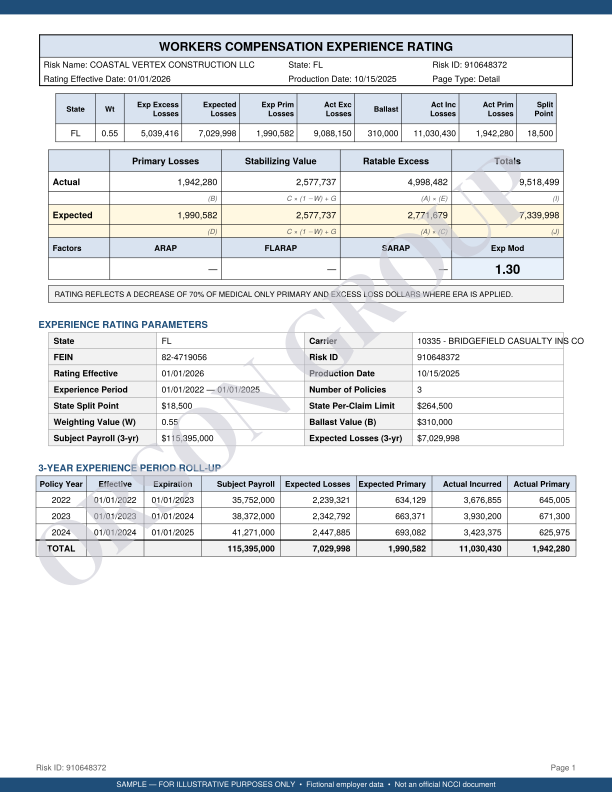
NCCI (National Council on Compensation Insurance) experience rating treats medical-only claims gently. An Experience Rating Adjustment (ERA) values a medical-only claim at about 30 cents on the dollar in the mod (NCCI, 2026). A strain that gets treated, released, and back on light duty is a bruise, not a break.
Indemnity changes the math. The moment a claim pays wage replacement, the discount disappears and the claim counts at full value up to the primary split point, about $12,000 (NCCI, 2026). Dollars above the split point still enter the calculation at reduced weight, but the primary layer lands at 100 cents.
So the same injury carries two mod prices. Handled as medical-only, a $12,000 claim counts as roughly $3,600. The same claim with a week of lost time counts as the full $12,000, and a serious one counts for far more.
What one $100,000 fall does
Run the fall. A roofer comes off a wet ladder during pre-storm tarping, fractures a wrist, and the claim matures at $100,000. About $12,000 of it lands in primary losses at full weight (NCCI, 2026). On a mid-size contractor's worksheet, a single claim at that severity can add five-plus mod points, moving a 1.05 toward a 1.10.
On $500,000 of workers comp premium, five points is about $25,000 a year. The claim stays in the mod for three policy years, so the premium tail approaches $75,000 before anyone counts bid eligibility, since many owners screen contractors at mod thresholds near 1.00. That is the arithmetic behind a storm-season injury nobody triaged.
Storm prep is frequency control, and the 72 hours are severity control
Property-claim guides drill a sequence into storm responders: "The order of operations: safe, documented, mitigated, noticed" (HurricaneLaw.Pro, 2026). The injured-worker version has the same shape, except the stakes run through the mod instead of the policy.
Prep before the storm is frequency control: materials secured, staging planned, crews pulled off the roof when the band arrives instead of racing it. The 72 hours after an injury are severity control: same-day treatment, a light-duty offer that keeps the claim medical-only, and reporting fast enough that the carrier can manage the file before it hardens into lost time. Late reporting is where winnable claims quietly turn into indemnity claims, because nobody made the light-duty offer in week one.
A contractor can price the distance between a 1.05 and a 1.10 with an EMR calculator. The calculator won't say which of last season's claims was winnable. The worksheet will.
What an audit would check
An audit checks whether storm-season claims were reserved and coded consistently with the treatment path that actually happened, whether medical-only claims drifted into indemnity through inattention, and whether the claim values on the NCCI worksheet match the carrier's loss runs. It also weighs whether the mod you were handed at renewal already carries a fall that better triage would have kept off the indemnity side.
Before the season's claims land on next year's worksheet, run yours through a free mod review and see what the last 72 hours cost you.