Alabama Retaliatory Discharge Ruling: Your $675K Risk
The Alabama Supreme Court upheld a $675,000 retaliatory discharge verdict against Envoy Air this month. The real lesson for Southeast contractors: that exposure lives entirely outside the mod, in the return-to-work file.

Alabama's Supreme Court affirmed a $675,000 retaliatory discharge verdict against Envoy Air on October 16, 2026, in a 5-4 ruling under Ala. Code 25-5-11.1's 'solely because' standard (Alabama Supreme Court, October 2026). The jury found the airline fired an injured worker about ten weeks after her return to work. The award sits entirely outside the experience mod.
A jury in Mobile, Alabama decided an airline fired an injured worker for one reason, and nothing else. The Alabama Supreme Court agreed, by a single vote, and left Envoy Air on the hook for $675,000 (Alabama Supreme Court, October 16, 2026). None of that money will ever show up on an experience mod worksheet.
For contractors who track every point their mod moves, that's the part worth sitting with. Experience rating measures injuries. It has nothing to say about what happens after you fire someone for having one.
Under Ala. Code 25-5-11.1, an employer may not terminate a worker "solely because" that worker filed a workers' compensation claim. Envoy argued its station manager had an independent reason: an allegedly falsified doctor's note. The jury didn't buy it, and five of Alabama's nine justices didn't either, affirming the retaliatory discharge finding on October 16, 2026 (Alabama Supreme Court, October 2026).
Why a $675,000 Verdict Skips the Mod Entirely
Jada Creagh slipped on the stairs during the last flight of the night at Mobile Regional Airport on October 25, 2018, and injured her shoulder (Business Insurance, October 2026). Her doctor capped her lifting at 10 pounds; her job called for 50. She returned to work in November, and her shift supervisor allegedly told her the last person who'd reported getting hurt on the job "was no longer there" (Business Insurance, October 2026).
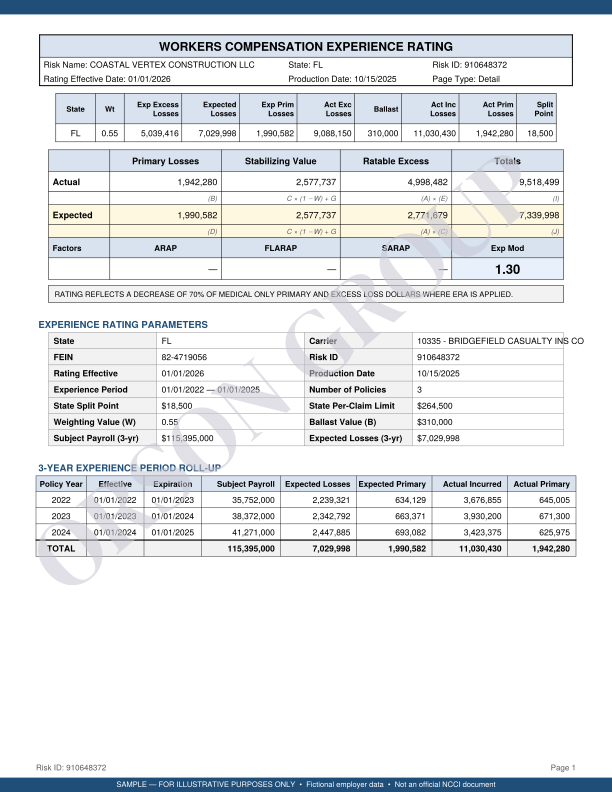
A Mobile County jury heard the case in September 2024 and awarded $250,000 for mental anguish and $425,000 in punitive damages, a total of $675,000 (Alabama Supreme Court, October 16, 2026). Punitive damages exist to punish conduct, not to compensate a loss, and that distinction matters for a contractor reading this from the Southeast. A comp loss runs through payroll, classification, and the Expected Loss Rate (ELR) before it ever reaches a mod calculation. A retaliatory discharge verdict runs through a civil jury and an appellate docket instead. It never touches either number.
The Ten-Week Window the Jury Read as a Pattern
Envoy didn't fire Creagh the week she got hurt. The station manager questioned whether she was still "a good fit" on December 3, suspended her December 28, and terminated her on January 7, 2019, roughly ten weeks after she'd returned to restricted duty (HRD America, October 2026). The company's defense leaned on the doctor's-note allegation surfacing at the end of that window, not the start of it.
The jury read the sequence the other way. Intervening events don't erase a motive; sometimes they confirm one. The court's majority found enough evidence that the station manager, not a neutral HR reviewer, made the actual call, with HR only signing off on paperwork built on somebody else's decision (Alabama Supreme Court, October 16, 2026). That's the fact pattern a thin return-to-work program produces when the person managing the file and the person managing the relationship are the same supervisor.
What Still Flows to the Mod, and What Doesn't
Run the comparison against something an Alabama contractor can actually feel at renewal. NCCI's filed loss-cost cut for voluntary workers' comp business dropped rates 4.5% effective March 1, 2026, with assigned-risk rates down 3.6% (Insurance Journal, October 2025). On a $50,000 contracting premium, that cut is worth about $2,250. Run that same premium through an EMR calculator and ten extra mod points cost more than the entire rate cut by itself.
Creagh's verdict is roughly 300 times that rate relief, and it came from a different ledger entirely. The underlying shoulder claim, the one that actually touches an experience mod, is governed by loss experience and classification. The $675,000 that followed the firing is governed by a civil jury, and now an appellate remand over whether the award itself was excessive (Alabama Supreme Court, October 16, 2026). A contractor disciplined enough to keep clean claim documentation can still lose a case the mod never saw coming.
What an audit would check
An audit checks whether a return-to-work file would hold up under the scrutiny the jury applied here: a timeline connecting injury, accommodation, and any disciplinary action, built independently of the claim's status. It looks at who actually made the termination call, not only whose signature cleared it, because Creagh's case turned on exactly that gap between the station manager and HR. We've reviewed comp files that read clean next to HR folders telling a different story about the same ten weeks, and the mismatch is never an accident.
A worksheet is not a termination file, but an audit of the worksheet is the one half of that story you can still correct before renewal.