Workers Comp Reserve Discipline Sets Your Mod
Rising Medical's 13th Benchmarking Study found 57% of top claims performers use analytics versus 34% of laggards. Your mod inherits that gap for three rating years.

Workers comp reserve discipline affects your mod because NCCI values each policy year's claims at the unit statistical date, and that paid-plus-reserve snapshot feeds your EMR for three rating years (NCCI, 2026). In Rising Medical's 13th Benchmarking Study, 57% of top-performing claims organizations used analytics versus 34% of low performers (Rising Medical Solutions, 2026), so carrier execution moves the mod as much as safety does.
Two contractors can run the same safety program and post different mods. The gap often isn't on the job site. It sits in a claims office neither of them has ever visited.
Rising Medical Solutions' 13th Benchmarking Study surveyed 338 workers comp claims leaders and split their organizations into performance tiers (Rising Medical Solutions, 2026). The spread is the story. Some 57% of top performers use analytics to guide reserve and closure decisions, against 34% at the bottom tier (Rising Medical Solutions, 2026). And 85% of those leaders said administrative burden crowds out the return-to-work work that actually closes files (Rising Medical Solutions, 2026).
Why the carrier's hand moves your mod
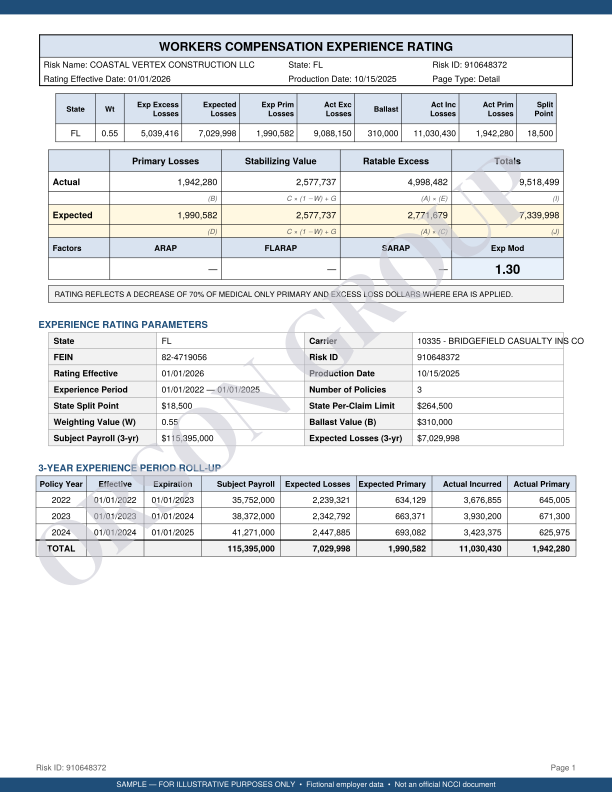
The experience modification rate compares your actual losses with expected losses. "Actual" doesn't mean what finally got paid. NCCI's Experience Rating Plan values each policy year's claims as of the unit statistical date, roughly two years after the policy takes effect, and that valuation, paid losses plus case reserves, is what enters the calculation (NCCI, 2026). Each policy year then stays in your experience period for three rating years.
That timing is why a stale reserve is more than a bookkeeping annoyance. A claim reserved high at unit stat and settled low two years later still spent three renewals being read at the high number. The correction arrives late, or never.
The industry is reserving leaner, not tighter
Carrier-level data points the same direction. Among the top 20 property-casualty insurers ranked by reserve-to-paid ratio, 45% reserved conservatively over the 2019-to-2024 development period, 30% aggressively, and 25% hit actuarial precision (Insurance Business, 2025). Conservative reserving was 65% of that group in 2015-to-2020 (Insurance Business, 2025). The industry's center of gravity has shifted toward leaner case reserves.
The trade press is blunt about the risk: "aggressive reserving carries elevated risks of adverse development, earnings volatility, and regulatory scrutiny" (Insurance Business, 2025). For a carrier, adverse development is an earnings problem. For a contractor, a reserve that later develops upward is a mod problem that already locked in.
Payout patterns show the same drift. The paid-to-incurred ratio fell to 88.9% for the 2020 accident year developed through 2024, from 89.6% the prior period and 90.2% at the 2017-to-2021 peak (Insurance Business, 2025). On a $100,000 incurred claim, the average carrier held back $11,100 in unpaid liability at that valuation point versus $10,400 a development period earlier (Insurance Business, 2025). Cumulative paid losses fell to $353.5 billion from $365.1 billion (Insurance Business, 2025). Carriers are holding claims open longer and paying slower, which is exactly the environment where a unit stat valuation carries more reserve and less payment history.
Execution quality is a mod lever
Contractors treat the mod as a safety scorecard. It is partly that. But the study's tier gap says the claims organization executing your file matters as much as the loss history you hand it. A claims shop revaluing reserves quarterly with analytics produces a different mod outcome than one that sets a number at intake and revisits it at unit stat, even from identical injuries.
The 85% admin-burden figure matters here too (Rising Medical Solutions, 2026). Return-to-work is the cheapest way to shrink an indemnity claim before valuation. When adjusters are buried in documentation, the aged indemnity claims that drive mods stay open, and an open claim at unit stat is read at full reserve.
In the worksheets we audit, paid losses almost never disagree with the carrier's file. The disagreements are in what was still unpaid at valuation, and in indemnity claims that aged past any realistic return-to-work window. That is where the mod is won or lost.
What an audit would check
An audit checks the loss-run values as of each unit stat date against what the claims actually closed at, and it weighs whether aged indemnity reserves reflect a real closure plan or an adjuster's default. It reads the actual-loss column of the worksheet for reserve inflation the carrier never corrected, and it tests whether your carrier's claims tier shows up in your number. For a rough dollar view, an EMR calculator prices the distance between the mod you were handed and the one your claims history supports.
The study is public. Your unit stat valuations aren't. Send us the worksheet and find out which claims shop your mod has been working for.