What a CCIP Enrollment Actually Does to Your Experience Mod
Crum & Forster's new admitted wrap-up product puts CCIP papers in front of more Southeast subs. Wrapped payroll leaves your unit stat report; the tail and re-entry don't leave you.

CCIP enrollment moves your on-site project payroll onto the general contractor's wrap-up workers' comp policy, so that payroll leaves your unit statistical report for the project term and your experience mod is rated on non-wrapped work only. Wraps typically run on $50 million to $100 million projects with a three-to-five-year completed operations tail (Arvori, March 2026). Wrap claims stay in the GC's program, but re-entry can shift your own rating.
Crum & Forster put an admitted wrap-up product on the market on September 16, 2026, and the product sheet matters less than the paperwork it will generate (Crum & Forster, September 2026). Admitted paper makes CCIP placement easier to quote, which means more Southeast subcontractors on data-center and healthcare megaprojects will see enrollment forms this bid season. Most will sign without asking what enrollment does to their experience modification rate (EMR, the mod). The honest answer: less than you'd think, and more than you'd like.
A CCIP (Contractor-Controlled Insurance Program) is a project-specific consolidated placement: the general contractor buys one set of policies covering the enrolled trades on a single job, usually workers' comp, general liability, and builder's risk (Arvori, March 2026). Wraps generally pencil out at $50 million to $100 million in construction value; below that, the administrative overhead outweighs the premium savings (Arvori, March 2026). Workers' comp is the prize, because it is "often where the largest premium consolidation occurs because individual sub workers' comp policies are replaced by a single program policy" (Arvori, March 2026). On a $200 million hospital job with 80 enrolled subcontractors, that is a lot of payroll moving off a lot of small policies (Arvori, March 2026).
What CCIP enrollment does to your unit stat report
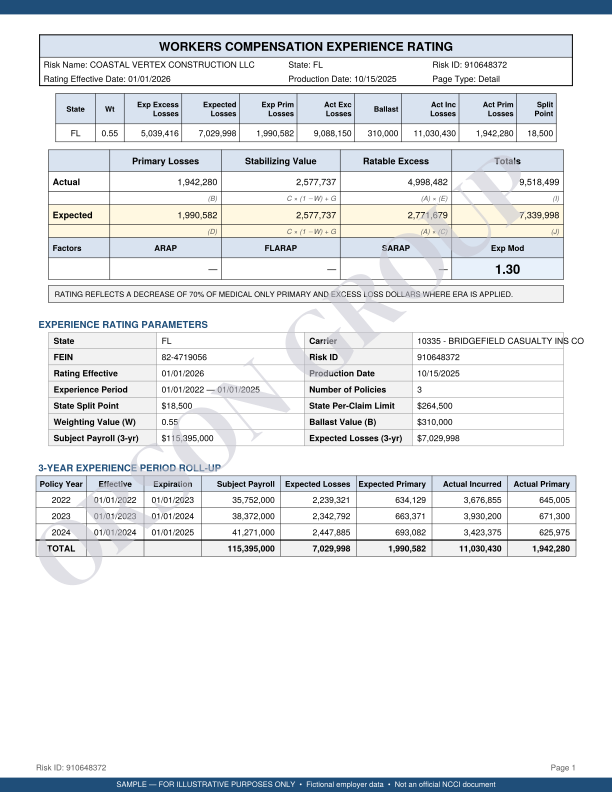
Enrollment moves your on-site payroll for that project off your policy and onto the GC's. Your unit statistical report, the payroll and claim data NCCI (National Council on Compensation Insurance) uses to build your mod, now carries only your non-wrapped work. Run the arithmetic on a sub with $8 million in total payroll and $6 million of it wrapped: the mod for that policy year is built on $2 million of exposure.
That looks like a gift until you see the denominator. Expected losses shrink with the payroll, so one serious claim on the remaining book, a yard injury, a highway incident on the way to a non-wrapped job, lands against expected losses sized for $2 million of exposure, not $8 million. The same mechanics that make a wrapped year look clean make an unlucky year look worse. The re-entry worksheets that land on our desk each spring usually show the same shape: a quiet wrapped year, then a mod that jumps on the first renewal after the sub returns to full exposure.
The enrollment term ends; the tail doesn't
Wrap coverage runs through a completed operations tail, typically three to five years after project completion (Arvori, March 2026). Claims on the wrap during that window belong to the GC's program, not your experience rating. For a sub with a spotty history, that is the deal's real appeal: a bad loss year on a wrapped project never touches the mod.
But the perimeter is narrower than the enrollment form suggests. Commercial auto, tools and equipment, off-site work, and every non-enrolled project stay on your individual policies (Arvori, March 2026). And the credit isn't real until enrollment is confirmed in writing by the program administrator; a sub who strips coverage at bid time can be briefly uninsured for on-site operations if enrollment is delayed or denied (Arvori, March 2026).
Three questions worth asking before you sign
None of this is a reason to refuse a wrap. It is a reason to read it. Three questions do most of the work. First, what payroll does the enrollment cover and what does your own policy keep, because that split sets the denominator on every mod you'll be rated on during the project term. Second, when does enrollment end and how long does the completed operations tail run, since the three-to-five-year window (Arvori, March 2026) decides how long wrap claims stay the GC's problem. Third, what will your own book look like at re-entry, because the first post-wrap mod is built from thin wrapped years, and reporting lag decides when that bill arrives.
A sub pricing the distance between the mod the wrap hands back and the mod re-entry hands forward can rough it out with an EMR calculator. The enrollment papers won't tell you which number the file actually supports.
What an audit would check
An audit checks whether the enrollment paperwork and the unit stat reports tell the same story: which payroll was wrapped, when it left, and when it came back. It reads the worksheet's expected losses against the exposure actually reported and weighs whether a quiet wrapped year is masking a frequency problem that re-entry will surface. For a sub mid-wrap, it also confirms the individual policy still covers everything the wrap doesn't.
If CCIP enrollment papers are sitting in your bid package, send us the worksheet and find out what your mod looks like before, during, and after the wrap.