Construction Fall Costs: Why 26% Sets the Safety Budget
Liberty Mutual puts lower-level falls at 26% of construction comp cost. Safety budgets built around incident counts misprice the hazard; loss dollars say height deserves first claim on prevention capital.

Construction fall costs now make lower-level falls the first safety budget problem: $2.64 billion, or 26% of serious-injury direct workers' compensation costs (Liberty Mutual WSI, September 2026). That is up $300 million from the 2025 construction index's $2.34 billion (Liberty Mutual WSI, 2025). Funding should follow loss concentration, not a flat hazard list.
Falls are construction's most familiar hazard. That familiarity is the problem. Construction fall costs now tell owners where the first marginal safety dollar belongs, yet many budgets still spread money evenly across every hazard named in a meeting.
The 2026 Workplace Safety Index from Liberty Mutual puts falls to a lower level at $2.64 billion, or 26% of construction's direct workers' compensation cost from serious injuries (Liberty Mutual WSI, September 2026). That implies roughly $10.15 billion across the construction injury-cost pool measured by the index ($2.64 billion divided by 26%; Liberty Mutual WSI, September 2026).
This isn't a tally of every scrape, near miss, or OSHA violation. The index ranks nonfatal injuries that cause more than five missed workdays by medical and lost-wage payments (Liberty Mutual WSI methodology, 2025). It is a severity budget written in claim dollars.
The line also moved. Liberty Mutual's 2025 construction index put lower-level falls at $2.34 billion, ahead of $1.93 billion for overexertion and $1.41 billion for struck-by injuries (Liberty Mutual WSI 2025, cited by CPWR, April 2026). The new fall figure is $300 million higher, a 12.8% increase ($2.64 billion minus $2.34 billion; Liberty Mutual WSI, September 2026).
Why construction fall costs should set the budget
Safety teams naturally count incidents. The Experience Modification Rate (EMR, the mod) responds to claim cost. Liberty Mutual's 26% share says that, for every $100 of construction serious-injury direct cost in this dataset, $26 came from one event category (Liberty Mutual WSI, September 2026).
That concentration is the decision. A program that gives lower-level falls the same money and management attention as a smaller cost driver is not balanced. It is underweight where one bad event can consume the loss budget.
The human measure lands in the same place. The National Institute for Occupational Safety and Health (NIOSH) wrote, "Falls remain the leading work-related cause of death in construction" (NIOSH, April 2026). The Bureau of Labor Statistics counted 1,034 private-sector construction deaths in 2024, including 389 from falls, slips, and trips (BLS, May 2026). Lower-level falls made up 95.9% of those 389 deaths (BLS, May 2026).
What frequency says about fall protection ROI
The fatality count is not the workers' comp cost index. Still, the two datasets point to the same budget priority. Construction accounted for 48.8% of private-industry fatal falls, slips, and trips in 2024 (BLS, May 2026).
Nonfatal frequency is just as lopsided. Construction recorded 30.0 falls, slips, and trips with days away from work per 10,000 full-time workers, versus 22.6 across private industry (BLS, May 2026). For falls to a lower level alone, construction's rate was 13.9 per 10,000, against 4.1 across private industry (BLS, May 2026). That is about 3.4 times the all-industry rate (13.9 divided by 4.1; BLS, May 2026).
The index supplies the cost ranking. BLS supplies the frequency check. Neither tells a contractor which piece of equipment to buy, but together they make an evenly divided prevention budget hard to defend.
What a 10% fall-cost reduction buys
Apply a modest reduction to the current figure. Cutting lower-level fall cost by 10% would keep $264 million in direct medical and wage payments out of construction claim experience ($2.64 billion multiplied by 10%; Liberty Mutual WSI, September 2026). That is the worked dollar case. It doesn't count schedule disruption, replacement labor, litigation, or the injured worker's loss.
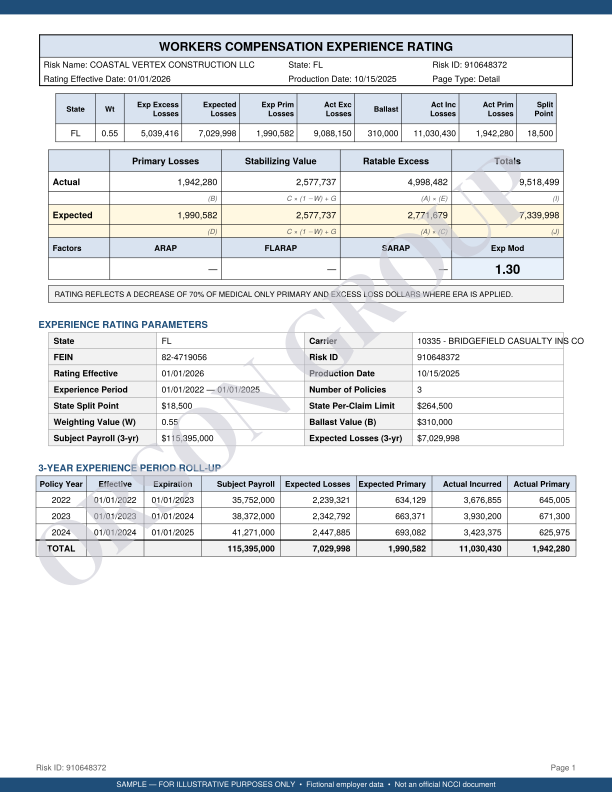
At the account level, the national index cannot promise a one-point or 10-point mod improvement. Your payroll, expected losses, and actual claim values decide that. A contractor can use the EMR calculator to price a supported mod difference without inventing a sample account.
On worksheets we review, the costly fall isn't a chart category. It is one claim row large enough to drown out a clean year. The earlier report on subcontractor fall claims explains why ownership and documentation matter after the event; the 2026 index makes the pre-claim capital choice. The cheapest valid fall claim on a worksheet is the one prevention kept from existing.
What an audit would check
An audit checks how a fall loss entered the worksheet, what value was reported at the rating date, and whether the current claim record still supports it. It also separates a valid severe claim from reporting or attribution errors that overstate the account's experience. Prevention protects the worker first; an audit can only address the mod after a claim exists.
If a fall loss is already on your worksheet, send it for a mod review and we'll test whether its reported value still matches the claim.