Florida Physician Dispensing Rule Took Effect September 2
Florida's Division of Workers' Compensation finalized the rule on September 2, striking the language that let physicians dispense. The drug channel changes; the disputed dollars still sit in your mod.

Florida's physician dispensing rule took effect September 2, 2026, when the Division of Workers' Compensation struck the language letting physicians dispense medication and barring insurers from disallowing it (Insurance Journal, September 2026). Carriers can route prescriptions to pharmacies now. Florida's total cost per claim still grew 5% in 2025 (WCRI CompScope, 2026).
The court decided this in February. The rule caught up on September 2.
Florida's Division of Workers' Compensation posted finalized rules that day striking language which had stated flatly that physicians and nurse practitioners may dispense medication to injured workers, and that insurers cannot disallow it (Insurance Journal, September 2026). The Florida physician dispensing rule is now the version carriers will actually adjudicate against. Seven months of ambiguity closed in a single filing.
That matters more than the ruling did. A decision tells you who won. A rule tells your adjuster what to do on Monday.
What the September rule changed that February did not
The First District Court of Appeal decided Publix Super Markets v. Department of Financial Services on February 25, 2026, case No. 1D2023-0941 (Akerman, 2026). It held that the department's rules could not "be squared with the plain language of the 'absolute choice' provision in section 440.13(3)(j)" (Akerman, 2026). Section 440.13(3)(j) gives an injured worker free, full and absolute choice of pharmacy or pharmacist. Dispensing practitioners registered under section 465.0276 are not pharmacists, so that choice never reached them.
We covered the ruling itself in July. What was missing then was the operative text. A carrier reading a court opinion is guessing at its own authority; a carrier reading a rule is not. September 2 is the date that guessing stopped.
The dispute does not disappear, it relocates
Here is the part contractors are not pricing. Removing a reimbursement pathway does not remove the argument. It moves the argument from whether a bill gets paid at the dispensing rate to whether it gets authorized at all.
Florida already pays to have those arguments. Defense attorney fees ran $7,600 per claim in 2025, against a $6,890 median across the states the Workers' Compensation Research Institute (WCRI) studies (WCRI CompScope, 2026). That $710 gap is not a rounding difference. It is the cost of a system where medical entitlement gets litigated, and a fresh authorization boundary is a fresh place to litigate.
Disputed dollars are slow dollars. A claim that argues about medication stays open, and an open claim keeps reserving. Florida's medical payments per claim rose 4% in 2025 for claims with more than seven days of lost time, and total costs per claim grew 5% (WCRI CompScope, 2026). Indemnity reached almost $22,000 per claim in 2024 after a 4% rise, following 12% in 2023 (WCRI CompScope, 2026).
None of that is drug spend. All of it lands on the worksheet.
Why the channel change reaches your mod slowly
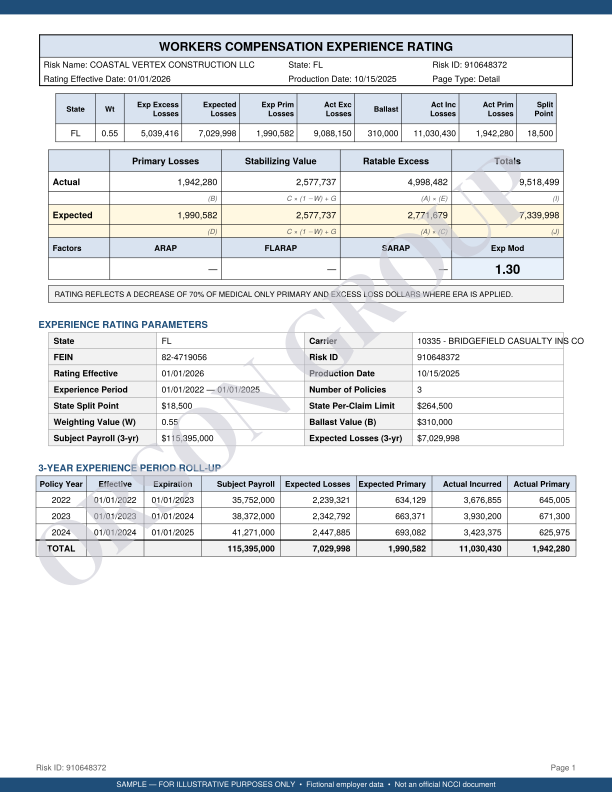
Your experience modification rate is not built from this year's pharmacy policy. It is built from claim values captured at a valuation date and carried across three rating years.
So a Florida contractor gets the worst ordering. The dispute surface changed on September 2, 2026. The claims already sitting in the experience period were valued under the old channel, at the old prices, with the old arguments attached. Any savings the new rule produces show up in claims that have not happened yet, while the claims setting your 2027 renewal are already priced.
That asymmetry is the whole story. Rule changes are prospective. Mods are retrospective. An EMR calculator will price the distance between a 1.15 and a 1.02 on your payroll, but it cannot tell you which of those two your file supports.
The second rule nobody is reading
The same batch carried something else. New regulations require injured workers who seek reemployment to be screened for immigration status using the latest federal I-9 Employment Eligibility Verification form (Insurance Journal, September 2026).
Read that as a claim-duration change, not a paperwork change. Reemployment is how a lost-time claim stops accruing indemnity. Adding a verification step to that door means some claims stay open longer, and duration is the variable that turns a manageable claim into a mod problem. For contractors with seasonal or subcontracted crews in Florida, this is the rule worth reading twice.
What an audit would check
An audit checks whether the medication dollars on your open Florida claims were priced under the channel that existed when they were incurred, and whether reserves still reflect a dispute posture the September rule has since changed. It weighs claim duration against the reemployment path, because a claim that cannot close is a claim that keeps rating. It also reads the valuation dates against the rule's effective date, since the two rarely line up the way a renewal conversation assumes.
The rule is public and dated; your worksheet is neither, so send us the worksheet and find out which one is actually setting your 2027 number.