Georgia Tort Reform Bennett: Severity Still Gets In
Bennett's $8.55M judgment shows Georgia's new trial sequence still admits injury facts in the fault phase. That matters while workers' comp cuts and umbrella pricing head opposite ways.

Georgia tort reform Bennett holds that injury evidence can reach the jury during the fault phase under O.C.G.A. 51-12-15, even though damages wait for phase two. The resulting verdict included $7 million in compensatory damages and $1,546,500 in attorney fees (Georgia Court of Appeals, September 2026). That leaves liability severity in a contractor's total cost of risk.
Georgia tort reform Bennett is not really a trucking-case footnote. It is the first appellate reminder that a fault-first trial does not mean a jury is blind to the human evidence behind a severe loss.
The Court of Appeals affirmed the result on September 9, six days before this report. It held that a jury can hear the nature, development, and persistence of injuries in the first phase under O.C.G.A. 51-12-15, even though the dollar award belongs in a later phase (Georgia Court of Appeals, September 2026).
That distinction lands at an awkward time for Southeast contractors. Workers' comp filings are offering rate relief. Umbrella and excess liability still aren't following them down.
Georgia tort reform Bennett keeps severity in the fault room
The crash happened on July 1, 2020, when a Transcontinental truck forced Bennett's vehicle into a guardrail on Interstate 75 (Georgia Court of Appeals, September 2026). The court recited that a 43,000-pound load shifted in Bennett's vehicle, and the record later included spinal-cord surgery, ongoing neurological deficits, and bladder dysfunction (Georgia Court of Appeals, September 2026).
Georgia's new statute took effect April 21, 2025. Its sequence lets a party demand separate phases for fault, compensatory damages, and other proceedings such as fees (Georgia Court of Appeals, September 2026). The Bennett trial used that structure in June 2025 (Georgia Court of Appeals, September 2026).
The carrier's argument was intuitive: save the full injury story for the damages phase. The appellate court disagreed because "proving fault requires proving both injuries and proximate causation" (Georgia Court of Appeals, September 2026). A contractor should not read a phased trial as an erased-severity trial. It is a different order of operations.
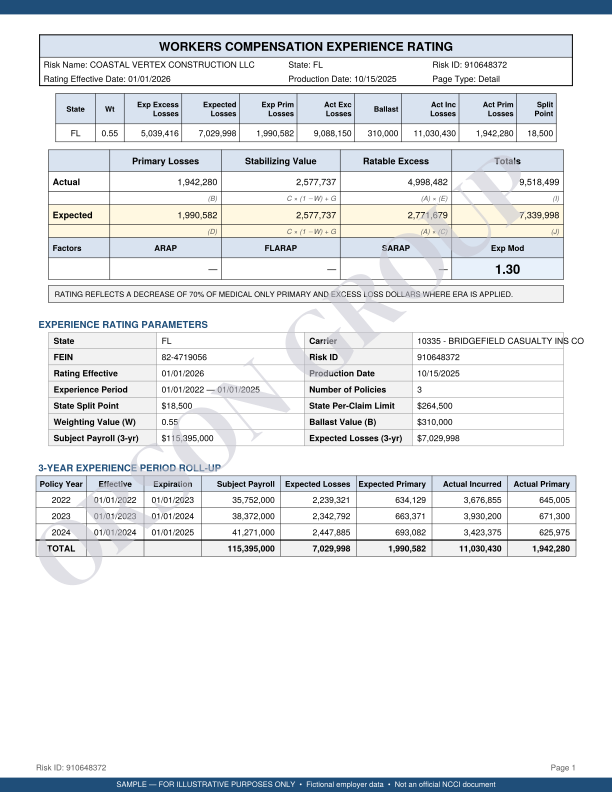
We see a similar budgeting mistake when a construction team treats a workers' comp rate filing as its whole insurance outlook. The experience modification rate is one cost lever. Third-party liability is another, and Bennett is about the second one.
The $8.55M signal is bigger than the compensatory line
The Bennett jury allocated 70% fault to Transcontinental and 30% to its driver. It then awarded $7 million in compensatory damages and $1,546,500 in attorney fees (Georgia Court of Appeals, September 2026).
Those actual figures produce an $8,546,500 judgment amount before any later post-judgment question ($7,000,000 plus $1,546,500; Orson calculation from Georgia Court of Appeals, September 2026). The fee award alone equals 22.1% of the compensatory award ($1,546,500 divided by $7,000,000; Orson calculation from Georgia Court of Appeals, September 2026). Put another way, every $1.00 of compensatory damages in this case carried about $0.22 more in fees.
That is the cost consequence. The point is not that every contractor faces Bennett's facts or verdict. It is that a law designed to sequence evidence did not bar jurors from hearing the injury evidence needed to decide causation. The severity story still arrives before the liability finding.
Workers' comp relief and liability pressure are moving apart
WTW's Commercial Lines Insurance Pricing Survey, or CLIPS, found aggregate commercial pricing up just 0.5% in Q2 2026, down from 2.5% in Q1 and 3.8% a year earlier (WTW, September 2026). Yet WTW said excess and umbrella liability remained the largest increase, still in the high single digits (WTW, September 2026).
That split matters more than the 0.5% headline. Workers' compensation has a much softer signal in nearby states. The National Council on Compensation Insurance (NCCI) proposed a 7.4% Florida workers' comp reduction for policies effective January 1, 2027 (NFIB, August 2026). North Carolina's August filing proposed a 10.6% overall loss-cost decrease and an 11.7% contracting decrease for April 1, 2027 policies (NCRB C-26-7, August 2026).
Those are not Georgia rate forecasts, and they should not be netted against umbrella pricing as if all lines share one exposure base. They do show the budgeting trap. A CFO can see a comp discount in a regional peer market while a severe auto or general-liability loss keeps liability terms, limits, and price under pressure. A soft comp cycle is not total cost-of-risk relief.
If an estimate would help price the workers' comp side, the EMR calculator can show what a mod difference costs. It cannot price a liability verdict. For the Georgia statutory backdrop, see the earlier Thigpen exclusive-remedy decision, which addresses a different boundary between workers' comp and tort exposure.
What an audit would check
An audit checks whether the mod on the workers' comp worksheet has support in current claim and payroll data, then keeps that result separate from the contractor's third-party liability exposure. It tests whether a projected comp saving is being mistaken for a companywide insurance saving. Bennett makes that separation harder to ignore.
If your workers' comp worksheet is carrying the whole risk-cost conversation, send it to us and we'll tell you what it does, and does not, explain.