Workers Comp Loss Cost Multiplier: The Number NC's Cut Skips
NCRB approved a 10.6% loss-cost cut for April 2027, with contracting down 11.7%. Every contractor sees the same percentage. What you pay depends on your carrier's multiplier and your mod, not the filed average.

North Carolina's 2027 workers comp rate cut lands at 10.6% for advisory loss costs overall and 11.7% for contracting, approved October 2, 2026, for policies starting April 1, 2027 (NCRB C-26-9, October 2026). That percentage applies to the loss-cost layer only. The carrier's loss-cost multiplier and the contractor's own experience mod still set the premium actually billed.
North Carolina's rate bureau just approved a real cut. Contracting loss costs fall 11.7% for policies starting April 1, 2027, and the residual market drops even further (NCRB C-26-9, October 2026; NCRB C-26-8, October 2026). A controller reading the headline could reasonably expect a smaller bill next spring.
Here's the trap. The cut is the same percentage for every contracting account in the state. If your rate falls by exactly as much as the contractor you're bidding against, neither of you gained ground. The number that actually separates you sits somewhere the filing never touches.
The North Carolina Rate Bureau (NCRB) locked in the new advisory loss costs under Circular C-26-9, approved October 2, 2026, for policies effective April 1, 2027 (NCRB C-26-9, October 2026). The statewide average fell 10.6%, but the five industry groups didn't move together: manufacturing down 10.4%, contracting down 11.7%, office and clerical down 12.0%, goods and services down 9.2%, and miscellaneous down 11.0% (NCRB C-26-9, October 2026). None of those numbers moved between the August filing and the October approval (NCRB C-26-7, August 2026; NCRB C-26-9, October 2026). The companion residual market filing, C-26-8, cut the assigned-risk level 14.3% overall and 15.3% for contracting (NCRB C-26-8, October 2026).
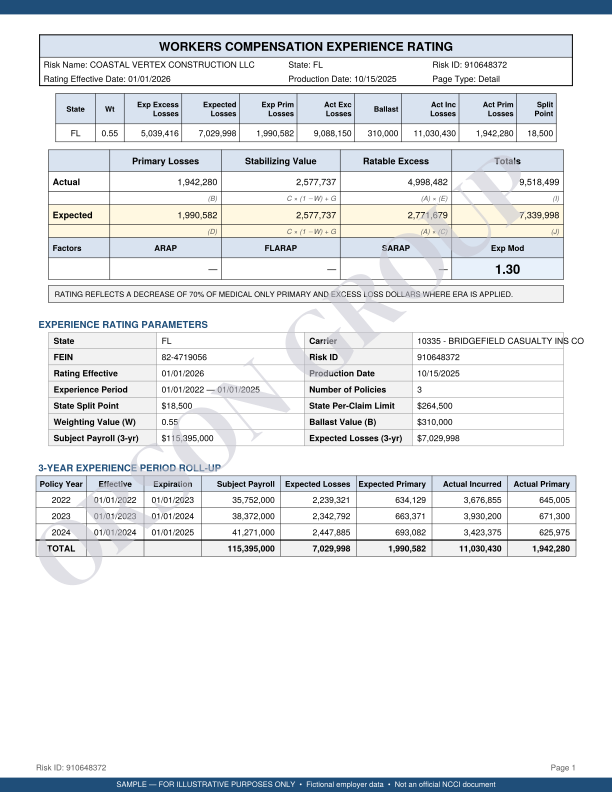
None of that is premium yet. NCRB limits the figures to claim costs plus "loss adjustment expenses that are specifically authorized to be included in the loss costs by statute," nothing for a carrier's overhead or profit (NCRB C-26-9, October 2026). Each carrier still files its own loss-cost multiplier (LCM) on top of that number, and the premium formula then runs the result through your experience modification rate (EMR, the mod).
Why a uniform cut doesn't move your competitive position
This is the piece a filing can't touch. Every contracting account in the state gets the same 11.7% reduction to the same layer of its rate. A contractor who was priced competitively before the filing is still priced competitively after it. One who was priced out of a bid is, on this number alone, still priced out.
That's the opposite of how a statewide cut usually gets discussed. The conversation treats 11.7% like relief. It's really a wash applied evenly, like a cost-of-living raise that lands on every paycheck in the building. Nobody's position relative to anyone else's changed.
Carriers can afford a falling table because claim costs keep climbing underneath it. The Workers Compensation Research Institute's 2026 CompScope benchmarks put workers' comp cost per claim growth at roughly 6% a year across 18 states, North Carolina included (WCRI CompScope, 2026). A falling advisory number and a rising cost trend can both be true at once. The gap between them is exactly what an LCM is built to absorb, and an LCM doesn't move on NCRB's schedule.
The residual market gap hasn't closed
For assigned-risk contractors, the 15.3% residual contracting cut sounds like the better deal, and on paper it is deeper than the 11.7% voluntary number (NCRB C-26-8, October 2026). But a bigger cut on a worse placement is still a worse placement. An account stuck in the residual market because its mod won't support voluntary coverage doesn't fix that mod by watching the assigned-risk rate fall around it.
The $2 million payroll math
The accounts we audit in the $2 million payroll range typically run somewhere between $180,000 and $240,000 in current voluntary contracting premium, depending on class mix. Apply the filed 11.7% cut to the loss-cost layer inside that range and the napkin math looks like real money, something in the $18,000 to $24,000 band.
But that math assumes the carrier's multiplier and the mod both hold flat. Neither is guaranteed, and neither is published anywhere a competitor can see. Two contractors on identical $2 million payrolls, bidding the same job, can walk into April 1, 2027 with the identical 11.7% cut and completely different net premiums, because the mod is the one input in the formula this filing never reset. A contractor running a mod even a few points above neutral is giving part of this cut back before the invoice prints. One running a few points below it is banking the whole thing, and then some. Run your own payroll through an EMR calculator and the gap shows up fast.
Massachusetts contractors learned a version of this lesson earlier in 2026, when a court made regulators show their math on a different statewide cut and the average still wasn't anyone's actual premium. North Carolina's filing is cleaner and fully approved, but the mechanic is identical: the published number describes the pool, not your account.
What an audit would check
An audit checks whether a contractor's mod is actually earning the competitive position this filing assumes everyone already has. It reviews the worksheet behind the mod for stale reserves, misclassified payroll, or an expected-loss reset that moved the wrong direction while the loss costs moved the right one. For assigned-risk accounts eyeing the deeper 15.3% cut, it also weighs whether the placement itself, not just the rate table, is what's actually costing money.
The filing is public and finalized. Whether your own mod and your carrier's multiplier are turning that cut into real savings is not, so talk to us about your worksheet before you build next year's bid around a number that applies to everyone the same way.