Older Worker Comorbidity Is Workers Comp's Real Mod Risk
NCCI's new data says construction isn't aging the way the rest of the economy is. The real mod risk is the comorbidity math inside the one older-worker claim a 95% male crew eventually files.

Construction is underrepresented in the 55-and-older claim share driving NCCI's aging-workforce story (NCCI, May 2026). But comorbidities linked to older workers, like hypertension and diabetes, drive three to four times higher medical utilization per claim (NCCI, May 2026), and a 95% male crew already carries a 28% higher care-cost baseline (NCCI, October 2026). That combination, not age, moves the mod.
Everyone assumes a graying crew is bad news for the mod. NCCI's (National Council on Compensation Insurance) own research, released October 29, 2026, complicates that story. Construction is one of the few trades the broader workforce-aging trend has mostly skipped. The industry is underrepresented in the 55-and-older claim share and largely insulated from the tenure story driving that trend elsewhere (NCCI, May 2026).
That should be reassuring. It isn't, because the lever here was never age by itself. It's what age tends to carry with it, and how that lands on a crew built the way yours is built.
Construction is the outlier in NCCI's aging story
Across the broader workforce, the demographic shift is real. The share of lost-time claims involving workers 65 and older doubled from 4% in accident year 2012 to 8% in 2025, and the 55 to 64 share rose from 18% to 22% over roughly the same stretch (NCCI, October 2026). Workers 55 and older now make up 24% of the US labor force but 28% of lost-time claims and 34% of lost-time losses, with 23% higher claim frequency and 32% higher severity than everyone else (NCCI, May 2026).
Construction doesn't fit that curve. Paul Hendrick, FCAS, a practice leader and senior actuary at NCCI, told the room at NCCI's Annual Issues Symposium on May 12, 2026 that demographic shifts have "a real, tangible impact on the nature and frequency of claims that occur every day" (NCCI, May 2026). For most industries, that means an aging claim mix. For construction, NCCI's own breakdown shows the opposite: the trade is underrepresented in the 55-plus claim share and largely skips the tenure pattern that's reshaping claims in healthcare and other sectors (NCCI, May 2026).
The comorbidity math nobody puts on a payroll report
Here's the twist. Claims involving workers 65 and older still require 21% more medical care on average than younger-worker claims, and that gap has nothing to do with age being in the formula (NCCI, October 2026). Workers 65 and older are 10% more likely than the average worker to carry a treated comorbidity, and those comorbidities carry their own utilization multipliers: roughly two times for degenerative conditions, three times for hypertension, and about four times for diabetes (NCCI, May 2026).
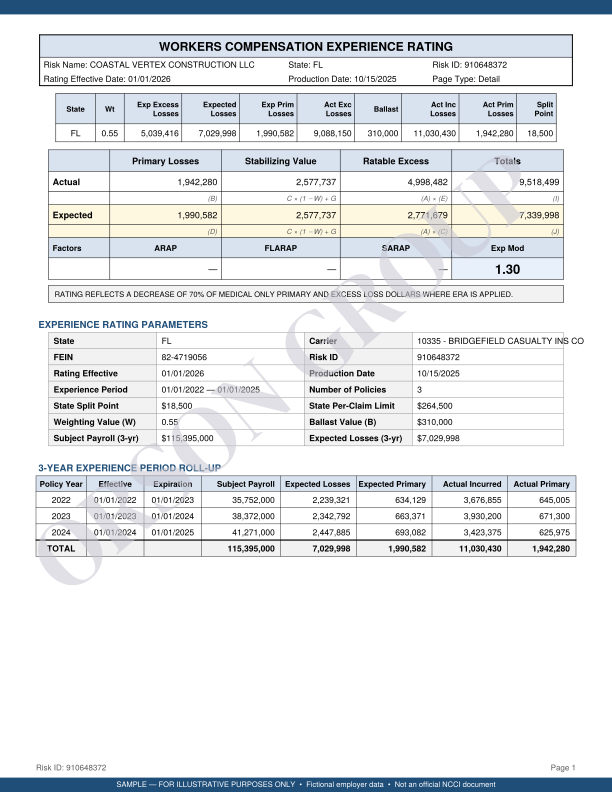
Run the arithmetic on a real number instead of a placeholder. The National Safety Council, drawing on NCCI claims data, puts the average workers' comp claim at $47,316 (National Safety Council, October 2025). Apply NCCI's 32% severity premium for workers 55 and older (NCCI, May 2026) and that single claim is already pushing past $62,000 before a comorbidity enters the picture. Layer in a hypertension diagnosis at roughly three times the medical utilization NCCI attributes to that condition, and the medical layer alone can dwarf what a severity-only estimate would have predicted. On a worksheet with a primary-excess split, that is exactly the direction a claim should not move.
Why a 95% male crew doesn't get a pass
Construction claims run about 95% male, against 49% in leisure and hospitality and 18% in health care (NCCI, May 2026). Claims involving male workers already require 28% more medical care on average than claims involving female workers, a gap NCCI traces to industry mix and injury diagnosis rather than age or sex alone (NCCI, October 2026).
That matters because the two patterns stack. An industry that's almost entirely male starts from a higher care-cost floor on every claim, aging workforce or not. When the rare older-worker claim does land on that kind of crew, it isn't starting from zero. It's starting from a baseline that was already elevated, and the comorbidity multiplier gets applied on top of it. A medical-only claim that would have stayed small on a younger worker can cross into lost-time territory on an older one, and that reclassification alone changes how the claim behaves on the worksheet.
What an audit would check
An audit checks whether reserves on open claims reflect the actual diagnosis and treatment path, not an age-blind industry average, and whether a claim's primary-versus-excess split still makes sense once comorbidity-driven treatment is added to the file. It also checks whether payroll and classification correctly reflect who is actually doing the work, since a crew's real demographic mix rarely matches the assumptions baked into a renewal.
NCCI's data says your crew probably isn't the one getting older. Send us your worksheet and find out whether the claims on it are telling a different story.