OSHA Top 10 Violations 2026: The Same Five Standards, Your Mod
Fall protection tops OSHA's FY2026 list at 4,041 citations, the 16th straight year, and five construction standards fill half the Top 10. The mod consequences outlast the citations.

OSHA's preliminary FY2026 Top 10, released September 15, 2026, puts Fall Protection General Requirements at No. 1 for the 16th straight year with 4,041 citations (OSHA, 2026). Five construction standards made the list: fall protection, scaffolding (1,725), ladders (1,659), fall protection training (1,273), and eye and face protection (1,120) (OSHA, 2026). Citations don't enter mod math, but the injuries behind them do, for three rating years.
For the 16th consecutive fiscal year, fall protection is OSHA's most-cited standard. The preliminary FY2026 figures, presented September 15 at the NSC Safety Congress & Expo in Indianapolis, show 4,041 violations of Fall Protection General Requirements, 29 CFR 1926.501 (OSHA, 2026). The ranking isn't the news. The news is that five construction standards fill half the list, and every one of them produces the kind of lost-time claim that lives in your experience modification rate (EMR, or just the mod) for three rating years.
OSHA's Top 10 counts violations out of federal inspections, and this year's preliminary window ran October 1, 2025 through August 31, 2026 (Safety+Health Magazine, 2026). It is enforcement output, not a survey of job-site conditions. That distinction matters more this year than usual, because the headline number fell hard.
The same five standards, again
The construction entries are familiar. Fall Protection General Requirements leads at 4,041 violations. Scaffolding climbed from sixth place to fourth at 1,725. Ladders slid from third to fifth at 1,659. Fall Protection Training Requirements sits eighth at 1,273, and Eye and Face Protection holds ninth at 1,120 (OSHA, 2026). Together those five account for 9,818 of the 17,701 Top 10 violations, roughly 55% (OSHA, 2026).
Prent Cline, acting deputy director of OSHA's Directorate of Enforcement Programs, presented the list and didn't soften the diagnosis. "Fall protection violations are often a failure to manage the job," he said, adding that employers should have zero tolerance for them (Safety+Health Magazine, 2026). That framing is the right one for a mod conversation, because a citation is a management failure that got caught before someone got hurt. A claim is the same failure on the day nobody caught it.
Fewer citations is not fewer falls
Every standard on the list drew fewer citations than in FY2025. Fall protection dropped from 5,914 violations to 4,041 (J.J. Keller, 2026), a 31.7% decline (MapTrack, 2026), and the Top 10 total fell 24.8% (MapTrack, 2026). Read that carefully before you celebrate. Citation counts track inspection activity and an 11-month data window, not the number of roofs working without guardrails. A contractor who treats a 31.7% decline as proof the hazard is fading is reading an enforcement metric as a safety metric.
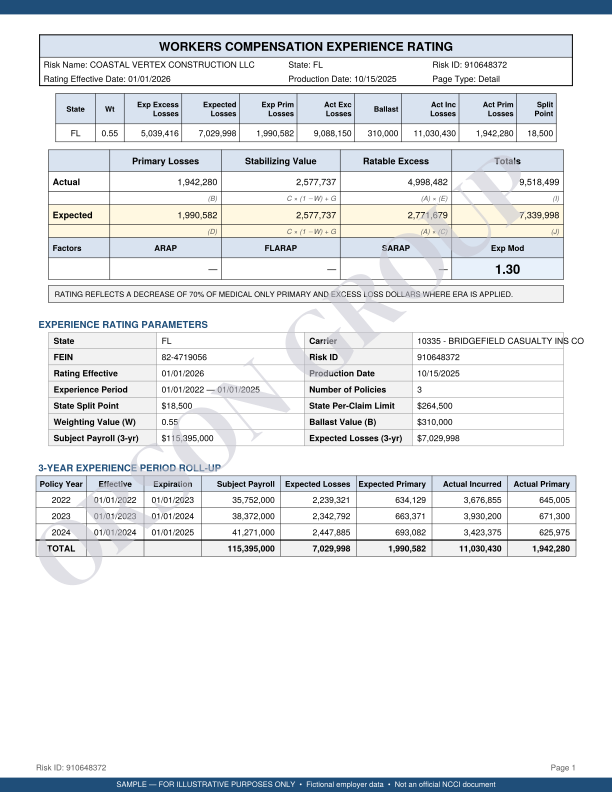
The mod doesn't count citations. It compares your actual losses with expected losses, and because of how frequency and severity are weighted in the formula, the lost-time fall is the most expensive claim type a small contractor can post. OSHA finalizes the list in December, and the final counts move a little each year (Safety+Health Magazine, 2026). The composition of the list barely does.
The worksheets we see tell the same story from the other side: the claims moving Southeast mods are falls, scaffold incidents, and ladder drops, the same five items OSHA keeps counting.
What one fall does to a $40,000 premium
Here is the arithmetic contractors miss. On a $40,000 manual premium, every 0.10 of mod is about $4,000 a year. A single lost-time fall can move a small contractor's mod by 0.10 to 0.25, and because each policy year's losses stay in the calculation for three rating years, that one claim can mean $12,000 to $30,000 of cumulative premium on that base. An EMR calculator will price the distance between a 1.04 and a 0.94 on your own payroll, but the direction of the move was set the day the claim went lost-time.
The bid threshold is the bigger cliff. Many Southeast general contractors and public owners screen subcontractors at a 1.0 mod, so the penalty for crossing it shows up on the bid list before it shows up on the premium. A contractor at 0.94 has room to absorb a bad year. A contractor at 1.04 is explaining itself in every prequal packet.
What an audit would check
An audit checks whether the claims inside your mod trace back to these same five hazards, and whether a fall or scaffold claim is still open with a reserve that has outgrown the medical reality. It reads injury descriptions against the classifications on the worksheet and separates a mod problem a safety program can fix from a data problem the carrier should fix. If the citation list and the claim list tell the same story three years running, the worksheet deserves a second look.
OSHA's list is public and your worksheet isn't. Start with a free mod review and find out which of the five standards is actually priced into your renewal.