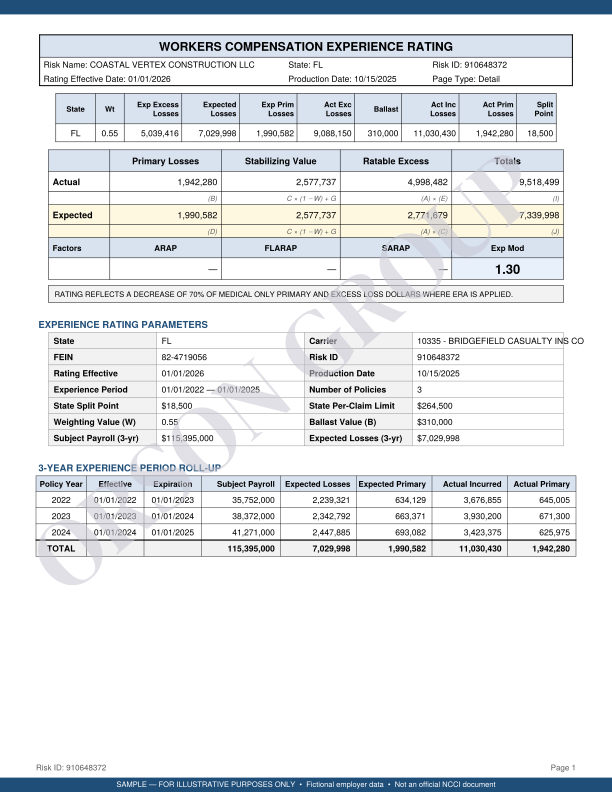
Shrinking Payroll and Your Experience Mod: The Down-Year Trap
Residential construction spending fell 5.5% in September alone. Cutting payroll shrinks the expected losses your mod is judged against while booked claims stay put, so a lean year can raise it.

Shrinking payroll can raise your mod. Expected losses are built from payroll, so a smaller year lowers the yardstick, while claims already booked don't shrink. With construction spending down 2.9% through September (Census Bureau, November 2, 2026), a 20% payroll cut makes any fixed-size claim weigh 25% more against that year's expected losses.
Construction is contracting, and plenty of contractors are contracting with it. The Census Bureau's September print put total construction spending at $2,186.1 billion, down 1.9% from August (Census Bureau, November 2, 2026). Residential alone fell 5.5% in one month to $848.8 billion (Census Bureau, November 2, 2026). Trimming crews feels like the careful response. For your experience modification rate (EMR, the mod), it's a move that gets priced later, and not in your favor.
Where the shrinkage is landing
Through the first nine months of 2026, spending totaled $1,649.6 billion, down 2.9% from the same stretch of 2025 (Census Bureau, November 2, 2026). The pain is lopsided. Nonresidential rose 1.1% in September while residential dropped (Census Bureau, November 2, 2026), so a home builder and a commercial sub are living through different years.
Headcount follows unevenly across the Southeast. Georgia construction employment fell about 4,900 jobs, or 2.1%, over the 12 months to September (AGC, September 2026). Florida added 3,300 jobs (0.5%), Alabama 2,800 (2.5%) and Tennessee 900 (0.5%) over the same window (AGC, September 2026). A Georgia contractor who cut payroll has company. A Florida one is swimming against the state.
Shrinking the yardstick, not the history
The mod compares actual losses to expected losses, and expected losses are built from payroll. Cut payroll and the expected side of that comparison falls with it. The claims already on your worksheet don't.
Put real arithmetic on it. A contractor whose payroll slides from $4 million to $3.2 million has 20% less payroll, so that year's expected losses fall 20%. A claim of the same dollar size now sits against a base that's 80% as large. Divide one by 0.80 and the claim weighs 25% more in that year's comparison.
That's the whole trap in one line: a smaller company is held to the same claims history with a shorter ruler. Our one-claim analysis shows how a single loss lingers through the experience window. A down year makes each lingering loss louder.
Why it arrives late
The lean year doesn't hit the mod the month payroll drops. It enters the rating window when the carrier's data for that policy year is reported, then stays in the calculation for several consecutive mods. Meanwhile the bigger years that built your claims history are rolling out one at a time and being replaced by smaller ones.
Layoffs add their own wrinkle. Contractors who call us after a lean year point at the new, smaller payroll and miss the older open claim sitting beside it. Crew reductions also don't erase claims from stressed, short-staffed jobs, and they don't touch anything already reserved.
Put a price on it. On a $150,000 annual premium, five mod points is $7,500 a year (arithmetic on an assumed premium; the EMR calculator will run your own). Over several renewals, that's the cost of a contraction nobody told the owner to budget for.
Where a rate cut won't help
Don't assume the market will cushion this. Even where filed rates are falling, the rating values and expected losses refile with them, so cheaper base rates don't undo a smaller denominator. The mod is a ratio, and ratios punish a shrinking base.
What an audit would check
An audit checks whether the payroll on the reported policy years matches the contractor's books, whether the down year's expected losses reflect the work actually performed and classified, and whether older open claims are still valued the way the file supports. It also weighs which rating-window years are about to roll off and what replaces them.
The Census data is public and your worksheet isn't, so send us your worksheet before the next renewal and we'll tell you what a smaller payroll is doing to your number.