Workers Comp Fraud Detection: States Cross-Match License Filings
A NY abatement contractor owed $163,561 in premium after a license database match, not an audit. Florida's $100M certificate ring shows where this heads next for GCs.

States are cross-referencing contractor license filings, permit records, and project notifications against workers comp policies, catching premium fraud without field audits. A New York asbestos-abatement contractor declared $50,000 in payroll against $354,000 actual and was assessed $163,561 (Insurance Journal, September 2026). Florida's $100 million certificate-rental ring shows the same shift at scale.
Nobody audited this contractor. That is the detail in the New York case that should change how a general contractor thinks about compliance. An asbestos-abatement company declared $50,000 in payroll on its workers comp policy. Its actual payroll was $354,000. The state caught the gap without visiting a jobsite, by cross-referencing license filings and project notifications against the policy (Insurance Journal, September 2026). The assessment came to $163,561.
For most of three decades, comp compliance ran on paper and trust. A general contractor (GC) collected a certificate of insurance from every sub, filed it, and moved on. States had no practical way to test any of it. That era is ending, and it is ending without an announcement.
The detection vector is data matching
States already hold the records. License boards know who holds an abatement, roofing, or electrical license. Labor departments know which projects were notified and when. Carriers report premium and payroll by classification. None of that data was built for enforcement, but it joins cleanly, and increasingly it is being joined. "States are cross-referencing license records more systematically" (Traci Sellers, ReSource Pro, August 2026). Sellers was describing adjuster licensing, but the mechanism is the same one that caught the New York contractor.
The abatement case shows how thin the old defenses are. Asbestos work is a licensed trade with mandatory project notification, so the state held two independent records: what the contractor told the license board and what it told its carrier. Declared payroll of $50,000 against actual payroll of $354,000 is a gap of roughly seven to one (Insurance Journal, September 2026). The $163,561 premium underpayment was recovered entirely from records the contractor had already filed (Insurance Journal, September 2026). No auditor knocked. No whistleblower stepped up. The databases talked.
Florida shows the same shift, at scale
Florida's 2026 certificate-rental case is the other bookend. A ring produced fraudulent certificates of insurance on an industrial scale, with roughly $100 million tied to the scheme (Insurance Journal, 2026). The paper looked perfect. That was the product.
The penalty math is now specific. Florida imposes $5,000 per misclassified worker plus doubled premium liability (Florida workers comp law, 2026). For a sub running ten workers off the books, that is $50,000 in per-head penalties before the premium true-up, and the true-up is doubled.
The quiet cost lands on honest contractors. Every bid built on unreported payroll undercuts a bid built on real premium. In a soft market where carriers are already shaving rates, the fraud discount is the margin, and the contractor absorbing it is the one whose mod and audit trail are clean.
Why this reaches the general contractor's mod
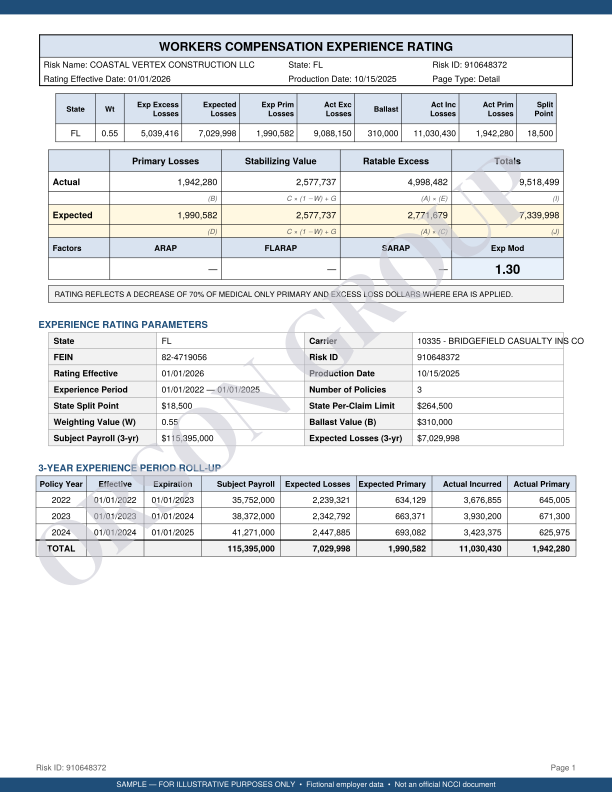
A GC has two exposures, and neither shows up on the certificate. First, payroll: if a sub's certificate is fake, rented, or lapsed, the sub's payroll can be pulled onto the GC's policy at final audit under the workers' comp premium formula. The GC pays premium it never priced into the job. Second, claims: an uninsured sub's injured worker can come against the GC's policy, and that claim then sits in the GC's experience modification rate for three years.
Run the New York numbers downstream. The $163,561 assessment is what the state recovered from the abatement contractor itself (Insurance Journal, September 2026). A general contractor above that same scheme doesn't get that bill. It gets the $354,000 in unpriced payroll at final audit, plus any abatement injury claim compounding inside its mod through the whole experience period (Insurance Journal, September 2026). An EMR calculator will price what one inherited claim does to the renewal; the certificate file won't.
The worksheets we review carry this more often than the enforcement dockets do. A GC's mod holding a claim from a sub that dissolved before the cast came off is a pattern, not a fluke, and it usually surfaces at renewal, when it is too late to reprice the job.
What an audit would check
An audit checks whether the certificates in the file correspond to policies that actually covered the scope and the dates, and whether the payroll those certificates excluded stayed excluded. It reads the mod worksheet for claims tracing back to subcontractor injuries and tests whether the experience period is carrying losses that belong to someone else's fraud. It also weighs whether the mod reflects the contractor's own loss history or the residue of a certificate that was never real.
Before the state's databases get around to your subs, send us your mod worksheet and see what your file actually supports.