Tennessee Workers Comp 2026: The First Valuation Test
Tennessee's July 10 update raised the TTD cap to $1,488.30 and widened fee exposure. For contractors, the danger is the reserve still open when first valuation arrives.

Tennessee workers comp 2026 changes raise the temporary total disability maximum to $1,488.30 for July 1, 2026 injuries (Tennessee BWC, July 2026). For contractors, the issue is valuation: NCCI first reports value losses 18 months after policy effective date, and incurred loss includes paid plus reserved dollars (NCCI, 2026). A stale reserve can become premium math.
State updates rarely arrive with one clean headline. Tennessee workers comp 2026 is not one headline either. The Tennessee Bureau of Workers' Compensation (BWC) used its July 10 update to group benefit caps, denial-fee exposure, kratom testing, and municipal lineman death benefits into one practical message for claim files (Tennessee BWC, July 2026).
The claims office will see the details. The contractor will see the mod.
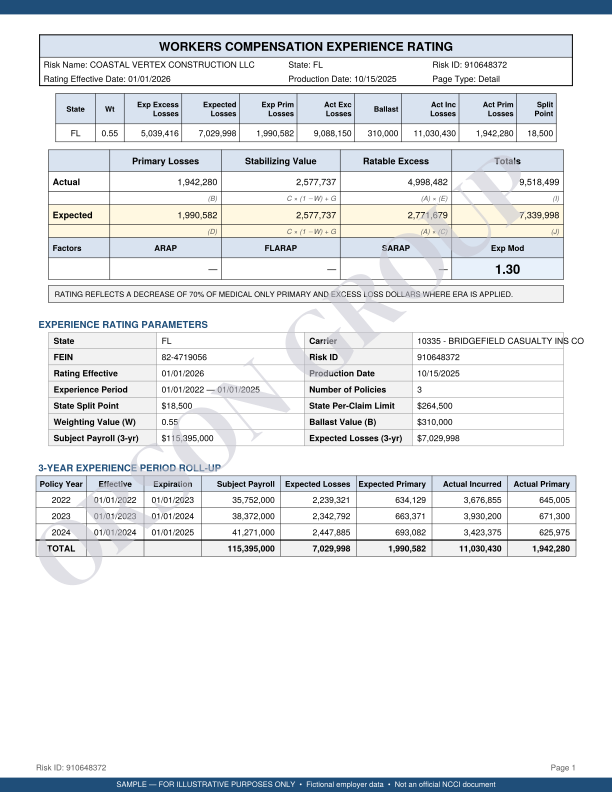
The Experience Modification Rate (EMR, also called the mod) is built from payroll and loss records that carriers report to the National Council on Compensation Insurance (NCCI). NCCI says first unit statistical reports are valued 18 months after the policy effective date and due two months later (NCCI, 2026). For a one-year policy, that is the first six-month window after expiration. Whatever reserve is still open can follow you into renewal pricing.
Tennessee workers comp 2026 puts more dollars on the file
The new temporary total disability (TTD) maximum is $1,488.30 per week for injuries from July 1, 2026 through June 30, 2027 (Tennessee BWC, July 2026). Permanent benefits top out at $1,353.00, and the minimum weekly benefit is $202.95 for the same injury period (Tennessee BWC, July 2026). The state average weekly wage is $1,353, which is why the temporary cap sits at 110% and the permanent cap at 100% (Tennessee BWC compensation rates, June 2026).
That is not abstract. A July 1-forward lost-time claim reserved for 26 weeks at the new temporary maximum carries $38,695.80 in indemnity reserve before medical is counted (calculated from Tennessee BWC, July 2026). Under the prior-year cap of $1,426.70, the same 26-week reserve would have been $37,094.20 (Tennessee BWC compensation rates, June 2026). The change is only $1,601.60 on that slice. But the full $38,695.80 is the number that matters if it is still sitting on the loss record at first valuation.
The reserve, not the statute, hits the worksheet
NCCI's unit reporting training says incurred losses equal paid amount plus reserved amount (NCCI, 2026). That sentence is the whole premium story. A claim does not need to be settled to affect the mod. It needs to be valued.
In our reviews of Southeast contractor worksheets, this is where the file usually goes stale. The worker is back. Medical treatment has slowed. The carrier's reserve still reflects the early worst case. Tennessee's higher weekly cap gives that early estimate a larger ceiling, and the first unit-stat valuation gives it a place to harden.
The denial rule raises the price of drift
Public Chapter 845 applies to injuries from July 1, 2026 through June 30, 2030 (Tennessee BWC, July 2026). It lets the Court of Workers' Compensation Claims award attorney fees and court costs at an expedited hearing when an employer "unreasonably denies a claim or delays benefits" (Tennessee BWC, July 2026).
That is not a command to pay every gray claim. It is a warning against letting no, not yet, and nobody updated the reserve collapse into the same file posture. A denial that was defensible on day seven can become expensive if the facts move and the file does not. The mod problem is quieter: legal friction often keeps the reserve alive long enough to hit the first report.
Kratom and linemen are not side notes
Public Chapter 950 classifies kratom as a regulated substance for workers' compensation purposes and extends workplace drug-testing policies to include it (Tennessee BWC, July 2026). For construction employers, the issue is consistency. Post-accident testing language that ignores kratom can leave a gap between the personnel file and the claim position.
The Chance Carlton Act adds a $250,000 annuity, paid over five years, for estates of municipal or local government electrical linemen killed on the job, for claims filed on or after July 1, 2026 (Tennessee BWC, July 2026). Most contractors will never touch that benefit. Utility contractors and public-work employers should not assume it is someone else's paragraph.
What first valuation will not forgive
NCCI says correction reports revise previously reported data, but later changes in reserves or paid amounts are listed as loss development, not ordinary correction territory (NCCI, 2026). That distinction matters. If a $38,695.80 reserve is simply too high after the valuation date, the next worksheet may not fix itself because the claim later calmed down.
The better question is earlier: what number is the carrier about to report? The six-month-after-expiration window is not long. It is long enough for a Tennessee lost-time claim to get real medical direction, return-to-work facts, and a reserve that matches the current exposure.
What an audit would check
An audit checks whether July 1-forward Tennessee claims are carrying the right injury date, benefit cap, injury type, and current reserve posture before the first unit-stat report. It checks whether fee exposure, kratom-related testing facts, or death-benefit exposure changed the incurred value that belongs on the worksheet. It also checks whether the claim value NCCI receives still matches the carrier's current file. The goal is not to relitigate the claim; it is to keep the mod from multiplying a stale snapshot.
If your Tennessee worksheet has a 2026 lost-time claim, send us your NCCI worksheet and we'll review whether the mod is carrying the right claim value.