Uninsured Subcontractor Workers Comp Claims Hit the GC Mod
Florida and Georgia make the GC jointly liable when a sub carries no coverage. The claim pays like the GC's own, rates like the GC's own, and sits in the mod for three policy years.

Yes. Florida makes construction contractors jointly and severally liable for workers comp benefits to an uninsured sub's employees (Fla. Stat. §440.11, 2026), and Georgia's statutory-employer rule does the same (OCGA §34-9-8, 2026). The claim pays from the GC's policy and stays in the GC's experience modification rate for three policy years (NCCI, 2026).
When a general contractor wins on exclusive remedy, read the win carefully. The reported dismissal of the tort suit in the Occidental and Turner matter means the subcontractor's injured employee can't take the GC to a jury (Business Insurance, 2026). That's the outcome every GC wants from a jobsite injury. It's also proof that the loss is a workers comp claim on the GC's own policy, which puts it inside the GC's experience modification rate for three policy years.
Exclusive remedy is the bargain at the heart of workers comp: pay the claim, and the employee can't sue. Florida and Georgia have written the fine print for GCs using uninsured subs, and it runs against the contractor.
What the statutes do to the GC
Florida is blunt about construction. In the construction industry, a contractor and its subcontractor are "jointly and severally liable for payment of compensation" to the sub's employees unless the sub carries its own coverage (Fla. Stat. §440.11, 2026). Georgia reaches the same result through its statutory-employer rule: when a sub fails to secure payment of compensation, the contractor above it is liable for the injured employee's benefits (OCGA §34-9-8, 2026).
So the GC's carrier pays, exclusive remedy holds, and the tort suit dies. That's the Occidental and Turner fact pattern. But the claim now sits on the GC's loss run at the carrier's full reserve. The statute solved the worker's problem and handed the GC a new one.
The mod math on one claim
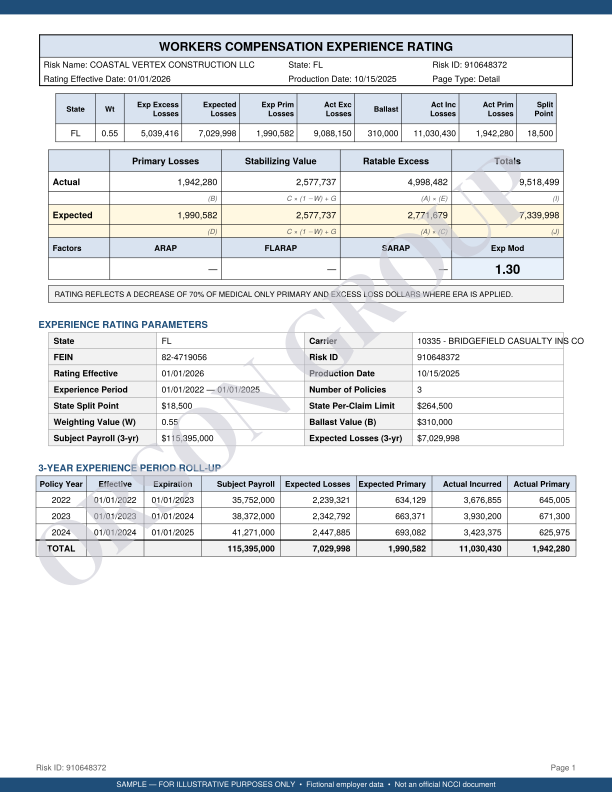
The experience modification rate compares a contractor's actual losses with expected losses across three policy years of data (NCCI, 2026). A $100,000 indemnity claim doesn't spread across those years gently. It lands at full value and stays ratable until it closes.
On a small GC running a 0.90 mod against modest expected losses, one six-figure claim can push the mod past 1.10. That swing isn't a rounding error. Going from 0.90 to 1.10 is a 22 percent premium increase on identical payroll. On a $150,000 annual premium, that's roughly $33,000 a year, and the claim sits in the rating period for three years: about $100,000 of extra premium stacked on top of the $100,000 the carrier already paid. The claim pays twice.
When we open a GC's worksheet, the claim that moved the mod is rarely the GC's own employee. It came in through the statute's back door.
Then there's the bid list. Owners and upstream GCs commonly screen subs at a 1.00 mod threshold, and a 1.10 doesn't clear it. A mod that was an asset in the prequal packet becomes a disqualifier, and that costs more than premium ever will.
The audit finds it before the claim does
The exposure usually surfaces at premium audit, before anyone gets hurt: when a sub can't show coverage, the carrier bills the sub's payroll at the GC's rates. As one industry guide puts it, the carrier will "add the sub's payroll to your auditable payroll and charge you WC premium on it" (The Contractor Matrix, 2026). A North Carolina GC absorbed roughly $180,000 in claims and defense costs after three subs' coverage lapsed on one project and a jobsite injury pulled every party into the claim (The Contractor Matrix, 2026).
The same file damage shows up on the liability side. One Midwest agency describes a GC whose GL renewal jumped 30 percent in a claim-free year because subcontractor costs doubled on the application and half the subs had no certificates on file (Lone Star Risk Partners, 2026). Carriers read missing certificates as unmanaged risk and price accordingly.
A subcontract with indemnification language gives the GC a route to recover from the sub after the fact. It doesn't restate the mods already issued, and it doesn't pull a 1.10 back under 1.00 while the claim is open. An EMR calculator prices the distance between the mod you have and the one your file supports. What it can't do is tell you whether the claim values feeding it are right.
What an audit would check
An audit checks whether sub certificates actually covered the dates each sub worked, whether the payroll audit picked up uninsured sub payroll under the correct classification, and whether any sub-generated claim carries a defensible reserve rather than a stale one. It also weighs the mod against the bid thresholds that matter, because a 1.10 that costs 22 percent on premium costs something larger on the bid calendar.
The statutes are public and your worksheet is not, so send us the worksheet and find out which claims on it you actually earned.