Workers Comp Election of Remedies: Why Filing First Wins
A Tennessee judge barred a construction worker's claim because he filed in Virginia twice first. For TN, GA, and AL contractors, the jurisdiction risk isn't which state you're based in. It's who files first.

Election of remedies in workers' comp means a worker who actively pursues a claim in one state is barred from refiling for the same injury in another state that also has jurisdiction. A Tennessee court applied the doctrine on September 30, 2026, after a worker filed twice in Virginia before ever filing in Tennessee.
A Tennessee contractor just watched a worker's comp claim disappear, and it wasn't because the injury wasn't real. Armon Stines had back surgery a week after his injury. His claim still died, because he picked Virginia first.
On September 30, 2026, the Tennessee Court of Workers' Compensation Claims denied Stines benefits for a back injury he suffered stepping off a walk board at a Virginia jobsite while working for Tennessee-based Pollard Management Inc., insured by Builders Insurance Company. He filed in Virginia on April 7, 2025, six days after the injury. He had surgery April 8. He filed in Virginia again on April 26, after retaining Tennessee counsel and trying to pivot forums. The court found he'd made his choice twice over, and that choice was final (Insurance Business America, October 2026).
What the order actually did
Stines argued the first Virginia filing shouldn't count. He said he was sedated from the surgery and didn't fully understand what he was signing. The court wasn't persuaded. It noted the second Virginia filing came on April 26, well after any sedation would have worn off, and that "the first filing contained all the correct information" (Insurance Business America, October 2026). A recorded statement to the adjuster the day after surgery, in which Stines confirmed he intended to pursue Virginia benefits, closed the argument further.
The order is interlocutory. A status hearing is set for November 30, 2026, and the appeal window is still open. But as of today, Stines has no Tennessee claim and his surgery bill sits wherever Virginia's system puts it.
The doctrine is old. The trap is new math.
Tennessee didn't invent election of remedies for this case. In Gray v. Holloway Construction Co., the state's Supreme Court let a worker proceed in Tennessee despite an earlier Texas filing, because that Texas claim turned out to be legally baseless and so no real election had occurred (834 S.W.2d 277, Tenn. 1992). In Goodwin v. Morristown Driver's Services, the Workers' Compensation Appeals Board let a Tennessee claim proceed because the worker's home-state filing had been thrown out for lack of subject-matter jurisdiction, not decided against him on the facts (Tenn. Workers' Comp. Appeals Bd., July 2019). The line the courts keep drawing is narrow: a dead-end filing doesn't bar you, but a live, actively pursued one does, even if you never collect a dime there (Tenn. Workers' Comp. Appeals Bd., August 2024). Stines' Virginia filings were live. Twice.
Why TN, GA, and AL contractors carry more of this than they think
Southeast contractors move crews across state lines routinely, and the rules don't treat that casually. Tennessee exempts an out-of-state worker from Tennessee coverage only if the assignment runs 14 consecutive days or fewer, or 25 total days a year, and that carve-out doesn't apply to construction employers at all (Tennessee Bureau of Workers' Compensation, 2026). A framing crew sent from Georgia for a three-week Tennessee job can be fully exposed to Tennessee's system from day one, with no reciprocity to fall back on.
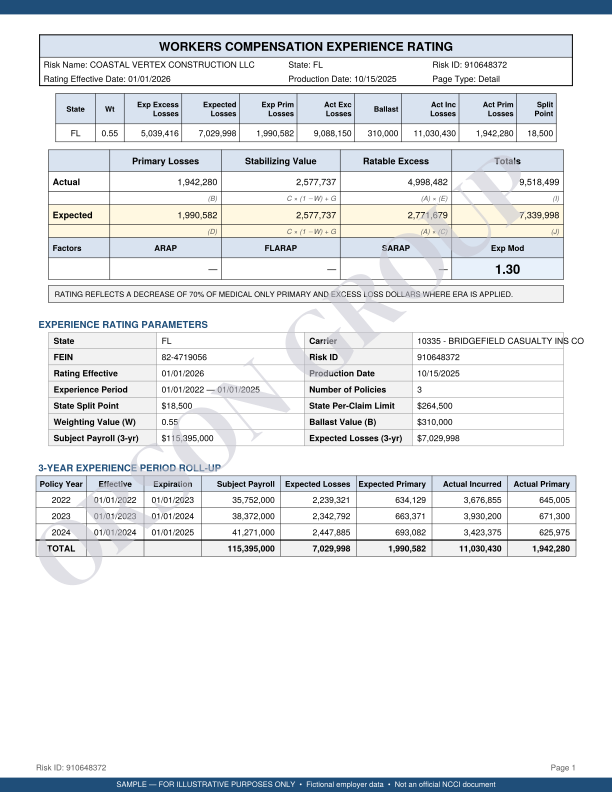
Layer on current rate pressure. NCCI has filed TN-2026-04, a 4.8% system-wide Tennessee loss cost change tied to the state's medical fee schedule, proposed for policies effective October 1, 2026 (NCCI TN-2026-04; Berkley Industrial Comp, 2026). On a $60,000 Tennessee contracting premium, that's roughly $2,880 moving before a single claim touches the mod (NCCI TN-2026-04; Berkley Industrial Comp, 2026), the kind of swing the workers' comp premium formula is built to isolate, and the kind an EMR calculator can price in minutes. What it can't price is which state's expected-loss table ends up absorbing a claim because of where an injured worker, not the employer, decided to file.
A prior filing already showed how the split point that governs a claim's mod weight can hinge on jurisdiction. Election of remedies is the step before that: it decides whether your state's rating data ever sees the claim at all.
What an audit would check
An audit checks which state actually received notice first, how fast that notice reached the carrier, and whether the claim file the home-state carrier holds matches what was filed elsewhere. It looks at whether the worker's choice of forum was documented inside the first 48 hours or discovered later, after counsel got involved. It does not hand a field supervisor a form to fill out on the jobsite.
A claim that never lands in the jurisdiction your mod expects it in is a renewal nobody can audit with confidence. If your crews cross state lines, send us your worksheet before the next injured worker decides your jurisdiction for you.