Workers Comp Medical Growth Meets a Smaller Benchmark
WCRI puts most states at 4% to 8% annual medical growth, while North Carolina proposes a lower 2027 carpentry ELR. Rising claims against a shrinking benchmark can lift the mod twice.

Workers comp medical growth doesn't move an Experience Modification Rate (EMR, the mod) in one direction. Medical payments per claim rose 4% to 8% annually in most WCRI states (WCRI, September 2026), while North Carolina proposed lower 2027 expected loss rates. When claim costs rise as the expected-loss benchmark falls, the same contractor can look worse without more injuries.
Medical inflation isn't a surcharge added to your Experience Modification Rate (EMR, the mod). Workers comp medical growth is now colliding with smaller expected-loss benchmarks, and the collision matters more than either number alone.
The new 27-state study from the Workers Compensation Research Institute (WCRI) puts annual medical payments-per-claim growth at 4% to 8% in most states from 2022 to 2025 (WCRI, September 2026). Florida rose 4% in the latest period, while California climbed 12% over two years (WCRI, September 2026). This isn't one national inflation rate. It's 27 local races between claim costs and the benchmark beneath the mod.
Workers comp medical growth hits both sides
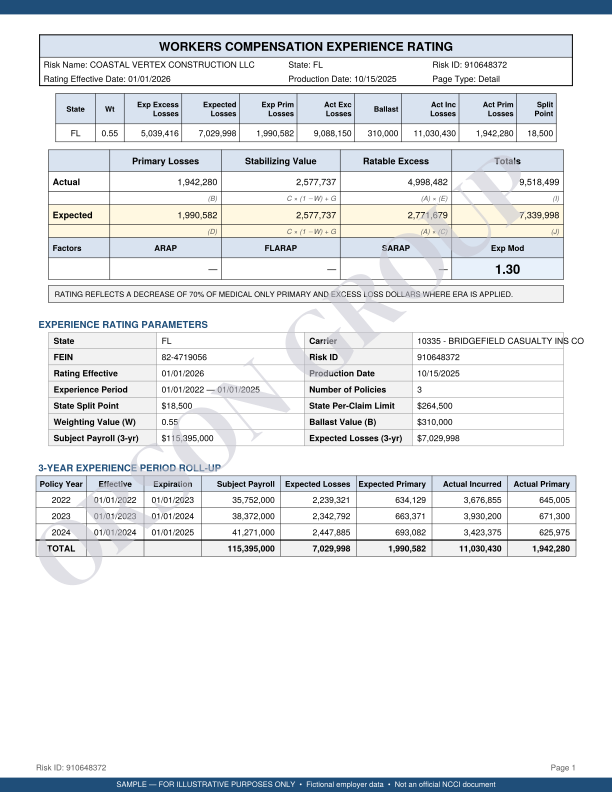
The National Council on Compensation Insurance (NCCI) defines an Expected Loss Rate (ELR) as expected losses per $100 of payroll. Expected losses equal the ELR multiplied by payroll divided by $100 (NCCI Experience Rating Worksheet, 2025). Actual incurred losses sit on the other side of the calculation, then the plan applies primary and excess loss treatment, weight, and ballast (NCCI Experience Rating Worksheet, 2025).
WCRI's study states represent about 68% of workers' compensation benefit payments, and 12 states received detailed reports (WCRI, September 2026). Sebastian Negrusa, WCRI's vice president of research, said, "starting in 2023, we see a consistent pattern of rising prices across states" (WCRI, September 2026).
But the 4% to 8% finding measures medical payments per claim. It isn't an automatic 4% to 8% increase in an ELR, a loss cost, or your mod. Medical was 53% of NCCI lost-time losses in Accident Year 2025, down from a 56.6% peak in 2016 (NCCI Asked & Answered, September 2026). A medical increase reaches the total-loss benchmark only through that medical share.
The frequency cushion is getting thinner
For years, falling claim counts paid for rising claim costs. That trade is weakening. NCCI estimated lost-time frequency fell 2% in Accident Year 2025, versus a long-term annual decline of 3.8%, while medical severity rose 4% (NCCI State of the Line, May 2026). Combined frequency and severity improved the loss ratio by 3%, short of the long-term 4.5% average improvement (NCCI State of the Line, May 2026).
The old cushion still exists. It's thinner. NCCI projected approved filing changes would cut bureau premium levels an average 5.0% from 2025 to 2026 (NCCI State of the Line, May 2026), which is why lower filed rates can coexist with hotter medical claims. A filed cut prices the class. It doesn't grade the contractor.
North Carolina makes the split visible. Its August filing proposes a 10.6% overall loss-cost decrease and an 11.7% contracting decrease for April 1, 2027 (NCRB C-26-7, August 2026). Class 5403, carpentry not otherwise classified, would fall 19.2% (NCRB C-26-7, August 2026). Medical inflation didn't disappear. Other inputs outweighed it.
The $500,000 payroll denominator
Here is the consequence for a North Carolina carpenter holding annual class 5403 payroll at $500,000 for three experience years (NCCI, 2020). The current ELR is 1.263 and the current D-ratio is 0.33 (NCRB April 2026 values, April 2026). Applied to $1.5 million of payroll, that produces $18,945 in expected losses (NCRB, April 2026).
For this model, apply NCCI's 53% systemwide medical share and a 5% medical severity increase from within WCRI's reported range. That allocates about $10,041 of the expected-loss base to medical, so the increase adds roughly $502 (WCRI, September 2026; NCCI, September 2026; NCRB, April 2026). It is the medical input, not the finished ELR, and it isn't a claim that carpentry's medical share equals 53%.
NCRB's proposed 2027 ELR for class 5403 is 1.083, which produces only $16,245 of expected losses on the same three-year payroll, a $2,700 decrease (NCRB C-26-7, August 2026). If actual losses started at $18,945 and their medical component rose by $502, the raw actual-to-expected ratio would move from 1.00 to about 1.20 (NCRB C-26-7, August 2026; NCCI, September 2026). That isn't a predicted mod. NCCI's full formula still applies the 0.33 D-ratio, primary and excess splits, weight, and ballast (NCCI Experience Rating Worksheet, 2025).
In carpentry worksheets we review, the class rate gets the attention and the ELR doesn't. Here, that habit hides a 14.3% expected-loss-rate cut for class 5403 even as medical payments are rising (NCRB C-26-7, August 2026). The mod doesn't punish inflation. It measures whether your losses outran the benchmark after every filing input was netted.
A contractor can use the EMR calculator to price a supported mod difference, but the raw 1.20 ratio above should not be entered as a mod.
What an audit would check
An audit checks whether the correct ELRs, payroll, class mix, and reported claim values reached the worksheet for its rating date. It separates movement in actual incurred losses from movement in expected losses, because medical growth and a falling benchmark can arrive together. It also tests whether the final mod reflects the rating values actually approved, not merely proposed.
If the benchmark beneath your mod is shrinking, send us your worksheet and we'll test whether the loss side still supports the number you were given.