Workers Comp Renewal Rates: The Soft Market Is Ending
Ivans shows workers comp renewals at −1.10% in August, up from −1.73% in Q1. The rate discount is fading, and the mod is the only lever that keeps paying after the cycle turns.

Workers comp renewal rates averaged −1.10% in August 2026, narrowing from −1.73% in Q1 2026 (Ivans Index, September 2026). The line is still negative year over year, but the discount is shrinking, and CIAB recorded the first back-to-back commercial premium declines since 2017 (CIAB, Q2 2026). When rate stops giving savings, the EMR becomes the main lever on the bill.
Workers comp renewal rates are the only ones in commercial insurance still below zero, and they are climbing toward flat. The August reading came in at −1.10%, up from −1.26% in July and −1.73% in the first quarter (Ivans Index, September 2026). The line is still a discount. The discount is shrinking, and the direction matters more than the level.
Workers comp renewal rates are closing on flat
The Ivans Index measures premium change on matched policies, same insured, same carrier, same agency, and it excludes policies with claims or exposure anomalies. So the −1.10% is clean renewal pricing, drawn from more than 120 million transactions across 38,000 agencies and 700 carriers (Ivans Index, September 2026). The quarterly path tells the story: −1.73% in Q1, −1.37% in Q2, −1.26% in July, −1.10% in August (Ivans Index, September 2026). That is a steady march toward flat.
The rest of the commercial market has already crossed. The Council of Insurance Agents & Brokers recorded a 1.2% average premium decline in Q1 2026, the first since 2017, ending a 33-quarter streak of increases, then a 2.0% drop in Q2, the first back-to-back decline since 2017 (CIAB Q2 2026 Market Index). WTW's like-for-like survey shows aggregate commercial prices up just 0.5% in Q2, against 2.5% the prior quarter and 3.8% a year earlier (WTW, September 10, 2026). Workers comp has now fallen for 18 straight quarters (WTW, Q2 2026). It's the outlier, and it's converging.
Comp has been the donor line
Why has comp been on sale while casualty lines held? Because carriers use it to pay for the exposures they cannot escape. Umbrella premiums rose 5.3% in Q2, a 35th consecutive quarterly increase, and commercial auto rose 4.5%, nearly halved from its 8.8% pace of a year ago (CIAB, Q2 2026). Property fell 6.3%, the sharpest drop of any line, with three-quarters of brokers reporting more property capacity chasing business (CIAB, Q2 2026).
One analyst put the mechanism plainly: "competition flourishes where risk is measurable and evaporates where it is not" (AInvest, September 10, 2026). Comp is measurable, so capital piles in and price falls. Umbrella and auto are priced against juries, so capital stays scarce. The comp discount is a cross-subsidy, and cross-subsidies end when the paying lines stop paying. WTW's 0.5% aggregate reading is that margin cushion thinning in real time (WTW, September 10, 2026).
When rate stops giving, the mod pays
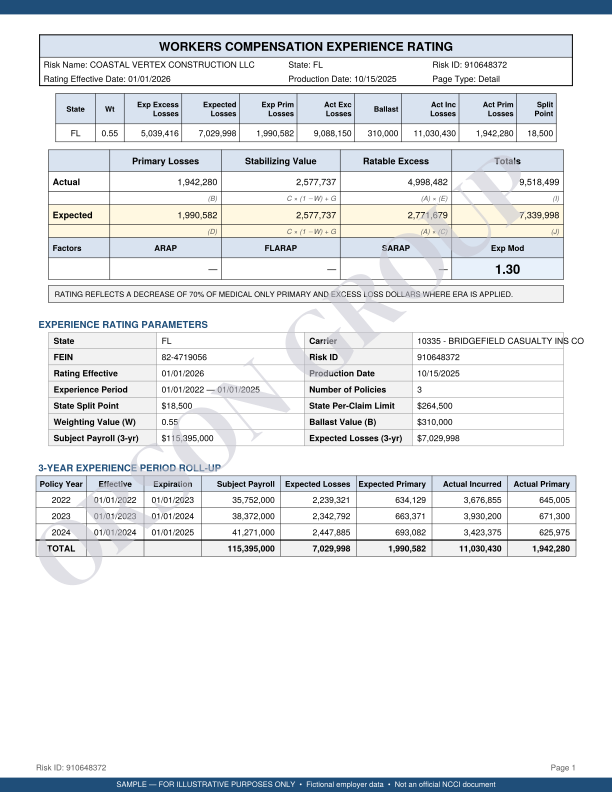
The experience modification rate, the mod, scales your premium by your own loss history against the class average. It is computed from your claims and payroll, not from the market cycle. That distinction is about to matter.
Run the arithmetic a CFO should run. On a $500,000 workers comp premium, the August renewal rate of −1.10% is about $5,500 versus the prior year (Ivans Index, September 2026). At the Q1 pace of −1.73%, the same account saved about $8,650. When the line goes flat, and this trajectory says it will, the rate dividend goes to zero.
The mod doesn't. A 0.10-point gap between the mod you were handed and the one your loss file actually supports is $50,000 on that same premium, roughly nine years of the current rate discount in one renewal. Price the distance with an EMR calculator, but the worksheet is what decides it. The renewal letters an audit reads this fall all lead with the rate cut; the worksheet underneath is where the money actually moved. Most of the gap sits in stale reserves on claims that closed months ago, or payroll parked in classifications the work doesn't match.
What an audit would check
An audit checks whether the claims feeding the mod are genuinely still open, whether reserves at the valuation date match what the files have actually cost, and whether light-duty returns and settlements landed before the unit statistical date. It reads the class codes against the work performed and tests whether the quoted rate cut survives contact with the worksheet. That is the difference between celebrating a $5,500 discount and collecting a $50,000 correction.
The market data is public and your worksheet is not, so send us the worksheet and see which side of the narrowing your renewal stands on.