Instant Workers Comp Certificates in Georgia Cut Both Ways
EverPeak's Georgia launch issues workers' comp certificates at online purchase, from $18 a month. The same instant document is what a Buford fraud operation used to cost one GC $700,000.

Instant workers comp certificates in Georgia are now real: EverPeak's direct channel, live September 21, 2026, issues a certificate at online purchase with policies from $18 a month (EverPeak, 2026). But a certificate is not proof of coverage. One Buford, Georgia scheme left a general contractor with more than $700,000 in added premium from a falsified certificate (Insurance Journal, 2025).
Georgia just got the fastest workers' comp purchase in the Southeast. EverPeak launched its direct-to-customer channel in the state on September 21, 2026: quote online, bind online, and the certificate of insurance arrives at purchase, with policies starting at $18 a month (EverPeak, 2026). For a two-man painting sub, that is real progress. For the general contractor who files the certificate and moves on, it is one more reason a piece of paper proves less than it seems to.
The speed is legitimate
EverPeak carries Pinnacol Assurance's Colorado operation behind it, along with what the company calls more than 100 years of workers' comp experience (EverPeak, 2026). Kathy Kranz, EverPeak's president, put the pitch plainly: "Small business owners in Georgia don't have time to wait around for a quote" (EverPeak, 2026). The service terms match the speed. Policyholders get claims contact within 24 hours of reporting, and EverPeak says its return-to-work program brings injured employees back 25 days faster than the industry average (EverPeak, 2026).
None of that is the problem. The problem is what an instant certificate trains the market to accept.
The fraud side moves at the same speed
Fake certificates were a working business model in Georgia before anyone made the real ones instant. Fernando Jose Cuellar Membreno was arrested in August 2025 for posing as an insurance agent and selling fake workers' comp policies to contractors and subcontractors, his second arrest on the same charges in four years (Insurance Journal, 2025). The Georgia Board of Workers' Compensation said its investigation "revealed that Membreno has stolen thousands of dollars from victims who were under the impression they had workers' compensation insurance coverage" (Georgia Board of Workers' Compensation, 2025). One of his falsified certificates cost a general contractor more than $700,000 in additional premium (Insurance Journal, 2025). The Insurance Commissioner's license verification site shows no licensed producer under either of his names (Insurance Journal, 2025).
The pattern repeats. In May 2026, a former Dalton agent was charged with felony insurance fraud and forgery after investigators found her customers believed they had bought valid coverage and were actually uninsured (Claims Pages, 2026). In late September, Florida's fraud bureau arrested the operator of Miami's Lanza Construction for declaring $41,600 in payroll while more than $1 million in labor checks cleared, evading about $90,000 in premium (Florida DFS, 2026).
A certificate that clears a jobsite compliance check tells you what the subcontractor declared. The Lanza file tells you what a declaration is worth. Instant issuance changes neither fact; it shortens the distance between a fake certificate and a compliance binder that looks current.
What lands on the general contractor
When a sub's certificate is fake, the injury does not wait for the fraud case to resolve. Regulators note that a contractor relying on a fraudulent certificate faces uninsured-employer exposure, contractual risk transfer disputes, and indemnity fights downstream (Claims Pages, 2026). The claim can land on the GC's own policy, and once it lands, it sits inside the experience modification rate math for three policy years.
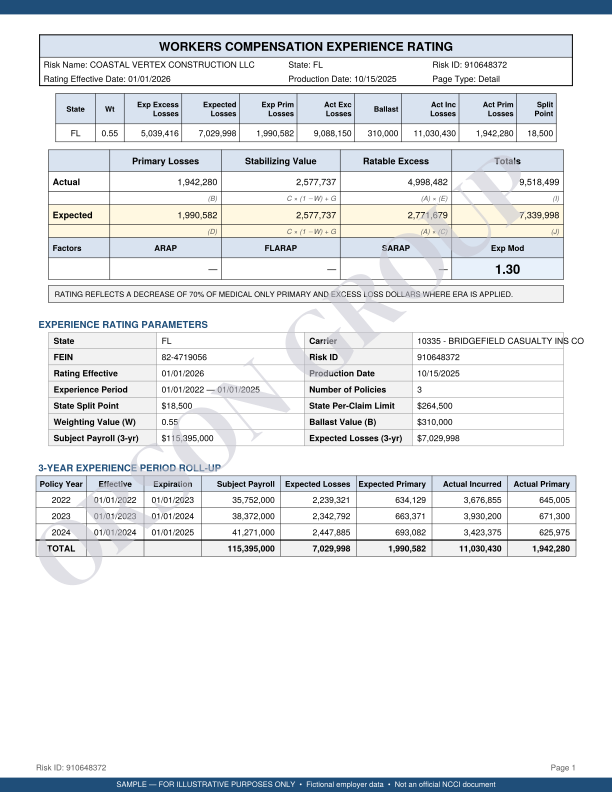
We see the aftermath of these files more often than the fraud itself: a mod worksheet carrying a claim nobody at the GC can place, traced back to a sub whose certificate was the only thing real about its insurance. The $700,000 in the Buford case is the premium side. The mod damage from a sub's fake coverage is a separate bill, and it outlives the prosecution. For how an uninsured subcontractor claim reaches the GC's mod, the short version is that the GC's policy becomes the only valid one on the job.
What an audit would check
An audit checks whether the certificates in a compliance file reconcile against carrier policy records rather than against each other. It weighs whether the payroll behind a sub's coverage matches the labor that sub actually ran, the same gap that separated Lanza's $41,600 declaration from its $1 million in labor checks (Florida DFS, 2026). And it reads the mod worksheet for claims that arrived through coverage nobody can locate.
If your certificate file is thick and your mod still moved, send us the worksheet and find out which certificate the numbers are actually honoring.