Portable Benefits Laws Reach Construction's 1099 Crews
NCCI monitored 1,102 workers comp bills in 2026 and Georgia joined the portable benefits column. Southeast contractors running on 1099 subs just got a safe harbor, and premium audits got a new question.

Portable benefits laws let a company contribute to a 1099 contractor's benefit account without the contribution counting as evidence of employment. NCCI monitored 1,102 workers' comp bills in 2026 and counted 167 enactments (NCCI, 2026). Georgia's HB 987 took effect July 1, 2026, and Alabama, Tennessee and West Virginia already have frameworks (Deel, 2026).
NCCI's 2026 Legislative and Regulatory Trends Report landed September 15, and one line in it matters more to a drywall contractor in Marietta than the rest of the document combined. The National Council on Compensation Insurance (NCCI) monitored 1,102 workers' comp bills across state legislatures this cycle and counted 167 enactments (NCCI, 2026). Among them, Georgia joined Idaho, Louisiana and West Virginia in enacting portable-benefits measures (NCCI, 2026).
That is the first sustained legislative movement that touches construction's 1099 problem without demanding everyone be converted to W-2. It changes how Southeast contractors can pay good subs. It also opens a question nobody has answered: what a premium auditor does with the money.
What NCCI counted, and what Georgia did
Georgia's HB 987 took effect July 1, 2026, permitting voluntary contributions to independent contractors' health insurance, paid time off and retirement without jeopardizing their contractor status, and compliance trackers estimate it covers more than 1 million independent workers (Deel, 2026). Georgia is not alone in the Southeast. Alabama's SB 86, effective December 31, 2025, was the first law to make contributions fully deductible for the company and tax-free for the worker (Deel, 2026). Tennessee's Voluntary Portable Benefit Plan Act set up a statewide benefit pool in April 2025 (Deel, 2026). West Virginia's HB 4009, effective June 12, 2026, added a state-law safe harbor plus favorable state tax treatment (Deel, 2026).
The pace is the story. Nine more states introduced bills in the first month of their 2026 sessions alone (Deel, 2026), and the federal Unlocking Benefits for Independent Workers Act, S.2210, is advancing through the Senate HELP Committee with bipartisan support (Deel, 2026). Utah went first, back in 2023 (Deel, 2026). NCCI's state list and the compliance trackers' state list don't match perfectly, which tells you how fast the map is filling in.
The safe harbor is the whole ballgame
Contractors have never offered 1099 subs anything that looked like a benefit, for one reason: benefits are evidence of employment. The new laws attack exactly that. Every enacted state law includes a safe harbor, under which "offering contractor benefits through a compliant portable benefits framework does not by itself constitute evidence of an employment relationship under state law" (Deel, 2026).
That sentence is why this is a construction story, not just a gig-economy story. The trades run on 1099 subs more than any delivery platform does. The sub-agreements that cross our desk still describe compensation in language a 1985 employment contract would recognize, and that language is what a premium auditor reaches for first.
Alabama shows the money. Under SB 86, a contractor contributing $5,000 a year into a sub's portable account deducts the full $5,000 on its Alabama return, and the sub pays no state income tax on the value received (Alabama SB 86, 2025). That is a real incentive to formalize something contractors have done informally for years: paying good subs more without creating paper that reclassifies them.
The audit questions nobody has answered
First, premium audit treatment. Workers' comp premium is built on payroll, and remuneration definitions are broad. If a carrier's auditor decides a benefit contribution is remuneration to a reclassified sub, the contribution lands in the premium base and the experience modification rate inherits the exposure. NCCI has not published guidance on how voluntary portable contributions interact with remuneration definitions, and none of the enacted state laws addresses it. The safe harbor protects classification under state law. It does not bind an auditor.
Second, sub-agreement drafting. A statute can say contributions don't create employment status; a contract that calls the same money "employee benefits" still reads like employment. If a sub is reclassified mid-term, their payroll and their claims come home to the contractor's policy and mod, which is how a staffing decision turns into a classification problem. It is also the same seam Florida prosecutors have been working in payroll fraud cases.
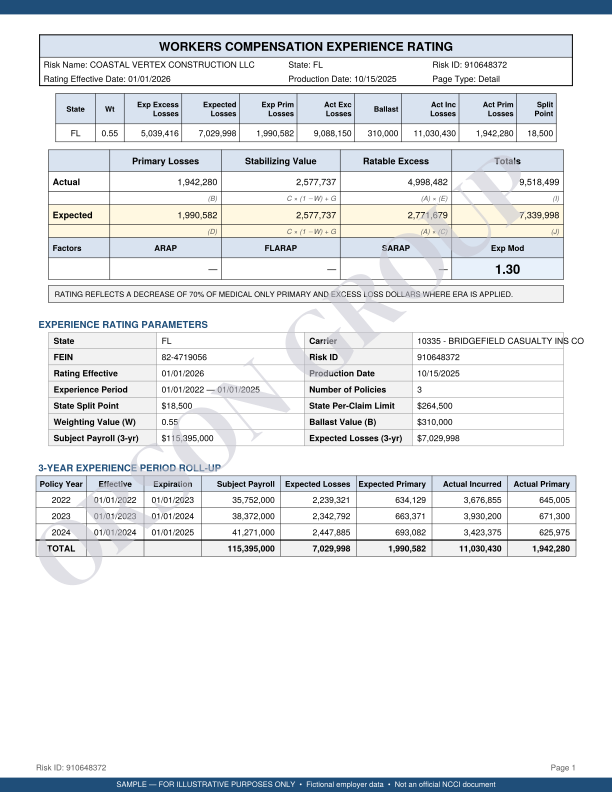
Contractors who want a rough sense of what reclassified payroll would do to the bill can run an EMR calculator, but the statutes won't tell you which side of the line your sub paper puts you on.
What an audit would check
An audit checks whether contributions to 1099 subs are documented as voluntary, worker-attached plan contributions rather than compensation contingent on the relationship. It reads the sub-agreement language against the state safe harbor and traces whether any contribution was picked up as remuneration on the last premium audit. It also weighs whether the contractor's 1099 population, if reclassified, would move enough payroll to move the mod.
The statutes are new and your sub-agreements are not; bring both to a mod review before renewal and see which one is setting your exposure.