Southeast Workers Comp Rates 2027: Five Down, Mods Decide
Five Southeast states filed 2027 comp decreases and Tennessee went the other way. When the market hands every contractor the same cut, the mod spread becomes the only lever that separates bidders.

Five of six Southeast states filed workers comp decreases for 2027: Florida 7.4% proposed for January 1, Georgia 8.8%, Alabama 4.5%, South Carolina 0.4%, and North Carolina 10.6% loss costs (NCCI, 2026; NCRB, 2026). Tennessee alone rises, with a 4.8% law-only increase October 1. Because every base rate falls or flattens, the experience mod becomes the only premium lever a contractor controls.
Five of six Southeast states filed workers comp decreases heading into 2027. That reads like good news, and it is, halfway. A rate cut every contractor in the state gets is not an advantage. It is a new baseline, and the advantage lives in the one part of the premium a contractor still controls: the mod.
The distinction matters because a comp premium is built in layers. Advisory loss costs set the base. The carrier's multiplier and schedule credits shape the middle. The experience modification rate sits on top and multiplies the whole stack. When the base falls across five states at once, the layers above it decide who actually keeps the savings.
The Southeast comp rate map for 2027
Start with the map. Florida's filing proposes a 7.4% decrease effective January 1 (NCCI, 2026). Georgia filed 8.8% (NCCI, 2026), Alabama 4.5% (NCCI, 2026), and South Carolina a rounding-error 0.4% (NCCI, 2026). North Carolina's Rate Bureau filed a 10.6% statewide loss-cost decrease, with contracting at 11.7%, for April 1, 2027 policies (NCRB C-26-7, 2026).
Tennessee is the one state moving against the tide. Its experience-rated portion falls 2.0%, but a 4.8% law-only increase takes effect October 1 (NCCI, 2026). A contractor there gets no relief from the map, which makes the mod the only offset on the table.
Trade screens back the picture. A SERFF-based screen of Southeast filings approved in August 2026 found no qualifying workers comp rate increase in the region at all this cycle, calling conditions "genuinely favorable for comp and fleet insureds in the region right now" (Filing Watch, 2026). Quiet fronts do not stay quiet forever, but for 2027 renewals the base is falling almost everywhere.
A cut everyone gets is not an advantage
Here is the part CFOs miss. Put the same decrease in front of every contractor in Georgia and nobody gains ground. On a $50,000 manual premium, the 8.8% filing is worth about $4,400 a year (NCCI, 2026). Every competitor with similar payroll gets the same $4,400.
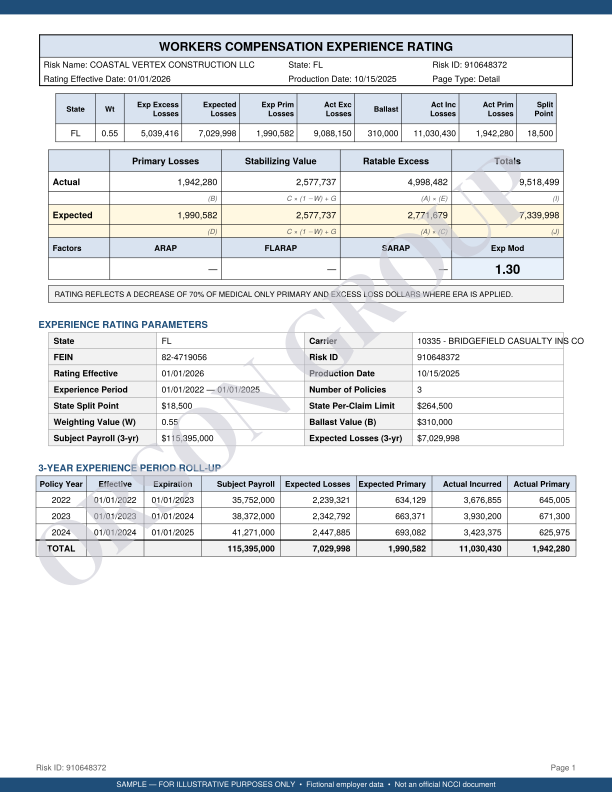
The mod does not work that way. It is account-specific, built from your own claims measured against expected losses for your classifications. A contractor at a 1.15 mod and a competitor at 0.95 sit 20 points apart on the same base. That is $10,000 a year on a $50,000 premium, more than double Georgia's cut, and it repeats every year while the rate cut is a one-time relevel. An EMR calculator prices your own spread; the workers' comp premium formula shows where the mod sits in the stack.
The multi-state accounts we see renew in two or three of these states at once, and in 2027 the quotes will move together. The mod is the only line on the renewal that will not.
The two-year math
| State | Filed change | Effective | Two-year effect on a $50,000 base | |---|---|---|---| | Florida | −7.4% proposed | Jan. 1 | $7,400 | | Georgia | −8.8% | Mar. 1 | $8,800 | | Alabama | −4.5% | Mar. 1 | $4,500 | | South Carolina | −0.4% | Apr. 1 | $400 | | North Carolina | −10.6% loss costs | Apr. 1, 2027 | $10,600 | | Tennessee | +4.8% law-only | Oct. 1 | −$4,800 |
Two caveats belong next to that table. North Carolina's figure is a loss-cost cut, so the carrier's multiplier and the mod still take their share off the top before it reaches the bill. And every number assumes the base is the only thing moving, which it never is.
Now set the table against the mod spread. Twenty mod points on the same $50,000 base is $20,000 over two years. No state in the region hands out that much, and Tennessee takes instead of gives.
What an audit would check
An audit checks whether the worksheet's expected losses track the refiled rating values in each state, whether claim values at the valuation date match what the carrier actually holds, and whether multi-state payroll landed in the right state's rating. For contractors working across two or three of these states, it also weighs whether the distance between a 1.15 and a 0.95 reflects the claims history or the paperwork.
Six states set the base. Your worksheet sets the rest. Send it for a review and find out which side of the spread you are on.