Tennessee Workers Comp Rates: Why October 1 Splits the Year
Tennessee's only loss cost increase in our footprint lands Oct. 1: +4.8%, law-only, after March's −2.0% cut. Same contractor, same payroll, roughly $3,600 apart by renewal date alone.

Tennessee workers comp loss costs rise 4.8% on October 1, 2026 under NCCI filing TN-2026-04, a law-only revision driven by the April fee schedule update (NCCI TN-2026-04, 2026). That reverses March's 2.0% decrease, so a contractor renewing on or after October 1 pays a 6.8-point swing the September renewal never sees.
In most of the Southeast, the workers comp calendar has one big date. This year Tennessee has two. NCCI (National Council on Compensation Insurance) filing TN-2026-04 raises Tennessee workers comp loss costs 4.8% effective October 1, 2026 (NCCI TN-2026-04, 2026), five months after a 2.0% decrease took effect in March (NCCI, March 2026).
Tennessee workers comp rates now split the year in two. A contractor renewing September 28 and one renewing October 5 buy the same coverage off different rate tables, and the gap between those tables is the whole story.
What a law-only filing actually is
NCCI revises Tennessee loss costs two ways. An experience filing reprices the state for how claims have actually trended. A law-only filing does something narrower: it adjusts loss costs for changes the legislature or the workers comp commission already made, with no judgment about experience at all. TN-2026-04 is law-only, and the driver is the April 2026 update to the Tennessee medical fee schedule (NCCI TN-2026-04, 2026).
CFOs conflate the two because the premium effect is identical. A 4.8% increase lands on the renewal either way. But the meaning differs. This filing says nothing about Tennessee claims getting worse; it prices a fee schedule change that already happened. It is also the only pending increase in our six-state footprint this cycle, which makes Tennessee the odd state out at exactly the wrong time of year.
The 6.8-point swing
March handed Tennessee a 2.0% decrease (NCCI, March 2026). October takes back 4.8% (NCCI TN-2026-04, 2026). The distance between a renewal that kept the March table and one that didn't is 6.8 points on the loss-cost layer.
Run it on a real account shape. A contractor with $500,000 in payroll carrying a 1.5 loss-cost multiplier sees roughly a $3,600 annual difference from the renewal date alone, before the mod moves a single point (NCCI TN-2026-04, 2026). Same loss run. Same class codes. The only variable is whether the policy attached before or after October 1.
That is why the workers' comp premium formula matters more than the headline filing number. Payroll times rate times mod, and the rate just changed mid-year for every policy that renews on the back side of the calendar.
Why the timing catches budgets
Experience filings tend to land on a predictable spring cycle, and renewal budgets get built off them. A law-only filing can arrive off-cycle, which is exactly what happened here. The CFO who budgeted in April off the March decrease priced a renewal that no longer exists by October.
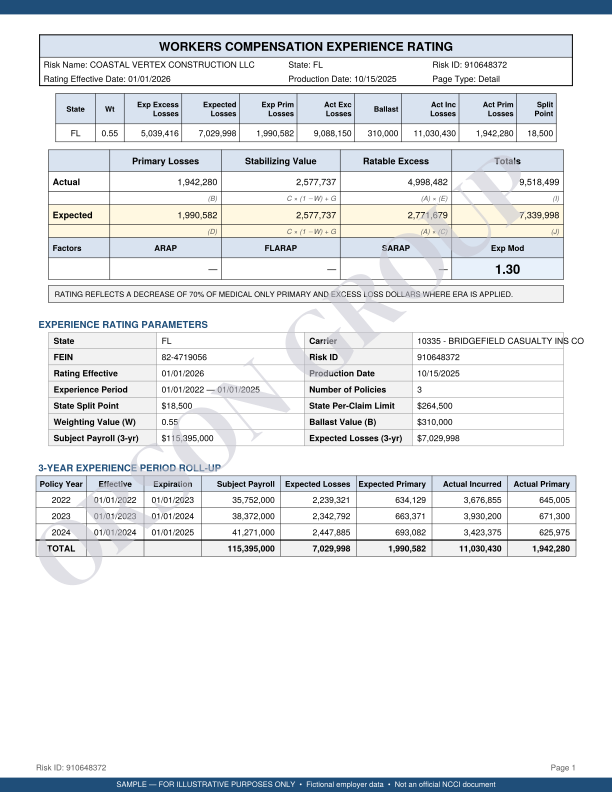
The mod doesn't cause any of this, but it compounds the confusion. The experience modification rate is calculated separately from the loss cost, so a contractor can watch the base rise 4.8% while the mod holds flat and conclude, wrongly, that the mod did it. If you want to price what the mod layer adds or subtracts, an EMR calculator will do that arithmetic; the filing won't.
The Tennessee renewals we review this quarter have a pattern: the ones quoted in September look like a soft market, and the ones quoted three weeks later on identical loss history don't, and nobody at the account can name the reason. October 1 is the reason.
What an audit would check
An audit checks which loss-cost table the renewal quote actually applied, and whether the loss-cost multiplier and mod were held constant across the comparison or quietly moved with it. It reads payroll and class mix against the prior term, because a payroll shift can mask or exaggerate the filing's effect. And it separates the fee-schedule-driven increase from anything the account's own claims did, so the renewal conversation argues about the right number.
Tennessee's filing is public and your renewal quote is not, so send us the worksheet and find out which side of October 1 your premium actually landed on.