NCCI's Time to First Treatment Data Is Moving Your Mod
NCCI finds time to first treatment hit 14.7 days in 2023, up from 12.8, as same-day care fell to 43%. Slower starts track with longer claims, the layer your mod weighs at full value.

Time to first treatment for workers' comp claims averaged 14.7 days in 2023, up from 12.8 in 2016, while same-day care fell to 43% from 48% (NCCI, October 2026). The mod moves because slower-starting claims tend to carry higher primary losses, the layer NCCI's split point weighs at full value.
Fourteen and seven tenths days. That's roughly how long the average workers' comp claimant now waits before seeing a doctor, and the wait is getting longer every time NCCI measures it.
NCCI's new Medical Treatment Dynamics report found that time to first treatment, the gap between injury and first medical care, averaged 14.7 days in 2023, up from 12.8 days in 2016 (NCCI, October 2026). Same-day care, treatment on the date of injury, fell to 43% from 48% over the same stretch (NCCI, October 2026). Most coverage of this report stopped at the access-to-care angle. The mod story is sitting underneath it, mostly unreported.
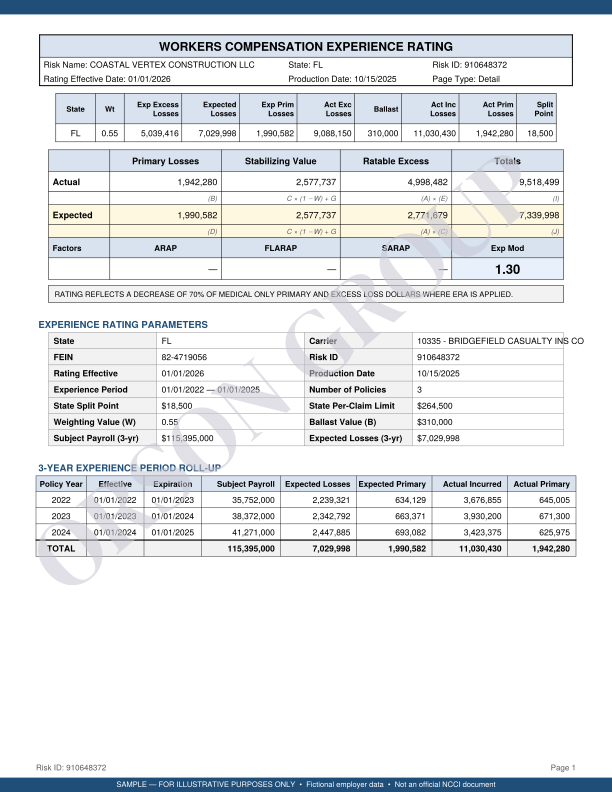
NCCI's Experience Rating Plan splits every claim into primary loss and excess loss at a dollar line called the split point. Primary loss counts toward your Experience Modification Rate (EMR, the mod) at full value. Excess loss gets a discount. Since November 2023, that line hasn't been one number for the whole country. NCCI now sets a separate split point for each state, ranging from $9,500 in Oregon to $38,000 in Louisiana (NCCI, 2023). A claim's dollars on the wrong side of that line matter more than the claim's total cost.
Why NCCI's time to first treatment data hits specialty claims hardest
National averages flatten the worst of it. Time to first physical therapy visit rose eight days to 55 days in 2023, and time to first major surgery rose ten days to 123 days (NCCI, October 2026). Those are the claims most likely to generate enough billing to test a split point, because they're still racking up charges three, four, five months after the injury date.
Treatment duration, measured start to finish once care begins, barely moved: 218.0 days in 2023 against 217.8 in 2016 (NCCI, October 2026). That stability is the real finding. Claims aren't taking longer to close because treatment drags on once it starts. They're taking longer to close because treatment starts later and then runs its normal course from a later starting line. Every week added to the front end shows up on the back end too.
The correlation NCCI found, and the one it didn't
NCCI's correlation analysis shows the relationship lives in specific claim types, not the average claim. Jurisdictions with bigger increases in time to first physical therapy also saw bigger increases in total treatment duration, at a 0.45 correlation; for major surgery claims the correlation was stronger, at 0.60 (NCCI, October 2026). Across all lost-time claims combined, that relationship was close to flat. The delay only bites where the claim was already headed toward real dollars.
Run the arithmetic on one. Take a soft-tissue claim in a state near the low end of NCCI's new range, where the split point sits at $9,500. Seen the same day and closed after six weeks of therapy, that claim might land around $7,000, all of it primary, none of it discounted. Push the first visit past the new 14.7-day average and the first PT referral out to 55 days, and the identical injury can run past $9,500 before the file closes. Every dollar under the split point counts against the mod at full value; every dollar over it gets an excess discount. The delay doesn't just make the claim bigger. It can decide which side of the line the claim's dollars land on. A contractor can run that renewal gap through an EMR calculator, last year's mod against a half-point higher one.
State variation and the one piece that cuts the other way
The national average hides real state-level spread. Mississippi's time to first treatment fell by nearly 17 days between 2016 and 2023, while Nevada's rose by more than 62 days over the same period (NCCI, October 2026). A contractor with crews in both regions inherits two different starting points for the same injury.
NCCI also found that claimants treated after the injury date increasingly start care in nonfacility settings, physician offices and independent physical therapy clinics, rather than hospitals: 82% in 2023, up from 79% in 2016 (NCCI, October 2026). Nonfacility starts also run lower overall utilization, the one piece of this data that cuts in a contractor's favor.
The direction of the underlying lever isn't controversial in the industry. Dr. Lawrence Goren, a physician with four decades in workers' comp, put it plainly: "It is well established that compression of care creates much better outcomes, which result in workers' compensation cost savings." (Risk and Insurance, September 2026). NCCI's new numbers show that compression loosening instead.
What an audit would check
An audit checks when a claim's first treatment date landed relative to the date of injury, not to coach faster scheduling, but to see whether a slow start lines up with reserve growth that pushed the claim's primary loss closer to, or past, the split point your state actually uses. It also checks whether a claim that opened medical-only stayed that way or drifted into lost-time territory as treatment stacked up. We see that drift on worksheets crossing our desk more often than the published averages would suggest.
Neither question requires guessing; both are already sitting in the loss runs and the worksheet your carrier filed.
The 14.7-day average is public. What it did to your specific claims isn't, so send us your worksheet and we'll find out together where your claims actually fell.