Truss Erection EMR: Three Roof Collapses in Ten Days
Greer, Winter Garden, New Smyrna Beach: three truss collapses in ten days. On a $400K-payroll framer, one $75K lost-time claim can hold 0.15 to 0.25 EMR points for three rating years.

Truss erection collapses are among the costliest lost-time claims in framing, and the EMR carries them for three rating years. On a $400,000-payroll framing contractor, one $75,000 lost-time claim can add roughly 0.15 to 0.25 EMR points, about $15,000 to $25,000 in cumulative premium (The Orson Group, 2026). A collapse usually injures several crew members, so it hits the mod as multiple claims, not one.
Between September 19 and September 25, 2026, three roof truss assemblies came down during erection on Southeast job sites: Greer, South Carolina on the 19th, Winter Garden, Florida on the 24th, and New Smyrna Beach, Florida on the 25th (News reports, 2026). Three in ten days is a cluster, not a coincidence. Truss erection EMR exposure is the number a framing contractor never prices until a roof actually comes down.
Here is the uncomfortable part. In 1993, structural engineer Harvey Kagan published an analysis of three truss collapses he had investigated personally, and the failure pattern he documented then is the same one on display now (Kagan, 1993). Thirty-three years apart, the mechanics haven't changed. Only the calendar has.
Why trusses fall during erection
Metal-plate-connected wood trusses are, in Kagan's words, "extremely flexible and unstable until set in place and adequately braced" (Kagan, 1993). A truss run isn't a structure until the crew finishes it. Manufacturers publish handling and bracing recommendations for exactly this reason, and Kagan's finding was blunt: "many truss installers ignore these guidelines" (Kagan, 1993).
His case file reads like a catalog of erection failures. One assembly collapsed twice during erection on the same project. Another stood for six years before it came down, a failure traced to mishandling during installation (Kagan, 1993). OSHA's compliance guidance for truss bracing under 1926 Subpart R exists for the same reason: an unbraced truss run is a live hazard until the system is complete (OSHA, 2026).
What truss erection losses do to the claim ledger
A collapse is rarely one claim. The crew on the deck falls together, and every worker who hits the ground opens a separate claim file with its own reserve. Trauma-transport claims we audit in this class typically run $30,000 to $80,000 medical-only and cross into six figures once indemnity starts (The Orson Group, 2026).
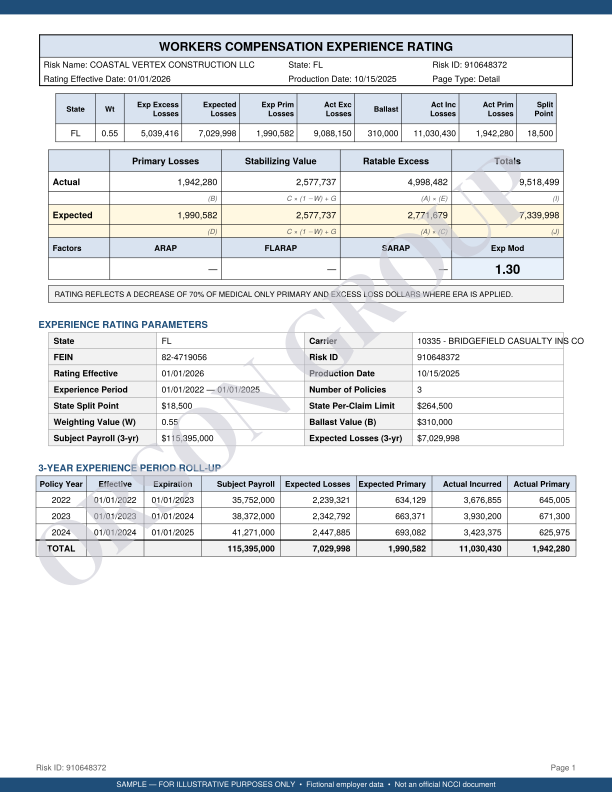
The experience modification rate is built to forgive severity more than frequency. Every claim splits into a primary portion that counts at full weight and an excess portion that gets heavily discounted, which is why four claims of $5,000 each will typically hurt a mod more than a single $80,000 claim (TriCore Safety, 2026). That trade-off between frequency and severity is the mechanic to keep in mind here.
A collapse breaks the mercy. Multiple injured workers mean multiple primary portions landing in the same policy year, with severity stacked on top. It's a frequency event wearing a severity costume.
The truss erection EMR bill
Run the numbers on a modest framing contractor. On $400,000 of payroll, a single $75,000 lost-time claim can add roughly 0.15 to 0.25 EMR points, and the experience period holds that claim for three rating years (The Orson Group, 2026). The cumulative premium difference over those years runs about $15,000 to $25,000 before the claim finally ages out (The Orson Group, 2026).
Premium is the smaller half of the bill. Many general contractors and public owners gate bids at a 1.00 or 1.05 mod, and a framer sitting at 0.94 before a collapse can cross that gate in one policy year. The claim then costs the pipeline, not just the policy. A contractor can price the distance with an EMR calculator, but only the worksheet says which number is actually supported.
One pattern from our audit desk: the last truss drop we reviewed had been settled and closed for more than a year, but the worksheet still carried the surgeon's initial reserve because nobody told the carrier to release it. Collapse claims are big enough that a stale reserve alone can hold a mod a tenth of a point high. The valuation date is where that distortion lives.
What an audit would check
An audit checks whether every injured worker from the event appears on the worksheet at an accurate value, and whether reserves set at the valuation date still match what the claims actually cost. It reads the classification against the erection work performed, since truss erection is often reported under a carpentry code that carries the wrong expected losses. For a general contractor, it checks whether an uninsured sub's collapse exposure can migrate onto the governing mod.
If a collapse sits anywhere in your experience period, send the worksheet to The Orson Group before the next bid package asks for the number.