Workers Comp Intoxication Defense: Not Equal by State
Florida, Georgia, Tennessee, and Alabama let a certified drug-free workplace program flip the burden onto the injured worker after one positive test. South Carolina has no such presumption, full stop.

The workers comp intoxication defense is not uniform across the Southeast. Florida, Georgia, Tennessee, and Alabama let a certified drug-free workplace program turn a timely positive test into a presumption the worker must rebut, a conclusive one in Alabama's case (Ala. Code 25-5-51). South Carolina's statute, 42-9-60, builds no such presumption; a positive test there proves nothing on its own.
Southeast contractors have absorbed one lesson about drug testing and workers' comp: a positive test alone does not end a claim. That part is true. It is also only half the story once you leave the general rule and go state by state. In Florida, Georgia, Tennessee, and Alabama, a positive test taken the right way after running a compliant program comes close to ending the claim, by statute. In South Carolina, the identical test proves nothing by itself.
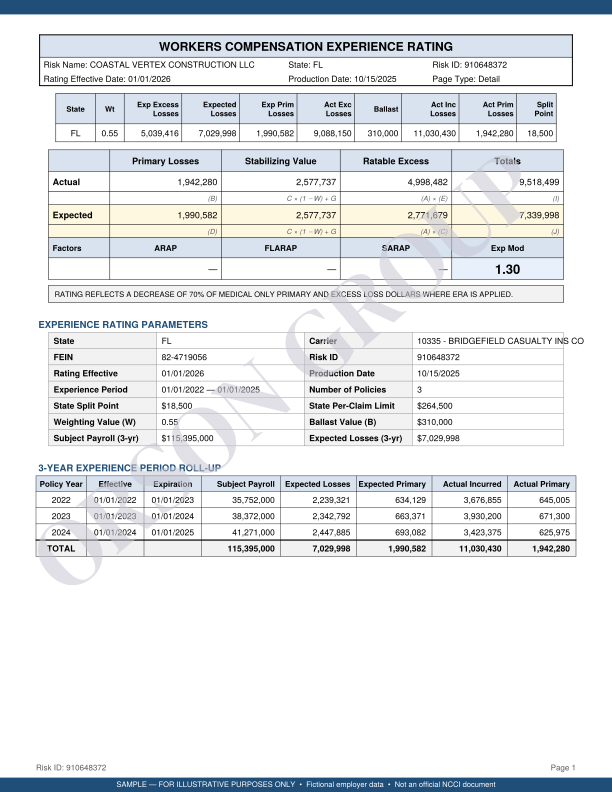
The intoxication defense bars compensation when the worker's own impairment, not a jobsite hazard, caused the injury. Win it, and the claim may never land as a loss on the NCCI (National Council on Compensation Insurance) worksheet that sets your experience modification rate (EMR, the mod). Lose it, or never get the chance to raise it, and a contested claim can shadow that worksheet for three straight rating years regardless of how it eventually resolves.
Four states hand the employer a shortcut, if the paperwork is clean
Florida Statute 440.09 presumes an injury was occasioned primarily by intoxication or drug influence once a qualifying positive test comes back. Run a certified drug-free workplace program, and the law only lets the worker rebut that presumption with evidence there is "no reasonable hypothesis that the intoxication or drug influence contributed to the injury," the exact phrase the statute uses (Fla. Stat. 440.09, 2026). Skip the certification, and the standard drops to clear and convincing evidence, still demanding, but a meaningfully lower bar for the worker to clear (Fla. Stat. 440.09, 2026).
Georgia runs a similar trade on a stricter clock. O.C.G.A. 34-9-17 creates a rebuttable presumption when a worker tests at 0.08 grams or more of blood alcohol within three hours of the accident, or shows any amount of marijuana or a controlled substance within eight hours (O.C.G.A. 34-9-17, 2026). Once that presumption attaches, the worker must rebut it with clear, positive, and uncontradicted evidence. Georgia also pays for the paperwork that unlocks the defense: a program certified by the State Board of Workers' Compensation earns a 7.5% premium credit on top of the legal protection (Georgia SBWC, 2026).
Tennessee ties the same mechanism to its own thresholds. Tennessee Code Annotated 50-6-110 triggers the presumption at a 0.08% blood alcohol level for most jobs, 0.04% for safety-sensitive ones, or a positive drug confirmation, so long as the employer runs a certified program (Tenn. Code Ann. 50-6-110, 2026). A 2011 amendment raised the worker's rebuttal burden from a plain preponderance of the evidence to clear and convincing evidence, and that change is still deciding contested Tennessee files today (Tenn. Code Ann. 50-6-110, 2011).
Alabama does not bother with rebuttable
Alabama goes a step past the other three. Under Alabama Code 25-5-51, a drug test conducted and evaluated to the US Department of Transportation's 49 C.F.R. Part 40 standard is a conclusive presumption of impairment, not a rebuttable one (Ala. Code 25-5-51, 2026). The worker cannot introduce evidence that the test was wrong or that they were not actually impaired; that question is closed. What stays open is causation, whether the impairment, not a bad ladder or a missing guard, is what caused the fall. Refuse the test after a written warning, and Alabama forfeits the claim outright, no presumption analysis required (Ala. Code 25-5-51, 2026).
South Carolina never adopted the trade
South Carolina breaks the pattern entirely. Section 42-9-60 bars compensation for an injury occasioned by the employee's intoxication, but it attaches no presumption to a drug test at all (S.C. Code Ann. 42-9-60, 2026). The employer carries the full burden from the first day of the file, and a positive test functions as evidence, not a legal trigger. Carriers still need something closer to eyewitness testimony that the worker's behavior before the accident looked intoxicated, a standard the state's Supreme Court set almost fifty years ago and that still controls today (Kinsey v. Champion American Serv. Center, 1977). A drug-free workplace program may still be worth running in South Carolina for other reasons. It does not buy a presumption there.
The gap is not academic for a multi-state general contractor. A Georgia crew running the certified program on $400,000 of manual premium collects a $30,000 annual credit before a single claim is ever filed, tied to the same certification paperwork that unlocks the clear-positive-and-uncontradicted-evidence standard on a contested claim (Georgia SBWC, 2026; O.C.G.A. 34-9-410, 2026). Move that same crew onto a South Carolina job, and the certification stops buying anything on the claims side. Price what a single contested claim is actually worth to your renewal with the EMR calculator before assuming a program built for one state protects you the same way in another.
What an audit would check
An audit checks which state's law actually governed the claim, whether the drug-free workplace certification was current and on file with the carrier on the date of the accident, and whether the test that followed met the timing and chain-of-custody standard that state's presumption requires. It also checks whether a contested claim that should have fallen off the worksheet under a winning defense is still sitting there as an open reserve.
These statutes sit in public code books. Whether your worksheet actually applies the right one does not, so put your file in front of us and find out which state's rule really set your last renewal.