Workers Comp Split Point 2027: Why $500 Moves Your Mod
NCCI quietly re-indexes every state's split point each filing cycle, and Colorado's 2027 filing moves it from $14,500 to $15,000. A claim that size swings from discounted excess to full primary weight overnight.

NCCI's split point, the dollar line dividing a claim's primary losses (full weight in the mod) from its excess losses (reduced weight), is indexed annually by state. Colorado's January 1, 2027 filing raises it from $14,500 to $15,000 (NCCI, Colorado DOI, July 2026), about 3.4%. A claim near that line now lands entirely in primary treatment, unchanged.
NCCI doesn't announce a new national split point every year anymore. It quietly recalculates one for each state, folded into that state's ordinary loss cost filing, and most contractors never notice it happened. Colorado's filing for January 1, 2027 is the kind worth noticing. It moves the primary and excess split point from $14,500 to $15,000, filed by the National Council on Compensation Insurance (NCCI) on July 30, 2026 (NCCI filing NCCI-135032459, Colorado Division of Insurance, July 2026).
A $500 shift sounds small next to the filing's headline number, an overall average loss cost decrease of 3.9% for 2027 (NCCI, Colorado DOI, July 2026). But the split point doesn't touch the rate. It touches the mod math underneath the rate, and a claim sitting right at the old line gets reclassified without a single new dollar of loss.
Why the line keeps moving
The split point itself isn't new. What changed on November 1, 2023 is that it stopped being one number. For decades every NCCI-administered state used the same countrywide split point, last set at $18,500 (NCCI Item E-1409, 2023). NCCI replaced that single figure with a state-specific value, calibrated so each state's primary losses land at roughly the same share of total ratable losses, a target D-ratio (the share of expected losses that fall below the split point) near 40% (NCCI Item E-1409, 2023). At the 2023 and 2024 rollout, state values spread from $9,500 in Oregon to $38,000 in Louisiana (NCCI, 2024). A Southeast contractor and a Pacific Northwest contractor were never working off the same primary loss threshold, even when their mods looked similar on paper.
North Carolina's rating bureau adopted the identical methodology that year, filing it as an enhancement to NCCI's Experience Rating Plan (NCRB Circular C-23-3, 2023). Georgia, Alabama, and South Carolina run on NCCI's version directly. The mechanism behind Colorado's 2027 move is the same one working through every Southeast contractor's worksheet, on its own annual clock.
The $300 that changes column
Run the Colorado numbers against an actual claim. A lost-time claim that reaches $14,800 in incurred losses would split, under the old $14,500 line, into $14,500 of primary loss and $300 of excess loss, with that excess layer discounted before it reaches the mod (NCCI filing NCCI-135032459, July 2026). Move the line to $15,000 and the same $14,800 claim, same injury, same medical bills, falls entirely below it. All $14,800 counts as primary loss, at full weight, in the next experience rating calculation.
Nothing about the claim changed. The $500 shift in where NCCI draws the line did. For a Colorado contractor, an EMR calculator can price what a swing like that is worth against a renewal premium. For one with payroll scattered across the Southeast, the number that matters isn't Colorado's $500. It's whatever their own state files next.
By hazard group, not a flat line
The filing doesn't treat every class the same way once a claim crosses the new line, either. Colorado's rating values put the weighting applied above $15,000 at 43.0% for the lowest hazard group and 16.0% for the highest (NCCI filing NCCI-135032459, July 2026). A framing crew and a crane operation can see an identical dollar claim discounted at very different rates once it clears the split point, because frequency and severity move at different paces by hazard class. That detail never shows up in a one-line headline like "3.9% decrease." It only shows up inside the experience modification rate formula itself.
What an audit would check
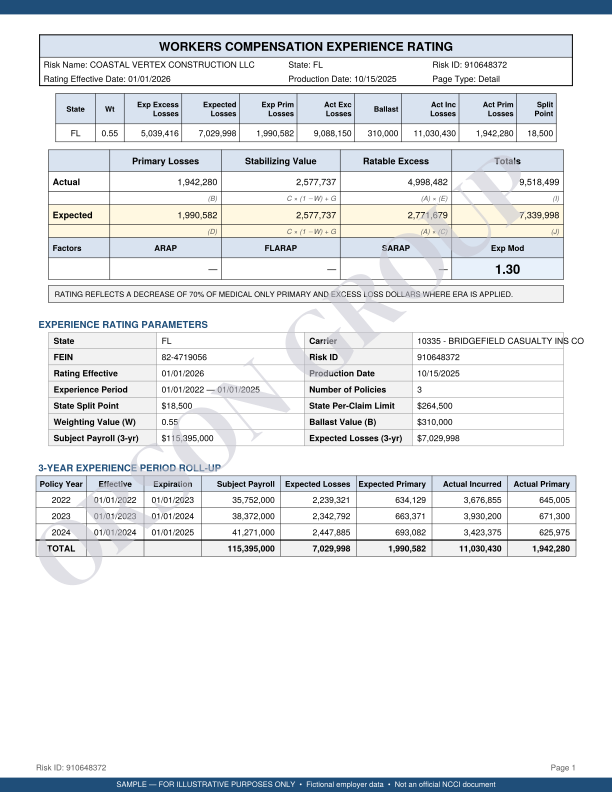
An audit checks whether the worksheet behind a renewal actually reflects the split point filed for that policy year, not last year's figure carried forward out of habit. It checks which open claims sit close enough to the new line that a reserve change could move them across it, and whether the hazard-group weighting applied matches what NCCI actually filed. None of that shows up on the loss cost summary a broker forwards. It only shows up in the worksheet itself.
A worksheet still rated on last year's split point is a different kind of error than a bad claim, and the only way to catch it is to put your file next to the current filing.