Data Center Workers Comp Meets the Memphis Mega-Site
A $30M fall suit at xAI's Memphis site shows the comp structure under the Southeast data-center boom: borrowed staffing crews, stacked subcontractors, and a mod that absorbs the fall.

A $30 million lawsuit over a staffing-agency worker's 25-to-30-foot fall at xAI's Memphis site shows what data-center mega-sites are doing to Southeast workers comp (Shelby County docket, 2026). The South holds 48% of planned U.S. data centers (SACE, 2026). The claim lands on the policy of the employer of record, usually a staffing agency's mod, and reaches the GC's mod when that coverage fails.
A worker supplied by a staffing agency fell 25 to 30 feet at xAI's Colossus site in Memphis. The lawsuit that followed seeks $30 million, punitive damages included (Shelby County docket, 2026). The tort numbers will get the headlines. The workers comp question underneath is the one nobody answered before the loss: whose policy was the employer of record, and whose mod absorbs the fall?
That question is coming to a lot of Southeast job sites, because the buildout behind this fall is the biggest sustained construction labor draw this region has seen in decades.
The boom behind the fall
The South now holds 48% of all planned U.S. data centers, and metro Atlanta carries the largest data-center construction pipeline in the country (SACE, 2026). In the Tennessee Valley, data centers went from 1% of TVA's industrial load in 2019 to 19% last year, with roughly $50 billion in new capital projects queued to serve that demand (SACE, 2026). Duke Energy says data centers drive more than 85% of its expected load growth and is using that forecast to justify 9.7 GW of new gas plants (SACE, 2026).
Nationally, data centers drew 176 TWh, or 4.4% of U.S. electricity, in 2023, with a path to as much as 12% by 2028 (Lawrence Berkeley National Laboratory, 2023). The American Society of Civil Engineers graded U.S. energy infrastructure a D+ and projects data centers will demand 35 GW by 2030, up from 17 GW in 2022 (ASCE, 2025). Simon Mahan, executive director of the Southern Renewable Energy Association, put the strain plainly: "The Southeast is growing fast. Our power needs are growing faster. But our grid is not keeping up." (Capacity, 2025).
Grid stress is an energy story. Labor stress is a comp story. A site that size doesn't hire a thousand electricians; it hires dozens of subcontractors, and the subcontractors borrow crews from staffing agencies that can be smaller than the crane rental.
Whose policy the claim lands on
Experience rating attaches a loss to the policy that covers the worker. If the staffing agency is the employer of record, the fall lands on the agency's policy and the agency's experience modification rate. If that coverage was invalid or never bound, NCCI's experience rating plan and state rules can push the loss up to the general contractor's policy, where it lands on the GC's mod (NCCI, 2026). We have watched a borrowed-labor claim travel that exact path and turn a clean GC worksheet into a renewal problem.
Workers comp is a trade: no-fault benefits in exchange for the worker giving up the right to sue the employer. A $30 million demand with punitive damages tells you someone is arguing the trade never happened, either because no valid policy covered this worker on this date or because the defendants sit outside the comp shield. Either way, the coverage structure failed before the fall did. The same stacking that makes a mega-site fast is what makes the uninsured subcontractor problem expensive.
The mod math of borrowed labor
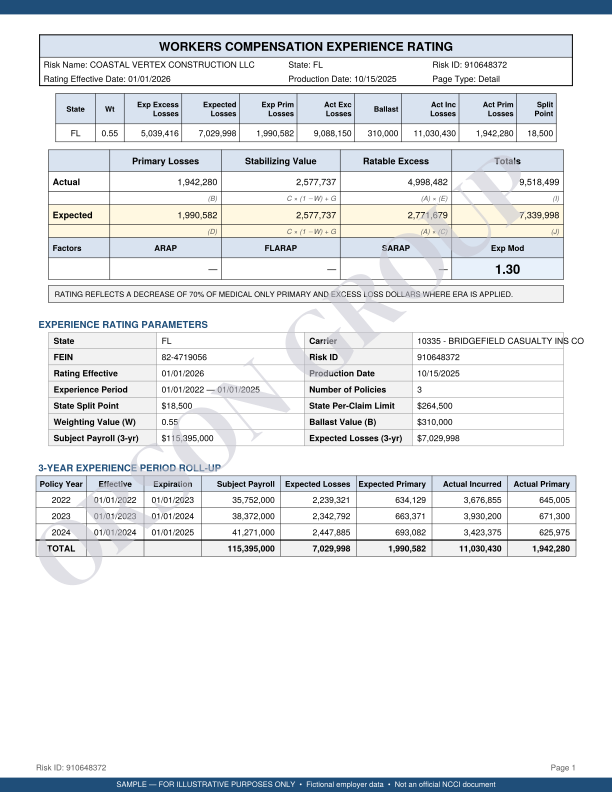
Staffing agencies are small-payroll employers. A serious fall reserve set against a modest expected-loss base can move a small agency's mod from near 1.00 to a number carriers decline to quote, and the claim sits in the rating window for three policy years. The certificates from these mega-sites tend to reach an audit months after the injury, when the only question left is whose mod pays for the fall.
General contractors who verify every agency's comp certificate and pull mod documentation from subs before mobilization are buying something concrete: certainty about where the next loss lands. The alternate employer endorsement is the other lever. It names the GC on the staffing firm's policy so borrowed crews are covered, while the claim still runs through the staffing firm's mod. An EMR calculator will price the distance between a 1.05 and a 1.40 on the same payroll, which is the number that tells you what that certainty is worth.
There is also a timing risk nobody prices. An independent study commissioned by the Southern Environmental Law Center found that regional utility data-center forecasts have roughly a 0.2% chance of materializing (SELC, 2026), and the Southern Alliance for Clean Energy is now calling for an 18-month moratorium on new large data centers across Tennessee, North Carolina, South Carolina, Georgia, and Florida (SACE, 2026). If the pipeline thins, the claims stay. A comp program staffed for peak volume gets to keep the losses after the work does.
What an audit would check
An audit checks whether every staffing agency on the site carried in-force comp coverage on the injury date and whether the certificates named the right entities. It traces the fall claim to the policy that actually absorbed it, then reads that employer's worksheet to see what the reserve is doing before the valuation date locks it into the mod. For general contractors, it separates the claims that belong to your file from the ones you were merely standing next to.
The Memphis docket will sort out the $30 million; send your NCCI worksheet to The Orson Group and find out what your mod says before a loss does the arguing.