Lockout/Tagout Is a Workers' Comp Problem, Not Just OSHA's
OSHA hit ModWash with $446,864 for willful and repeat lockout/tagout failures. The citation is a fine. The amputation claim behind an unlocked machine is a mod problem that runs three rating years.

A lockout/tagout (LOTO) violation and a workers' comp amputation claim are usually the same failure measured twice. OSHA proposed $446,864 against ModWash for willful and repeat LOTO violations in September 2026 (OSHA, September 2026). The average amputation claim runs $125,058 (NCCI data via NSC Injury Facts, 2025), close to OSHA's own $165,514 willful penalty cap.
OSHA didn't need a fatality to make an example out of ModWash. On September 23, 2026, the agency proposed $446,864 in penalties against the car wash chain's Sicklerville, New Jersey locations, most of it for willfully exposing workers to hazardous energy during equipment maintenance (OSHA, September 2026). One willful citation, two repeat citations for missing lockout procedures and training, and five serious citations covering unattached lockout devices and uncontrolled noise (OSHA, September 2026).
Car washes aren't construction sites, but the equipment is the same kind Southeast trades service in-house every week: pumps, conveyors, compressors, skid steers, the paver nobody sends out to a dealer. The citation is a fine with a ceiling. The claim behind the same unlocked machine has no ceiling at all.
A citation and a claim, same failure
Lockout/Tagout (LOTO), the OSHA standard requiring equipment to be de-energized and tagged before anyone services it, ranked third on OSHA's preliminary FY2026 Top 10 list with 1,863 citations, behind only fall protection and hazard communication (OSHA, September 2026). That's down 14.4% from 2,177 the year before, but it has sat in the Top 10 for well over a decade.
The penalty math didn't move either. Maximum penalties stayed at $16,550 per serious violation and $165,514 per willful or repeated violation in 2026, because the Bureau of Labor Statistics never published the October 2025 inflation data OSHA needed for its annual adjustment during last year's funding lapse (OSHA, May 2026). A flat penalty schedule means the citation side of this math hasn't gotten any more expensive. The claim side has.
ModWash's statement after the citation read, "The safety of our team is always our top priority, and we take OSHA's findings seriously" (ModWash, via Patch, September 2026). That's the standard line. It doesn't change what an unlocked machine does to a hand.
The bill OSHA doesn't send
On June 1, 2026, OSHA cited a Georgia Piggly Wiggly franchisee, RBG Foods, $196,251 after an employee lost four fingers in a meat grinder with no lockout/tagout program in place and no report filed within OSHA's 24-hour amputation window (OSHA, June 2026). That penalty is real money for a small operator. It is not the number that follows the business.
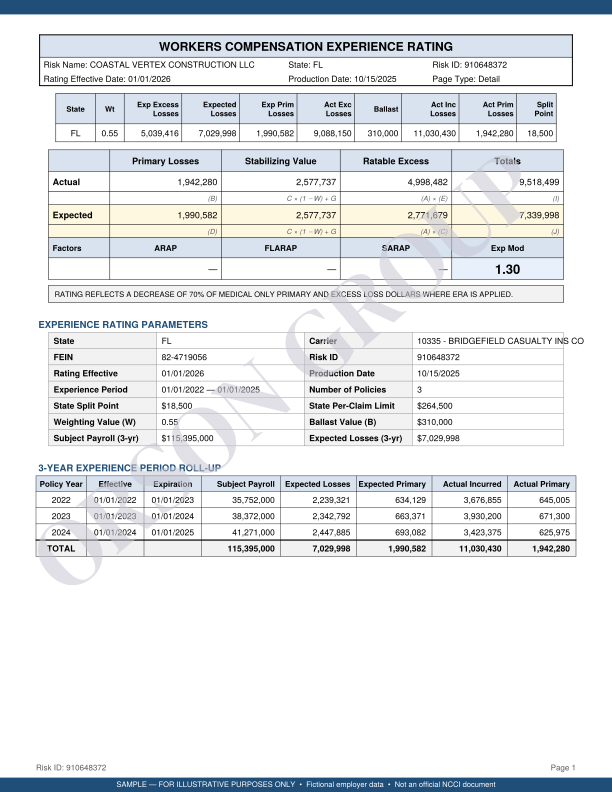
Amputation claims average $125,058, the highest of any injury category NCCI tracks, well above the $68,231 average for other trauma claims (NCCI data via National Safety Council Injury Facts, 2025). Run that against ModWash's own citation: a $446,864 penalty already strains a multi-location operator. Add one amputation claim from the same unlocked equipment and the loss side alone can approach the $165,514 willful penalty cap, on top of the fine, not instead of it. And unlike the citation, that one claim doesn't clear in a single renewal. It sets the mod for three rating years.
Who's actually exposed in the Southeast
OSHA renewed its National Emphasis Program (NEP) on amputations in June 2025, running through June 2030, targeting workplaces where machinery requires energy control procedures (OSHA, June 2025). That program was built for manufacturing floors. The exposure looks the same wherever a crew services its own equipment instead of sending it to a shop: a landscaping outfit servicing mowers in the yard, a paving crew clearing a jammed conveyor, a trucking fleet doing its own preventive maintenance on a lift gate.
Those aren't the contractors OSHA's press releases usually name. They're the ones who never filed a lost-time claim before and don't expect their next renewal to look any different because of it.
What an audit would check
An audit checks whether a contractor's energy-control procedures exist on paper only, whether equipment maintenance happens in-house or at a shop with its own lockout program, and whether a prior near-miss or minor claim already flagged the same machine. It also checks whether reserve and classification data on file reflect that exposure accurately, since a willful OSHA citation and an underpriced mod can trace back to the same missing procedure.
The cost of a bad mod compounds the same way an amputation claim's severity does: slowly, then all at once at renewal. Send your worksheet to an audit before a near-miss on that machine turns into the renewal that sets your mod for three years.