Heat Claims Are Still Comp Claims: Southeast Contractors Before the Next 103-Degree Day
A North Carolina appeals court confirmed a heat-stroke injury is a comp claim, not a lawsuit. Tort immunity protects you in court, not the mod, and one heat claim can drag three years of premium.
Heat-related comp claims are rated like any other injury. A catastrophic heat-stroke claim with hospitalization and permanent disability can carry six-figure reserves and affect your EMR for three rating years. Comp exclusivity can shield an employer from a civil lawsuit, as the North Carolina Court of Appeals held in Moreno v. Florida Orange Gold (N.C. Court of Appeals, 2026), but it does not keep the claim off your worksheet.
In Moreno v. Florida Orange Gold LLC, the North Carolina Court of Appeals upheld summary judgment barring a tort suit by a farm worker left totally and permanently disabled by heat stroke, even though a coworker had died of heat stroke at the same employer in 2020 (N.C. Court of Appeals, 2026). He collapsed on July 19, 2022, after weeding all day with the heat index near 103 degrees (Claims Journal, August 2026). The employer's failure to fully implement its heat plan may have been negligent, the court said, but workers' comp remained his only remedy (Insurance Journal, August 2026).
That ruling matters to your mod. Here is why.
A heat-stroke hospitalization is not a general liability claim. It is a workers' comp claim. It goes on your loss run. It enters your experience modification calculation. And it sits on your worksheet for three rating years, the length of the experience period (NCCI Experience Rating Plan, 2026).
Tort immunity does not protect the mod. The legal shield that prevents a civil lawsuit from a heat injury has zero bearing on how NCCI calculates your experience rating. The difference is that heat claims with hospitalization and disability tend to carry larger reserves than the average construction injury.
The dollar scale of a catastrophic heat claim
A heat-stroke claim with hospitalization, an ICU stay, and permanent disability sits at the severe end of construction injuries. The worker in Moreno was hospitalized for nearly a year and remains totally and permanently disabled (Claims Journal, August 2026). Claims like that routinely carry initial reserves in six figures, and a reserve that size on a mid-sized contractor's worksheet can move the mod several points.
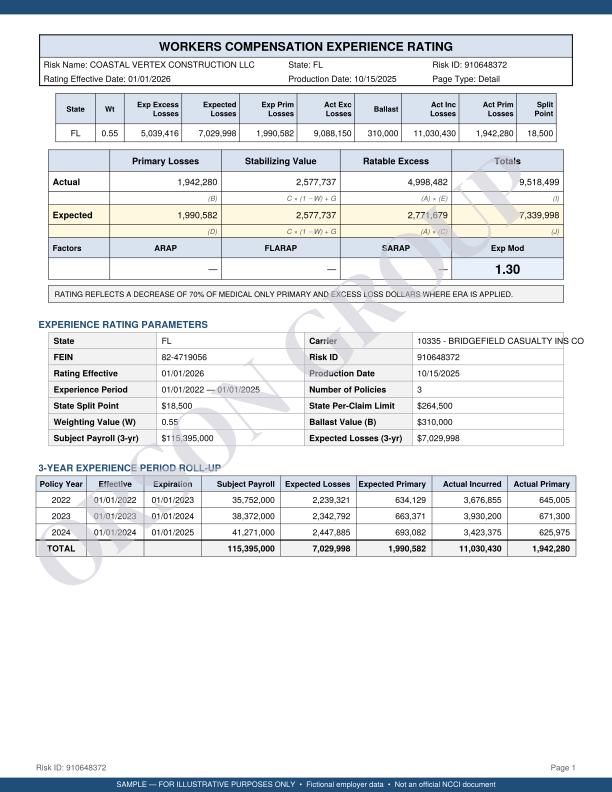
As an illustration: a contractor with a 0.95 mod that takes on a $120,000 heat claim could see the mod climb to 1.05 or higher at the next valuation. On $8 million in payroll at a blended rate of $4.50 per $100, that 10-point swing is roughly $36,000 in additional premium per year. For three years.
The split point determines how much of that claim hits the primary layer versus the excess layer. NCCI sets the split point by state and updates it each year, so check the figure printed on your own worksheet. Loss dollars above it get discounted in the excess layer, but the primary portion hits the mod at full weight. A $120,000 claim still pushes hard.
What carriers and rating bureaus actually look for
OSHA's heat-illness prevention guidance emphasizes written prevention plans, supervisor training, and emergency response protocols. Carriers care about the same things, but for a different reason. They want to see that the employer has controls in place because it signals lower claim frequency and faster claim resolution.
A written heat plan with thresholds for modified work schedules. Supervisor authority to stop work when conditions hit dangerous levels. A buddy system so workers flag symptoms before they become emergencies. An emergency transport protocol that gets someone to the hospital fast. A modified-duty pathway that brings the worker back at reduced capacity instead of letting the claim run open. And quarterly loss-run reviews that catch reserve creep before it lands on your worksheet.
Moreno shows the gap between having a plan and running one. After the 2020 death, the employer adopted a program with training, water, rest breaks, weather briefings, and a buddy system. When the worker collapsed two years later, no one called 911; the company president drove him to the hospital in the bed of a pickup truck, and his body temperature on arrival was 109 degrees (Insurance Journal, August 2026). A plan on paper does not keep a claim off your worksheet.
The reserve problem is the hidden cost
The initial reserve is not the final cost. But it is the number that hits your mod. If a carrier sets a $120,000 reserve on a heat-stroke claim in July, that reserve sits on your worksheet until the claim closes or the valuation date passes. If the claim settles for $60,000, the difference comes back. But the mod was already calculated on the higher number.
This is where most contractors get hurt. They do not know the reserve was set too high or that it inflated the mod. They find out at renewal when the premium quote is $30,000 higher than expected and the broker says the mod went up.
Quarterly loss-run reviews catch this. If the reserve on a July heat claim is still at $120,000 in October and the worker is back on modified duty, that reserve needs to come down. A mod audit checks whether the reserves on your worksheet match the carrier's current claim files.
What an audit would check
An audit checks whether heat claims on your worksheet carry reserves that reflect current claim status, not the initial estimate. It checks whether the claim is coded to the correct classification. It checks whether medical-only claims are getting the 70% reduction the Experience Rating Adjustment gives them in ERA states (NCCI Experience Rating Plan, 2026). And it checks whether closed claims are still sitting open on your loss runs, dragging the mod higher than the actual loss history supports.
If a summer heat claim is about to land on your next worksheet, send us the worksheet before the valuation date and see what that reserve is really costing you.