How to Lower Your EMR: The Four Levers That Move a Mod
Most advice on lowering an EMR starts and ends with safety. Safety is one lever of four, and it's the slowest. The other three work on claims you already have.
You lower your EMR by changing the losses the formula counts: fewer claims, claims that stay medical-only, reserves that match what claims will really cost, and a worksheet free of reporting errors. Safety works slowly because the mod looks back three policy years. Corrections work fastest because a wrong number can be fixed now, even retroactively.
Ask how to lower your EMR and you'll hear one answer: run a safer shop. It's true, and it's incomplete. Safety changes the claims you haven't had yet. Your current mod is built from claims you've already had, and three other levers act on those.
An experience modification rate, also called an X-Mod or e-mod, compares your actual losses to the losses expected for a business of your payroll and classifications. Every way of lowering it comes down to the same thing: the actual-loss side of that comparison gets smaller, or the expected-loss side gets corrected. Here's how each lever does that, and how long it takes.
Lever one: fewer claims, and why it's slow
The formula punishes frequency harder than severity. Each claim is split at a state-specific threshold, and the portion below it counts at full weight while the portion above is discounted. Ten small claims do more damage than one large one of the same total cost. So a safety program that prevents ordinary injuries does more for a mod than one aimed only at catastrophes.
The catch is the calendar. The mod uses three policy years of history and skips the most recent one, so a claim stays in the calculation for three renewals. A safer year starts helping about a year after it ends, and it takes three clean years to flush an old bad one. Safety is the right long game. It can't fix the renewal in front of you.
Lever two: what kind of claim it becomes
An injury is not finished being priced the day it happens. Whether the worker loses time beyond the state waiting period decides how the claim is coded, and a medical-only claim is discounted by roughly 70% in the mod formula. Same injury, same medical bills, a fraction of the mod impact.
That's the lever a return-to-work program pulls. Keeping an injured employee working in a modified role changes which bucket the claim lands in, and it shortens the claim's life while it's at it. This lever acts on claims as they occur, so its effect shows up in the same three-year window as lever one, but it's available on every single injury.
Lever three: what the claim is valued at
Your mod doesn't count what a claim has cost. It counts what the carrier has paid plus what the adjuster has reserved for the future, as of the valuation date. A reserve is an estimate, and estimates go stale. A claim that's healing well can carry a reserve set on its worst day, and that reserve is in your mod at face value whether the money is ever spent or not.
This lever is faster than the first two because it acts on open claims already inside the experience period. A reserve that comes down before the valuation date never enters the calculation at its inflated figure. Timing is the whole game here, and most contractors only learn the valuation date existed after it passed.
Lever four: whether the worksheet is right
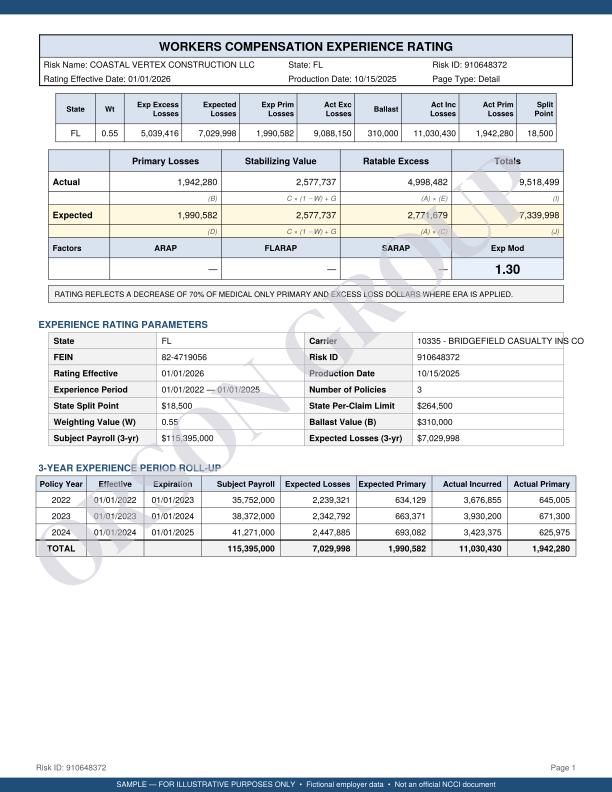
The first three levers assume the worksheet is accurate. Often it isn't. The rating bureau calculates your mod from data the carrier reports, and nobody audits that data on your behalf. Claims land on the wrong employer. Closed claims keep reserves they never paid. Payroll sits in the wrong classification, which shrinks expected losses and makes ordinary experience look bad. A recovery from a third party never gets credited back.
This is the only lever that can lower a mod that's already been issued. A correction is not an appeal: when the data is shown to be wrong, the bureau re-runs the number, and the revised mod can reach back into policy periods the error touched. It's also the only lever that costs nothing in operations. Nobody has to work differently. The number just has to be right.
How far down can it go
Not to zero. Every employer has a minimum mod, the figure the formula would produce with no claims at all, and it's set by your payroll and classifications. The distance between your current mod and that floor is the most any combination of levers can recover. A small contractor may have only a few points of room. A larger one may have thirty.
Knowing that distance changes the question. It stops being whether your mod is good and becomes how much of the gap is real experience and how much is stale reserves and bad data.
What an audit would check
An audit checks the fourth lever first, because it's the one that pays immediately: the worksheet against current loss runs, claim coding, reserve values at the valuation date, and the payroll and classifications behind expected losses. What survives that review is your real experience, and the first three levers are how you work on it. Send us your experience rating worksheet and we'll review it for free.