September 29, 2026 · Claims & Severity
Workers Comp Reserve Discipline Sets Your Mod
Rising Medical's 13th Benchmarking Study found 57% of top claims performers use analytics versus 34% of laggards. Your mod inherits that gap for three rating years.

Vol. III · No. 40· The Mod Report
Timely analysis of NCCI releases, state filings, rate changes, and what current industry data means for contractors renewing this year.
Rising Medical's 13th Benchmarking Study found 57% of top claims performers use analytics versus 34% of laggards. Your mod inherits that gap for three rating years.
Fall protection tops OSHA's FY2026 list at 4,041 citations, the 16th straight year, and five construction standards fill half the Top 10. The mod consequences outlast the citations.
Five Southeast states filed 2027 comp decreases and Tennessee went the other way. When the market hands every contractor the same cut, the mod spread becomes the only lever that separates bidders.
Bennett's $8.55M judgment shows Georgia's new trial sequence still admits injury facts in the fault phase. That matters while workers' comp cuts and umbrella pricing head opposite ways.
A NY abatement contractor owed $163,561 in premium after a license database match, not an audit. Florida's $100M certificate ring shows where this heads next for GCs.
NCRB filed an 11.7% contracting loss-cost cut and a 15.3% residual cut for April 1, 2027. The catch: expected losses refile too, so the mod can give part back.
A Tennessee court ruling on disputed causation shows why broad medical releases and early claim decisions move your mod long before reserves harden. A $75K premium contractor can see 5 to 15 points of swing.
No fresh NCCI or NCRB filings this week. That doesn't mean your premium is standing still. One lost-time claim can erase a statewide loss-cost cut for a $1M payroll contractor.
Florida AG seized $2.4 million from a ring processing nearly $100 million in payroll through shell construction corporations using rented WC certificates. A GC with clean reporting can still absorb the EMR damage.
A North Carolina court ruling on heat-stroke liability and OSHA's 2024 fatality data show why tort immunity does not protect your mod. A single catastrophic heat claim can drag three rating years of renewal premium.
New Jersey's $2.775 million STG Logistics settlement shows how 1099 misclassification creates three costs at once: back premium, uninsured subcontractor charges, and a distorted experience mod that haunts renewals.
NCCI's June 2026 medical inflation read came in at 1.0%, well below trailing averages. Don't mistake temporary trend relief for a durable mod improvement. Your 2027 worksheet still carries the claims that actually move.
OSHA's federal heat rule passed committee on July 23 but faces a Senate floor fight. Southeast contractors can't pause heat safety programs while the rule is in limbo. Heat claims still hit loss runs and drive future m.
South Carolina pushed 52 employers into compliance in June, covering 307 workers who were previously uninsured. For contractors, that is a payroll audit warning, not clerical noise on active jobs.
OSHA proposed $343,797 after a Blazey Construction trench collapse hospitalized a worker. The citation is public, but the EMR story follows renewal and bid conversations after the trench is backfilled.
Palm Beach court records allege $9.42 million of concealed payroll behind real-looking certificates. For construction CFOs and controllers, the lesson is blunt: a COI is paper, not payroll proof.
A Florida Supreme Court ruling on July 9 revived a workplace-shooting claim and widened when an assault counts as work-related. One $150,000 assault claim can push an otherwise clean contractor mod past 1.00.
Tennessee's 25% bad faith penalty plus attorney fees under TCA 56-7-105 makes wrongful claim denials costly for carriers. For contractors, disputed claims drag reserves and mods for years.
Florida's Three-Member Panel keeps raising what carriers pay for outpatient and ASC surgery. Surgical reimbursement already hit 210% of Medicare, and every extra dollar of medical lands on a contractor's mod.
Four deaths in two years at a Georgia postal center traced to dead cell zones and delayed EMS. On a remote jobsite, one catastrophic claim can hold your mod above 1.00 for three renewal cycles.
Heat illness claims rise at least sevenfold above 90 degrees, and construction takes 21% of them. One lost-time case sits in the primary loss layer for three rating years, moving a $50,000 account by real money.
OSHA fined three employers $3.52 million for one Houston spill cleanup. The citations never touch a mod. The injured workers behind them are the exposure contractors miss.
WCRI's 2026 index shows Florida workers' comp medical prices up 41% in a single year. That fee schedule reset lands on open reserves, and open reserves are what your mod is built from.
A Tennessee contractor left bonuses out of overtime and owes $1.73 million. The same payroll mistakes that trigger a DOL case quietly inflate your workers' comp premium first.
NCCI's June 23 MDCRC agenda puts utilization, wages, treatment patterns, and comorbidities in one frame. Contractors won't see that first in rates. They'll see it in reserves.
A June Texas fall case landed at $973,522.24. Florida's contractor rule is blunter: missing subcontractor coverage can move the claim upstream.
South Carolina's 2026 loss cost filing moved only −0.4%. The louder signal is operational: one commission seat is open while 11 Richland hearing dates keep moving through August renewals.
NCCI's June 16 dashboard gives carriers a cleaner construction yardstick. A contractor with $500,000 in manual premium has $50,000 riding on a 0.10 mod gap.
NCCI's new ASB shows 2025 premium-level cuts in Alabama, Florida, and Georgia. A 0.16 EMR move on $250,000 of manual premium can still turn the renewal higher before carrier credits.
Koren did not make psychiatric treatment payable. It showed how a vague authorization can leave a claim file cloudy long before the unit-stat date.
Thigpen involved a 16-year-old, three weeks into the job, operating a compactor on a four-foot pad. That is not just a safety story. It is mod exposure.
NCCI still shows a 91% calendar-year result, but the 102% accident-year number is the timer. SE contractors have one or two renewal cycles to lock cleaner terms.
Florida roofers are hearing two renewal stories at once: statewide rates are down, but voluntary-market access is thinner and assigned risk can still punish the file.
A cleaner jobsite in 2024 may not lower the mod until 2026 or 2027. The delay is built into NCCI's reporting calendar, not your carrier's mood.
Florida's new workers' comp fee schedule is no longer just a rate-filing story. Enlyte's 2026 data shows higher bill payments flowing into claim values.
Carriers are pulling back from staffing workers' comp. For Southeast contractors using temp labor, the weak link may be the policy behind the certificate.
Enlyte's 2026 data shows behavioral health comorbidities nearly quadruple workers' comp medical costs. For construction contractors, that's a mod problem no safety program can fix.
First-year construction workers drive 47% of claim costs, and the Southeast is on a hiring surge. The mod impact from every new crew member is predictable, and it isn't small.
WCRI data shows workers' comp pharmacy costs per claim rose 24% since Q1 2022. Topical dispensing markups and CGRP migraine drugs are the new cost drivers, and they flow straight into your mod.
A Massachusetts temp agency hid $6.1 million in payroll from its workers' comp carrier. The contractors whose workers got hurt on those jobs will feel it in their mods for years.
A Georgia construction worker dies on an Alabama jobsite. The employer's mod impact hinges on which state's split point applies. Most multi-state contractors don't know the difference.
OSHA's revised Heat NEP has an 11-point inspection framework most contractors aren't ready for. The documentation gaps feed claims that inflate your e-mod for three years.
Travelers analyzed 1.2 million claims and found first-year construction workers drive 44% of injuries and 47% of claim costs. That concentration reshapes your mod.
OSHA fined a Huntsville builder $115K after a December trench collapse killed a worker. The penalty is a footnote. The three-year EMR spike is what changes a contractor's insurance future.
OSHA's 80°F inspection trigger and WCRI's sevenfold claim surge converge on the same thermometer. For Southeast contractors, June through September is a four-month window where both land on the mod worksheet.
Two Georgia work zone deaths in five days show why a single fatality reshapes your mod for three consecutive renewals. Subrogation recovery is the lever most contractors miss.
SC just added stroke to its firefighter presumption, joining a Southeast-wide cost trend. The ripple reaches contractors who never set foot in a fire station.
Travelers data shows workers 60 and older miss 97 days per injury versus 80 overall. Construction medical severity is up 13%. Your mod formula carries both for three years.
The NC Industrial Commission flagged a fraud scheme targeting Spanish-speaking injured workers. The real EMR risk isn't the scam itself; it's what happens when workers stop trusting the claims process.
NCCI's experience rating adjustment modifies how the formula treats smaller accounts. Many contractors don't know the ERA exists, and it can cap the mod movement in ways that are both a surprise and an opportunity.
NYSIF added a 10% WC premium credit for heat illness prevention equipment in construction, capped at $1,000 per year. The credit is narrow. What it signals about how carriers are pricing heat risk is broader.
NCCI's 2026 State of the Line shows construction lost-time frequency down 40% since 2015. Medical severity up 13% in the same year. The mod formula sees both, and one is running faster than the other.
WC reserve redundancy fell to $14 billion in 2025, from $16 billion the year before, the second consecutive year of decline. That cushion is what has kept calendar-year results favorable. As it thins, the math changes.
Two Alabama trench enforcement actions, $286,000 in OSHA fines. CB&A got $170,145 willful; Breland got $115,855 after a fatal collapse. The fines are visible. The WC claims that follow are what move the mod.
NIOSH data: 70% of fatal construction falls occur at firms with 10 or fewer employees. Many have a 1.00 mod not from a clean record, but because their premium is too small for NCCI to generate one.
OSHA's revised Heat National Emphasis Program, effective April 10, 2026, covers 55 industries through 2031. Construction is on that list. A heat citation and a WC heat illness claim start from the same temperature.
WC claim frequency in construction rises roughly 10% on peak heat days. Two or three additional heat claims hold the mod elevated for three years. The prevention ROI runs differently than most contractors calculate.
Two carriers, the same workers' comp line, a nearly 8-point gap in combined ratios. Hanover posted 85.4% ex-cat. AMERISAFE landed at 93.2%. That divergence tells you something about where renewal pressure is heading.
Tennessee's +4.8% order looks like the loss trend turning. It's the medical fee schedule passing through, and net of March's cut, 2026 ends near +2.7%. Your renewal date sets the bill.
Florida and Georgia make the GC jointly liable when a sub carries no coverage. The claim pays like the GC's own, rates like the GC's own, and sits in the mod for three policy years.
Crum & Forster's new admitted wrap-up product puts CCIP papers in front of more Southeast subs. Wrapped payroll leaves your unit stat report; the tail and re-entry don't leave you.
Liberty Mutual puts lower-level falls at 26% of construction comp cost. Safety budgets built around incident counts misprice the hazard; loss dollars say height deserves first claim on prevention capital.
WCRI puts most states at 4% to 8% annual medical growth, while North Carolina proposes a lower 2027 carpentry ELR. Rising claims against a shrinking benchmark can lift the mod twice.
The Athens auger amputation is not just a claim severity story. The 24-hour OSHA reporting trigger gives underwriters a file before the three-year mod math catches up.
The Alabama Governor's Safety and Health Conference kicks off in September 2026. If your safety program lives in a binder of conference notes, your mod is exposed. A single lost-time claim on a $500K payroll adds 0.08 .
A Massachusetts court let a GC walk on tort liability for a subcontractor's fatal fall. The EMR impact still hit three policy years. Here is what Southeast contractors should document before and after the claim.
NCCI's WCWMI fell to 1.0% in June 2026, but the index is expected to climb back toward 2.0% to 2.5%. For construction contractors, one severe lost-time claim still dominates the mod regardless of aggregate price relief.
NCCI's 2026 Southeast filings show rate decreases of 6.6% in Alabama and 7.1% in Florida. Your premium can still rise. The mod on your worksheet decides whether the cut reaches your renewal.
A Kentucky appellate ruling shows that assigned-risk premium disputes are won with contracts, classification language, and payroll records, not general rate complaints. A $500K payroll swing can mean $15K to $40K.
An Alabama appellate decision clarifies that paying medical or TTD early does not concede compensability. But the claim file must reflect it, or the mod absorbs the cost.
Travelers' 2026 data shows first-year employees produce 37% of injuries and 44% of construction injuries. For a $500K-payroll contractor, one $35K lost-time claim can move the mod 15 points and cost bid eligibility.
A July 2026 cancellation case turned missed payroll records into a denied claim. For construction CFOs, the audit file is a coverage control.
OSHA's July 13 release put $299,569 on the front page. The larger bill may arrive later, when fatal claim reserves move through the mod and underwriting file at renewal.
Palm Beach records show how $167,906 to $414,614 of allegedly avoided premium can become a bid advantage. Honest subs do not lose only to better crews; sometimes they lose to missing insurance cost.
OSHA's Focus Four drive nearly 60% of construction deaths, and each maps to a severe lost-time claim. Falls caused 389 of 1,034 fatalities in 2024, the severity that moves your mod on bid day.
A posted panel is a cost-control lever, not a compliance poster. McCray shows how a gang box mistake shifts medical control and lands on your mod three years later.
Massachusetts regulators ordered a 14.6% workers' comp cut, then a court told them to show their math. A statewide average still isn't what any single contractor pays.
Florida raised physician reimbursement to 175% of Medicare and is rewriting its billing rules this month. Every dollar of medical severity that follows lands on your mod for three years.
A frozen shoulder caught late runs $75,000 and up (WorkCompCentral, July 2026). The lag between injury and first report is a controller's number, not an HR footnote, and it lands on your mod.
A February appeals ruling and a July 15 rule hearing quietly reset what Florida carriers pay for physician-dispensed drugs. The leak shows up three years later, in your mod.
North Carolina just doubled its disfigurement and organ-injury awards, effective July 1, 2027. It isn't a rate filing, which is why the contractors most exposed to severe claims are the ones most likely to miss it.
Public Chapter 845 gives unreasonable denial a price tag for injuries from July 1, 2026 through June 30, 2030. On Tennessee jobsite claims, the money problem starts before the hearing.
Florida's 2025 report puts Code 5606 in the top 10 by policy count. The title sounds simple; the supervision test is where audit bills start.
Jencap's June 18 construction warning points to the right problem: fewer claims aren't enough. NCCI and WCRI severity data show how a 0.10 mod move can erase a 5% loss-cost cut.
South Carolina's June 17 bench order puts AI claim work on the record. For contractors, the risk is not the tool. It is the claim fact that gets repeated.
NCCI's June IRRWG agenda points at the quiet problem behind one catastrophic construction claim: the formula softens severity, but renewals still feel it.
WorkCompCentral called the federal heat rule "limbo" on June 15. Florida contractors still face lost-time claims, General Duty Clause citations, and schedule disruption when crews work through summer heat.
HB 315 doubles several North Carolina scheduled-injury caps starting July 1, 2027. The dollar change is narrow, but the reserve signal matters for contractors with hand and arm claims.
CPWR's 2026 dashboard shows construction had 25 of 48 heat fatalities in 2024. OSHA sees the hazard. Your mod sees the claim for three renewals.
North Carolina's subcontractor rule is blunt: no proof of coverage means additional premium. On $5 million of uninsured sub payroll, an $8 rate becomes $400,000.
OSHA's heat enforcement record looks modest until a serious illness or fatality occurs. The written plan is where inspectors start, but the workers' comp worksheet is where the cost can linger.
Travelers puts construction at 114 lost workdays per indemnity claim. That makes EAP integration a claims-duration issue, not an HR perk.
Your 2026 renewal may still look friendly. The data under it is less friendly, especially for construction accounts heading into 2027.
Florida approved its ninth straight workers' comp rate cut for 2026. The statewide number is 6.9% lower. For roofers and other high-hazard trades, the savings may never arrive, and the reason isn't the rate.
WCRI CompScope 2026 data shows Florida claimant attorneys involved in 41% of workers' comp claims. That 10-point gap above the national median feeds directly into inflated reserves and higher mods.
The Escobar Plastering case ended with federal prison. The mod damage it caused general contractors across Orlando is still sitting on their worksheets, three years deep.
WCRI's 2026 Medical Price Index shows WC medical costs rising faster than the price index alone predicts. For Southeast contractors, that gap compounds inside your mod.
Two Tennessee rulings split exclusive remedy into two lanes: one that shields GCs using staffing labor from tort suits, and one that doesn't. Your mod is in play either way.
WCRI CompScope data shows Florida workers' comp costs per claim up 5% in 2025. The fee schedule jumped, the claims data followed, and your experience mod absorbs the impact before filed rates adjust.
A $101 million Henderson County verdict shows how third-party recoveries stall inside the NCCI experience rating system, costing contractors years of inflated mod and excess premium.
WCRI's 2026 drug study shows physician-dispensed topicals dominate WC prescription costs. The impact hides inside medical-only claims, where inflated totals erode the 70% discount protecting your mod.
Tennessee's SB 1579 targets ghost WC policies that report $0 payroll. When a sub's zero-exposure coverage fails, the claim lands on the GC's worksheet and inflates the mod for three years.
WCRI data shows heat-related illness claims jump sevenfold at 90°F. Construction takes 21% of those claims, and most land squarely in the primary loss layer that drives your mod.
California's WCIRB just filed for its second straight double-digit workers' comp rate increase. The severity trends behind it aren't staying in California, and your next SE renewal will reflect that.
NCCI's latest data shows workers' comp at a 91% combined ratio, but the accident-year number landed at 102%. For contractors approaching renewal, that gap tells the real story.
Colorado is the first state to give employers the right to force e-mod corrections when claims close below reserves. You don't have to wait for your state to catch up.
NCCI's Classification Inspection Program examines thousands of contractor payrolls each year. The reclassification rate tells you something about how stable your own codes are.
WC medical costs rise at 6% per year. Unit prices grew 2.5%. The gap is friction: utilization review costs growing 28% annually, case management, and administrative overhead that stacks on every open claim.
When a carrier recovers claim costs from a subcontractor's policy, does that recovery reduce the general contractor's actual losses on the NCCI worksheet? The answer depends on timing and the source of the recovery.
NCCI's 2025 release puts workers' comp at a 91% combined ratio. Still profitable. The accident-year number tells a different story, and it's the one that drives renewal pricing.
Workers' comp has delivered rate decreases for over a decade. Net written premiums fell 0.2% in 2025 while the accident-year ratio crossed 100%. The rate turn conditions are forming. That window matters for your mod.
Travelers' 2026 report: 44% of construction WC injuries involve first-year workers. Those workers miss 114 days on average, the most of any industry. Both numbers sit directly on your mod worksheet.
NCCI extended expected loss rates to three decimal places on January 1, 2026, across 38 states. Three decimal places sounds like an administrative rounding detail. In the EMR formula, it isn't.
NELP estimates misclassification costs $20,399 per worker annually. When a misclassified construction worker is injured, the uninsured claim can reach the GC policy and experience worksheet.
WCRI's 2026 CompScope benchmarks show WC costs growing at 6% per year across 18 states, Florida and North Carolina included. That's not just a trend. It's the input that recalibrates your next experience rating.
A $30M fall suit at xAI's Memphis site shows the comp structure under the Southeast data-center boom: borrowed staffing crews, stacked subcontractors, and a mod that absorbs the fall.
NCCI monitored 1,102 workers comp bills in 2026 and Georgia joined the portable benefits column. Southeast contractors running on 1099 subs just got a safe harbor, and premium audits got a new question.
Tennessee's only loss cost increase in our footprint lands Oct. 1: +4.8%, law-only, after March's −2.0% cut. Same contractor, same payroll, roughly $3,600 apart by renewal date alone.
Florida's Division of Workers' Compensation finalized the rule on September 2, striking the language that let physicians dispense. The drug channel changes; the disputed dollars still sit in your mod.
Ivans shows workers comp renewals at −1.10% in August, up from −1.73% in Q1. The rate discount is fading, and the mod is the only lever that keeps paying after the cycle turns.
NCCI's 7.4% Florida filing is a statewide average, not a bid input. Until the class pages surface, construction estimators should treat it as a headline, not earned margin.
Steris is building a $600M, 600,000-sq-ft facility in North Carolina. For the contractors landing that work, rapid payroll growth can move the mod and the premium in ways the bid never modeled.
A West Virginia heat-syncope ruling and OSHA's Region 4 enforcement push show how one preventable heat illness becomes a three-year mod problem. One $35,000 lost-time claim outweighs dozens of medical-only incidents.
A $25,000 reserve swing on a single claim can move your mod enough to shift annual premium by five figures. The claim isn't closed until the court says it's closed.
A Tennessee employee sought $562,783.85 in unauthorized medical bills. The Appeals Board said fee schedule rules. But the claim still hits your mod for three years.
WCRI's July 2025 FlashReport finds 44 states plus D.C. use fee schedules, but services outside fixed reimbursement can push reserves before unit-stat and inflate your mod for years.
OSHA hit Orchids Builders with $349K in July 2025 penalties for repeat fall-protection violations. The citation fades. The experience rating drag runs three years and costs more than the fine.
OSHA's database refreshes daily, and Florida construction already shows 848 NAICS 23 inspection rows for 2026. That public record can quietly move renewal terms before the mod moves.
The Fourth Circuit kept South Carolina's OSHA penalty fight alive only procedurally. The bigger contractor cost is the lost-time claim that can follow bids for three mod years.
NCCI's July snapshot says hiring is running at 114K jobs a month in 2026. For construction CFOs adding crews, the EMR bill arrives quietly after the backlog rush.
Tennessee's July 10 update raised the TTD cap to $1,488.30 and widened fee exposure. For contractors, the danger is the reserve still open when first valuation arrives.
OSHA's July 1 Federal Register notice put $12.8 million in Susan Harwood training grants on the table. The real return isn't the grant money. It's the claim that never becomes a mod charge.
South Carolina held its 2026 medical conversion factor at $52.00. That's a price story. Your experience mod runs on severity, and severity is what a frozen fee schedule doesn't touch.
A Tennessee robbery claim just drew a procedural ruling. The financial lesson for Southeast contractors: one contested lost-time claim can add up to 0.15 to a mod and roughly $37,500 a year.
SCWCC quietly reworked its hearing playbook in June 2026: an AI bench order, a revised decision template, new Richland dates. A hearing is where indemnity, and your mod, get set.
NCCI's new telecommuter class code lands July 1, 2026. For contractors it re-applies the strict clerical test to the home office, where one misread can move a $250,000 payroll off a 0.25 rate.
Two Massachusetts roofers were indicted this summer for booking roofing crews as siding workers and painters. The premium gap that tempted them runs six figures on a single job, and the audit finds it.
North Carolina just doubled its serious disfigurement and organ-injury caps to $40,000, effective July 2027. The reserve swing on one severe claim can move your mod before the loss run catches up.
CWCI found unlisted professional-code payments grew to 14.4% of professional service payments. That leakage can sit inside reserves until it reaches your EMR.
HB 315 doubles North Carolina's key disfigurement and organ-injury caps in 2027. The premium effect may lag, but severe-claim reserves will not wait politely for the next rate filing.
McCray turns a taped-up gang box panel into a mod problem. In Georgia, physician control can fail before the shoulder claim gets priced.
OSHA's June 2026 stand down put trench work back on the calendar. The fine gets noticed, but the claim coding is what follows your mod.
Taylor v. Argos did not kill light duty. It showed where thin offer records turn into extra TTD, reserve pressure, and a worse mod story.
Bristol's 2026 asphalt bid makes workers' comp coverage a responsiveness issue. One owner exclusion or stale subcontractor certificate can end the bid before safety gets read at all.
Thigpen shut down the tort suit, not the risk. A 16-year-old's compactor death still points straight at OSHA reporting, owner scrutiny, and the mod.
Ivans shows workers' comp renewals down 1.31% in May. That can make EMR creep look harmless, right when NCCI's reserve cushion is shrinking.
South Carolina's Burnstein Von Seelen case moved undocumented labor from a paperwork issue to a prosecution issue. For GCs, the exposure chain runs through workers' comp, COIs, and management liability.
ANV's June 2026 workers' comp acquisitions show where hard-to-place construction accounts go when standard carriers stop competing.
A fake COI can pass prequalification and still turn into payroll on the GC's own workers' comp audit. The bill usually arrives after the job is done.
Sprains, strains, and shoulder claims don't look like boardroom events. On an experience rating worksheet, they can do more damage than the rare catastrophic loss.
Loss costs are falling across the Southeast for 2026. Most contractors still won't see a smaller bill, because wage growth is inflating the one number a rate cut can't reach.
NCCI's 2026 State of the Line data shows construction medical severity spiked 13% in Accident Year 2024. That's the worst of any industry, and it hits the mod formula where it hurts most.
WCRI's 2026 data puts Alabama at 471% above Medicare for outpatient surgery, the highest of any state measured. That $28,713 per-case gap hits your experience rating worksheet as actual loss dollars.
June through September drives more construction lost-time claims than any other stretch. Heat, new hires, and rising severity converge, and the mod formula counts every one.
Everest sold $2 billion in commercial renewal rights to AIG, including a sizable workers' comp book. Your mod doesn't change when carriers do, but your claim handling might.
NCCI's 2026 comorbidity data shows diabetes quadruples medical costs on WC claims. With 4.8 million losing ACA coverage, construction's uninsured gap is about to hit your mod.
NCCI's workers' comp reserve cushion fell from $16B to $14B. The accident-year ratio crossed 102%. For SE contractors, the soft market won't last, and the mod you carry into the turn matters.
Florida's two-clocks ruling changed how long a claim can stay open. It didn't add dollars to your loss run. It added months of reserve life, and that hits your experience mod at the next valuation date.
ENR's 2026 Top 400 survey shows most contractors can't fill craft positions. When you hire fast to keep pace, your injury frequency rises. So does your mod.
Six inspectors for 60,000 workplaces. A 186-year inspection cycle. OSHA's staffing collapse means the regulatory backstop most contractors assumed existed never shows up, and your mod doesn't care why.
94% of contractors report unfilled craft positions. When the labor gap pushes inexperienced workers into high-hazard roles, claim severity rises, and those losses land directly on your mod worksheet.
AGC data shows construction input costs up 6.6% while bid prices lag at 3.6%. The margin squeeze doesn't just hit the P&L. It shows up in your claims, then in your mod.
NCCI's Paul Hendrick called it in one sentence: GLP-1 drugs are bringing obesity rates down. For a line of insurance where obesity is the costliest comorbidity, that's not a health story. It's a pricing story.
NCCI's AIS 2026 data shows lost-time claim frequency fell 2% in 2025 while severity rose 4%. Contractors see fewer claims and expect a better mod. That's not always how the formula works.
Lucy Suarez of EliteOne Solutions faces five felony fraud charges for issuing fake WC certificates in Dalton, Georgia. When a sub's coverage is fraudulent, the claim exposure doesn't stay with the sub.
General contractors who self-perform often allocate all payroll to a single governing code. NCCI's rules require a split. The mismatch can inflate premium and the mod.
Loss cost filings across the Southeast for 2026 show a split picture. Some states are down again. Others have stopped falling. The direction shift by state matters more than the regional average.
Escobar Plastering sold fake WC certs to FL construction subs for a decade. $148.8M in payroll, $14M in insurer losses. When a covered sub wasn't covered, the claim lands on the GC.
OSHA's revised Hazard Communication Standard hits its first deadline May 19, 2026. HazCom is the second-most-cited OSHA standard. In construction, a citation and a WC chemical injury claim can start from the same gap.
68.9% of fatal construction falls happen at specialty trade subs. That's where exposure concentrates, and where sub management intersects with your experience rating in ways most contractors don't track.
Florida's 1st DCA overturned 26 years of WC statute precedent in March 2026. The Estes ruling extends claim windows. If you have open FL claims inside your experience window, the reserve math may have changed.
North Carolina eliminated size-based penalty discounts for workplace fatalities on April 29, 2026. A small contractor facing a willful fatality citation now owes $165,514 per violation where it used to owe roughly $50K.
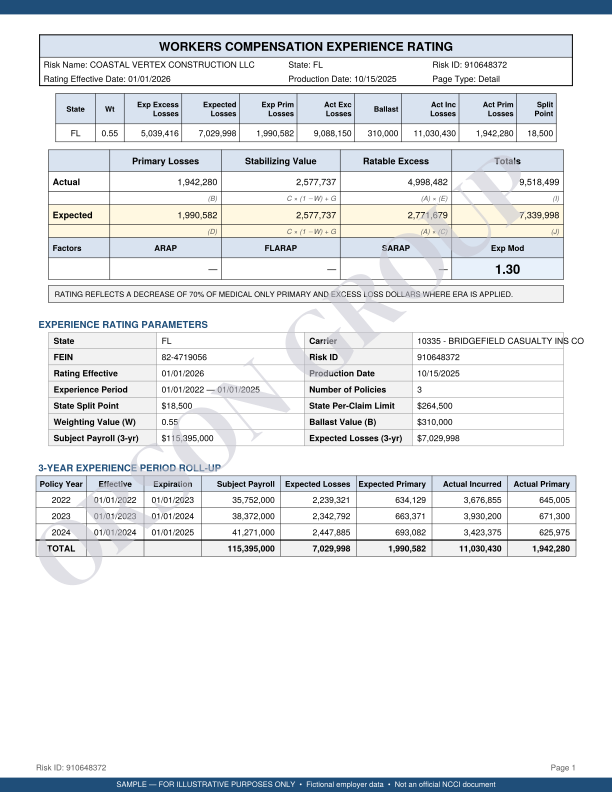
Upload your NCCI experience rating worksheet. We'll review it at no cost. If we find errors, you only pay when we recover your money.