Tennessee Workers Comp Rate Increase: +4.8% Isn't the Story
Tennessee's +4.8% order looks like the loss trend turning. It's the medical fee schedule passing through, and net of March's cut, 2026 ends near +2.7%. Your renewal date sets the bill.

Tennessee approved a 4.8% increase in NCCI voluntary loss costs and assigned risk rates effective October 1, 2026 (TDCI Order No. 26-54, August 2026). It is a law-only filing passing through the state's medical fee schedule update, not a deterioration in loss experience (NCCI TN-2026-04, June 2026). Blended with March's 2.0% decrease, Tennessee loss costs end 2026 up roughly 2.7% net.
Tennessee's workers comp rates are going up for the first time in more than a decade, and the headline number is doing misleading work. Order No. 26-54, entered August 25, 2026, raises NCCI voluntary loss costs and assigned risk rates 4.8%, effective October 1, 2026 (TDCI Order No. 26-54, August 2026). Read alone, it looks like the streak of decreases finally broke. It didn't.
The 4.8% is not underwriting deterioration. It is the state's medical fee schedule update passing through the loss costs, and whether a Tennessee contractor pays any of it in 2026 turns on one date: the policy's renewal inception.
What Order No. 26-54 actually approves
Commissioner Carter Lawrence signed the order August 25, 2026, approving a filing NCCI submitted June 8, 2026 (TDCI Order No. 26-54, August 2026). The operative sentence leaves no room for interpretation: "This increase of four and eight-tenths percent (+4.8%) will take effect on October 1, 2026" (TDCI Order No. 26-54, August 2026). The increase applies to both voluntary loss costs and assigned risk rates, measured against the levels that took effect March 1, 2026.
Tennessee law required a detour first. Tenn. Code Ann. § 50-6-402(b) obligates the Commissioner to consult the Advisory Council on Workers' Compensation before acting. The Council met July 31, 2026 and recommended approval by letter dated August 3, 2026 (TDCI Order No. 26-54, August 2026).
A law-only filing, not a loss trend
The percentage hides its own origin. NCCI's filing, TN-2026-04, is a law-only filing tied to the state's April 2026 medical fee schedule update. Berkley Industrial Comp's summary states it directly: "this is a law only filing, the change reflects the cost impact of the fee schedule update rather than experience based ratemaking" (Berkley Industrial Comp, June 2026).
That distinction changes what the number means. A trend-based increase means carriers are charging for worse loss experience. A law-only increase means the same injuries cost more to treat because the state repriced medical care. The Tennessee book didn't get riskier in 2026. The bill for treating its claims did.
The net math: March's cut against October's bump
The October order lands on top of a March decrease. TDCI approved a 2.0% voluntary loss-cost decrease effective March 1, 2026 (TDCI Matter No. 25-64, December 2025), and the assigned-risk rate level fell 1.1% while the plan's loss-cost multiplier moved from 1.809 to 1.826 (TDCI Matter No. 26-03, January 2026). The department's February announcement counted that as the 13th consecutive year of declines (TDCI news release, February 2026).
Stack the two moves and the year looks different. A 2.0% decrease followed by a 4.8% increase compounds to roughly 2.7% net: 0.98 times 1.048 equals 1.027. Tennessee loss costs end 2026 up about 2.7% against where they started, not 4.8%.
Run it on a real account. A $50,000 premium renewal priced at the full October level carries about $2,400 of increase ($50,000 x 4.8%; TDCI Order No. 26-54, August 2026). Priced against the net year, the same account is closer to $1,350 ($50,000 x 2.7%; TDCI Matter No. 25-64, December 2025). The gap between those two numbers is what a budget built on the headline percentage gets wrong.
Your renewal date is the real exposure
Loss-cost filings apply at policy inception, not continuously. A contractor whose policy renews September 15, 2026 locks the March loss-cost level for a full twelve months and doesn't see the 4.8% until September 2027. A contractor renewing November 1, 2026 absorbs it immediately. Same order, different year on the bill.
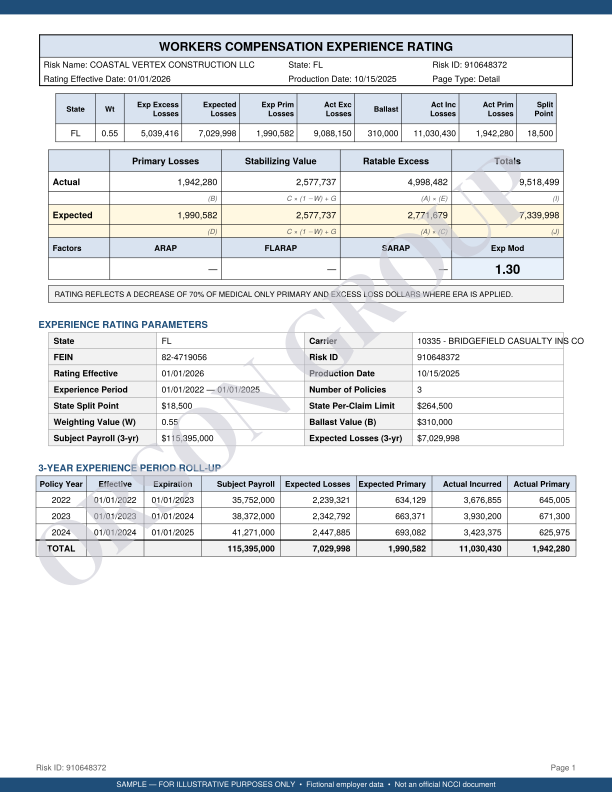
The experience modification rate rides on top of whichever level applies. A 1.15 mod stretches the October increase the same way it stretches everything else, which is why the mod is usually the bigger lever on the renewal than the filing is. The Tennessee worksheets that crossed our desk this summer were budgeted off the March baseline, and the October order is the line item none of them carry. The distance between the mod a contractor was handed and the one the file supports is worth more than 4.8% on most accounts; an EMR calculator prices that gap fast.
What an audit would check
An audit checks the inception date against October 1 and confirms which loss-cost level the renewal quote actually used. It reads the NCCI worksheet behind the mod for claim values and payroll that could compound the increase, and for assigned-risk contractors it separates the 4.8% loss-cost move from the multiplier change.
Send your NCCI worksheet for a free mod review and find out which number your next renewal is actually built on.