NC Split Point 2027: Why Your Mod Can Rise as Rates Fall
NCRB's approved 2027 filing cuts contracting loss costs 11.7%, but the same circular pushes North Carolina's split point to a fourth straight annual high. Hold claims steady and the mod can still inch up.

North Carolina's approved 2027 filing cuts contracting loss costs 11.7% (NCRB C-26-9, October 2026). The same circular also raises the experience-rating split point for a fourth straight year. Claims landing near that line get more dollars rated at full weight, which can erode part of the cut before any new claim is even filed.
North Carolina contractors got a real number to cheer this fall: an 11.7% cut to contracting loss costs, approved for policies starting April 1, 2027. Read the same circular twice, though, and a second number sits right next to it. The experience-rating split point went up again, the fourth straight year it has climbed, and that number works against the cut, not with it.
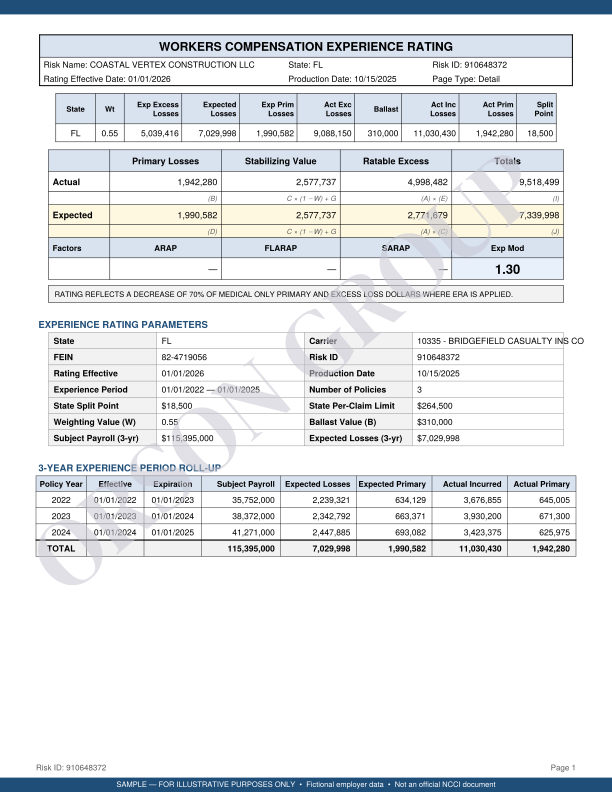
The split point is the dollar line NCCI uses to divide primary loss from excess loss inside the experience modification rate (EMR, the mod) calculation. Primary dollars count at full weight; excess dollars count at a fraction. Move the line up, and more of a mid-size claim counts at full weight than it did last year, with the claim itself unchanged.
North Carolina's split point has climbed every year since 2024
NCCI's move to state-specific split points reset North Carolina's line from $18,500 to $25,000 for policies effective April 1, 2024 (NCCI, 2026). It rose again to $25,500 for 2025 and to $26,000 for 2026 (NCCI, 2026). NCRB's approved 2027 filing, Circular C-26-9, carries the rating values forward again, and the pattern points to roughly $26,500 for policies starting April 1, 2027, a fourth consecutive increase (NCRB C-26-9, October 2026).
The same filing cuts the rate and quietly moves the line
NCRB's October 2 approval locked in the 11.7% contracting cut without changes from the August proposal (NCRB C-26-9, October 2026). The companion residual filing, C-26-8, cut assigned-risk contracting rates 15.3% (NCRB C-26-8, October 2026). Both of those numbers apply to the rate layer, the number NC's cut skips long before a single claim gets rated.
The split point lives somewhere else entirely: inside the rating values the same circular refiles for the mod calculation. NCCI resets the state's expected-loss figures broadly enough to keep the experience rating plan balanced on average across every contracting account in North Carolina. That balance is calibrated to the average claim across the whole class, not to any one contractor's actual claims. An account whose claims cluster near the split line doesn't get the average outcome. It gets whichever side of the line its claims happen to land on this year.
What it looks like on an actual worksheet
Take a contractor with two lost-time claims landing around $27,000 each, comfortably above both the 2026 and the 2027 split point. Under the $26,000 line, each claim splits into $26,000 of primary loss and $1,000 of discounted excess loss. Move the line to roughly $26,500, and each claim becomes $26,500 primary and $500 excess, a $500 shift per claim from the discounted bucket into the one rated at full value, with the claim count and claim size untouched.
Set that against the rate side. An 11.7% cut on a $70,000 contracting premium is about $8,190 ($70,000 x 11.7%; NCRB C-26-9, October 2026). Two claims sitting just above the old split line can claw back a real piece of that before anything about the account's actual loss history changes. Workers' comp claim costs are also still climbing nationally, up roughly 6% a year across 18 states including North Carolina (WCRI CompScope, 2026), so the mid-size claims most likely to sit near the split line keep getting bigger, not smaller. Run a claim history through an EMR calculator and the erosion adds up faster than the headline cut suggests.
What an audit would check
An audit checks where a contractor's actual claims fall relative to the split point in force for the rating year, not just whether the filed percentage looks favorable. It weighs whether a claim sitting near that line is valued accurately, since a reserve a few hundred dollars off the line changes how much of it gets full weight. For accounts with several mid-size claims, it also checks whether the expected-loss reset that came with the new split point actually matches the account's own claim mix.
The 2027 filing is public. What your claims look like against this year's split point is not, so send us your worksheet and find out which side of the line your renewal is actually on.