Workers Comp Employer Identity: Who Pays When It's Unclear
A Virginia ruling let an AmeriCorps volunteer add her real employer 27 months late, since its identity was concealed, not the deadline. Layered crews face the same ambiguity: whose mod absorbs the claim.

Virginia's Workers Compensation Commission let a Foster Grandparents volunteer add AmeriCorps as her employer 27 months late, past the two-year deadline, because AmeriCorps' identity was concealed from her (Insurance Journal, September 2026). The ruling doesn't toll deadlines generally; it applies narrowly when a worker cannot discover who employs her, a gap staffing, PEO, and multi-tier subcontracting routinely create.
Nobody in the Hampton, Virginia school system could tell a 78 year old Foster Grandparents Program volunteer who her actual employer was. Not her supervisor. Not the school's human resources office. She was hurt on May 1, 2023, assisting teachers and students, and when she filed a workers' compensation claim she named the people in front of her: first Peninsula Foster Grandparents, then Hampton Public Schools (Insurance Journal, September 2026).
Neither was her legal employer. Virginia law treats an AmeriCorps member who receives a stipend as an employee of AmeriCorps itself, the federal agency funding the program, not of the local sponsor signing her checks. She didn't learn that until 27 months after her injury, past Virginia's two-year filing deadline under Va. Code Ann. 65.2-601 (Insurance Journal, September 2026). The Virginia Workers' Compensation Commission let her add AmeriCorps anyway. For Southeast contractors staffing jobs through PEOs, temp agencies, and multi-tier subcontracts, the ruling isn't really about volunteers. It's about who answers for a claim when the people running payroll can't say with certainty whose worker got hurt.
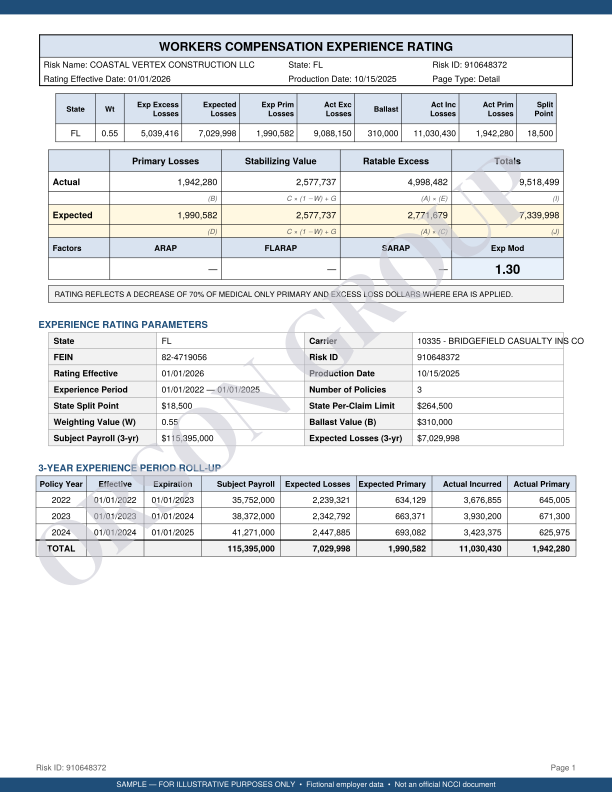
An experience modification rate only works if actual losses land on the policy that was supposed to absorb them. That assumption holds for a contractor with one payroll. It gets shaky fast once a worker's legal employer is a staffing firm, a PEO, or a subcontractor two tiers removed from the general contractor holding the job.
What the Virginia ruling actually decided
The deputy commissioner who first heard the case did not toll Virginia's two-year deadline for everyone in similar circumstances. The ruling did something narrower. It let one specific claimant substitute the correct employer after the clock ran, because that employer's identity had been hidden from her. The commission applied the doctrines of estoppel and imposition, finding AmeriCorps could not benefit from a deadline the claimant had no real chance to meet (Insurance Journal, September 2026).
The deputy's own language draws the line precisely: "An employee, such as the claimant, who was provided no information that her employer should be considered different from the entity that was routinely identified to her and that she routinely identified as her employer, should not be prejudiced" (Virginia Workers' Compensation Commission, via Insurance Journal, September 2026). The commission separated ignorance of law, which doesn't excuse a late claim, from ignorance of a fact, here, who the employer was, which can.
Layered payrolls make the same gap common
AmeriCorps is a narrow category, but the structural problem it exposes isn't. Professional employer organizations alone covered 5.4 million worksite employees across 233,000 client businesses at the end of 2025, and an estimated 14% of businesses with 20 to 499 workers now run payroll through one (NAPEO, 2026). Add staffing agencies and multi-tier construction subcontracts, where a classification code on file can describe work nobody on site actually performs, and "who is this worker's employer" stops being rhetorical.
That question already carries a mod consequence once it's answered. National experience-rating rules treat a commingled PEO policy as one combined mod and treat a client that leaves as its own, separately rated risk, with the change effective within 90 days of the move (NCCI Experience Rating Plan Manual, via ICRB). A contractor who doesn't know which side of that line a crew sits on doesn't know which mod a bad claim is about to feed.
The late claim still costs what late claims cost
Virginia's commission forgave the delay. Insurers don't forgive the cost of a late-reported claim. NCCI's research on accident report lag found claims reported in the third week after an injury run 35% higher than claims reported in week two, and claims reported more than two weeks out can cost up to 51% more overall (NCCI, 2015). Attorney involvement climbs alongside the delay: 13% of same-day-reported claims draw a lawyer, against 32% of claims reported after week four (NCCI, 2015).
Run that against a real number. A $20,000 medical-only claim that sits unresolved for a month while a staffing firm, a PEO, and a general contractor sort out whose name belongs on the paperwork can land near $30,200, 51% higher, by the time it closes (NCCI, 2015). That extra $10,200 doesn't vanish into the dispute. It becomes actual losses on whichever policy the claim ultimately attaches to, raising that contractor's mod regardless of who intended to carry the risk.
What an audit would check
An audit checks whether the entity named on a claim matches the entity actually carrying the experience-rating risk for that crew, not just the name on the certificate of insurance on file. It traces whether a staffing or PEO arrangement changed mid-policy-year without the mod being split or combined on time, and whether a late-named claim defaulted onto the GC's own experience. Layered payrolls create this ambiguity structurally; an audit's job is finding out whose file actually absorbed it.
The AmeriCorps ruling is public and your crew's payroll structure is not, so send us your mod worksheet and find out whose experience is actually carrying your claims.