Workers Comp Rates by State Diverge Heading Into 2027
New York cut loss costs 21.9% this month. Washington is asking for 4.9% more. The split proves state filings now move on local claims and law, not a shared national cycle.

Workers comp rates are not moving together nationally. New York's loss costs fell 21.9% effective October 1, 2026 (NY DFS, July 2026), while Washington proposed a 4.9% increase for January 1, 2027 (WA L&I, September 2026). The Southeast split too: five states filed cuts, Tennessee filed +4.8% (TDCI Order 26-54, August 2026).
New York turned its loss costs down 21.9% this month. Washington just asked employers for 4.9% more. Both moves are real, both are dated, and they happened six weeks apart. If you manage renewals across more than one state, the idea of a single national workers' comp cycle just stopped being useful.
The New York State Department of Financial Services approved the loss cost cut on July 15, 2026, effective October 1, 2026, citing declining lost-time claim frequency over three years and an estimated $1 billion-plus in employer savings (NY DFS, July 2026). Washington's Department of Labor & Industries proposed its increase on September 22, 2026, for policies effective January 1, 2027 (WA L&I, September 2026). "The cost of providing workers' compensation coverage continues to go up as wages and medical costs increase," said L&I Director Joel Sacks (Joel Sacks, WA L&I, September 2026). Washington isn't even passing through the full cost. The agency plans to draw down its contingency reserve so the increase lands at 4.9% instead of the number its own claims data would otherwise justify, adding about $1.44 a week per full-time employee (WA L&I, September 2026).
The Southeast isn't one number either
Drop into the Southeast and the pattern repeats at a smaller scale. Florida's rating organization filed a 7.4% advisory decrease for 2027, its tenth straight annual cut (NCCI, August 2026). North Carolina's rate bureau filed a 10.6% statewide loss cost decrease, with contracting classes down 11.7%, for policies effective April 1, 2027 (NCRB C-26-7, August 2026). Georgia's 2026 filing cut voluntary loss costs 8.8% and assigned-risk rates 9.3% (NCCI, 2025 GA filing). Alabama's 2026 filing cut voluntary loss costs 4.5% (NCCI, 2025 AL filing).
Tennessee broke the pattern. Its loss costs and assigned-risk rates rose 4.8% effective October 1, 2026, under an order tied to the state's April 1 medical fee schedule update, not to claims experience (TDCI Order 26-54, August 2026). Four states cutting and one raising, inside a region that gets described in trade coverage as uniformly soft.
Different levers, not one weather system
What moves these numbers isn't the same thing in every state. New York, Georgia, and Alabama are responding to the same driver: fewer lost-time claims relative to payroll. Tennessee's increase has nothing to do with claims at all; it's a law-only filing passing through a fee schedule change (TDCI Order 26-54, August 2026). Washington's increase is smaller than its own cost data supports because the agency chose to spend down a reserve rather than bill the full amount this year (WA L&I, September 2026).
That distinction matters for how you read soft-market coverage. A regional or national average implies one cycle lifting or lowering every account together. These filings show five separate decisions, each driven by a different input, landing in the same calendar year. Treating them as one trend is how a renewal budget gets built on the wrong number.
What a flat average hides for a multi-state book
Take a Southeast general contractor running comparable crews in Tennessee and Georgia, each with roughly $200,000 in current workers' comp premium before any mod adjustment. The Tennessee location absorbs the 4.8% increase: about $9,600 more, driven by the fee schedule, regardless of that crew's claims record (TDCI Order 26-54, August 2026). The Georgia location gets the 8.8% voluntary cut: about $17,600 less (NCCI, 2025 GA filing). Same company, same year, a $27,200 swing between two adjoining states with no change in how either crew actually works.
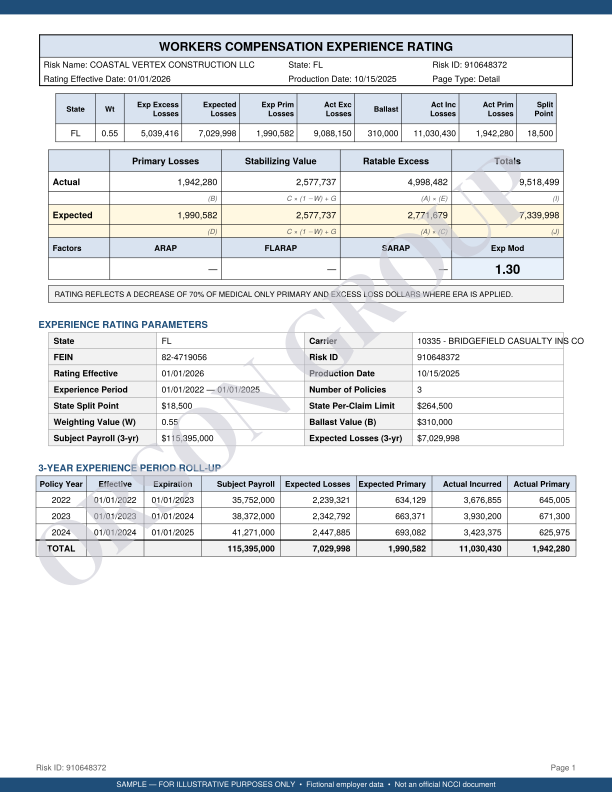
Budget off the regional average and you'd miss both ends of that swing. The workers' comp premium formula still runs through payroll, rate, and the experience modification rate at every one of these locations. The filed number only resets one input in that formula. The mod is the one your own claims history still controls.
What an audit would check
An audit checks whether a carrier applied the actual filed loss costs and rating values for each state where a contractor runs payroll, not a blended regional assumption, and whether the account's expected-loss values were refiled on the same schedule as the headline cut. For a multi-state book, it also checks whether a location benefiting from a state cut is still carrying a mod built on stale reserves from a different rating year. A filing changes the base number. It does not touch the worksheet.
Five filings, five different reasons, one renewal season. If you want to know which number is actually setting your premium instead of which one is in the trade press, send us your worksheet.