2027 Workers Comp Rate Filings: Three Dates, One Squeeze
FL OIR is weeks from a hearing on NCCI's 7.4% Florida filing while NC's residual cut runs 3.6 points deeper than voluntary. The 2027 rate season starts now, and the pool gets cheaper fastest.

The 2027 workers comp rate season turns on three pending actions: a Florida OIR public hearing on NCCI's 7.4% statewide decrease filing, NC DOI action on NCRB C-26-7 (10.6% advisory loss costs, 11.7% contracting) and C-26-6 (14.3% residual market), and the first 2027 NCCI filings in other Southeast states (NCCI, 2026; NCRB C-26-6, 2026).
Three regulatory clocks are running at once, and every one of them lands on April renewals. Florida's Office of Insurance Regulation (OIR) is expected to notice a public hearing on the National Council on Compensation Insurance (NCCI) filing that would cut Florida workers comp rates 7.4% (NCCI, 2026). North Carolina's Department of Insurance (DOI) is holding two North Carolina Rate Bureau (NCRB) filings that would cut advisory loss costs 10.6% and residual market rates 14.3% (NCRB C-26-7, 2026; NCRB C-26-6, 2026). The 2027 rate season doesn't start in January. It's breaking now.
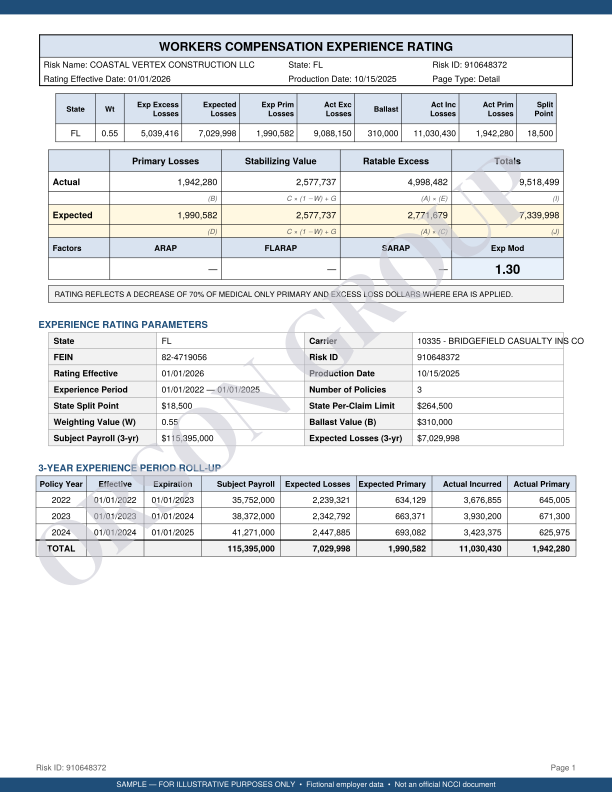
Here's the part that matters for contractors: none of these numbers is a mod cut. Every one of them is a base-rate move, and the experience modification rate (EMR, the mod) sits on top of whatever the regulators approve.
What's actually pending
Advisory loss costs are the claim-cost layer of the price, not the whole policy. Carriers layer their own multiplier, schedule credits, and your mod on top, which is why the workers' comp premium formula is the frame worth holding. A filing tells you where the floor moves. Your renewal tells you where your account lands, and the experience modification rate is the one input the filing can't touch.
Florida: the hearing that sets the tone
NCCI's Florida filing proposes a 7.4% decrease statewide (NCCI, 2026). Last cycle, OIR heard the NCCI filing on October 21 (FL OIR, 2025), and a hearing notice on the new filing is expected on roughly that timing, about three weeks out. The office's posture is no mystery. Commissioner Michael Yaworsky just approved four homeowner cuts averaging 7% across 62,000 policies and said "OIR is receiving a flood of rate decrease requests" (Insurance Journal, September 2026). Requested property decreases are running 4.8% on average, against the 15% increases OIR was approving in July 2022 (Insurance Journal, September 2026).
A regulator in that mood doesn't usually hand a filing back upward. But hearings trim filings, and the number that survives is the one your carrier prices from. Watch the hearing, not the press release.
North Carolina: two filings, two different markets
NCRB filed C-26-7 on August 31, 2026, proposing a 10.6% statewide advisory loss cost decrease and an 11.7% contracting decrease for policies effective April 1, 2027 (NCRB C-26-7, 2026). Its companion, C-26-6, proposes a 14.3% average residual market decrease, and 15.3% for contracting (NCRB C-26-6, 2026). DOI action is the last gate before either number becomes real.
The squeeze: the pool gets cheaper faster
Last cycle, the two tracks moved together. Voluntary contracting was filed at a 9.0% decrease (NCRB C-25-8, 2025) and residual contracting at 8.8% (NCRB C-25-7, 2025), two-tenths of a point apart. This cycle the pool runs 3.6 points deeper than the voluntary market (NCRB C-26-6, 2026; NCRB C-26-7, 2026).
Run the numbers on two identical $50,000 manual premiums. The voluntary contractor lands near $44,150 after the 11.7% contracting cut. The pool contractor lands near $42,350 after the 15.3% residual cut. That's $1,800 of new price advantage for the pool account in one renewal, before anyone's mod is applied.
The residual market doesn't underwrite discipline. It's where accounts land when discipline failed, and the deepest cut in the filing goes to the least disciplined segment of the market. General contractors will feel this on certificates. A pool sub quoting labor off a base that just fell 15.3% looks more plausible than it did last year, and the ACORD certificate doesn't show the 1.25 mod that explains why that account is in the pool. When a pool sub's number lands 15% under a voluntary sub's, the GC assumes someone found a better market. We've yet to audit the file where that was true.
The mod is still the lever. On a $42,350 pool base, the distance between a 1.25 you were handed and a 1.05 your file supports is $8,470 a year. An EMR calculator will price that gap for any account. The filings won't tell you which number is supported.
What an audit would check
An audit checks whether the approved numbers, whatever survives the FL hearing and NC DOI review, actually reached the renewal quote. It reads the mod worksheet against the claims and payroll behind it, and it weighs whether a pool placement is price relief or a symptom. On the certificate side, it separates a sub whose number reflects a filed decrease from one whose number reflects a file nobody should have accepted.
OIR and the NC DOI will set the floor. Your claims file sets the mod on top of it. Send us the worksheet and find out which one needs the work before April does it for you.