Workplace Violence Workers Comp Claims Are Climbing
NCCI logged a 62% jump in workplace assault rates since 2011, and Gen Re just told underwriters to price it. A missing violence plan now reads like a missing fall-protection plan.

Workplace violence workers comp claims are rising, and underwriters are starting to price the exposure directly. NCCI recorded a 5.3% annual increase in nonfatal workplace assaults from 2011 through 2021-22, with the assault rate per 10,000 workers up 62% (NCCI, April 2026). Gen Re's October 2026 guidance tells carriers to weigh a contractor's written prevention plan like a fall-protection plan.
A workplace shooting used to get filed under acts no employer could have stopped. That framing is coming apart fast. In the same six-week stretch, Gen Re told underwriters to start pricing violence like any other named hazard (Gen Re, October 2026), and CPWR, the construction industry's own safety research center, published a guide stating plainly that workplace harassment and violence are "recognizable, foreseeable and preventable" (CPWR, July 2026).
Two institutions that almost never cite each other landed on the same conclusion. For a contractor, that convergence is the story. Workplace violence workers comp claims have moved from an unpriced tail risk to a line item underwriters are starting to ask about by name.
NCCI, the National Council on Compensation Insurance, spent 2026 publishing a three-part Workplace Violence series that pulls apart assault and homicide claims by industry, cause, and severity. Read next to Gen Re's reinsurance guidance and CPWR's new construction-specific prevention guide, the series reads less like an academic exercise and more like the data sitting underneath a pricing shift that is already underway.
Why workplace violence workers comp claims are climbing
The trend line is not subtle. Nonfatal workplace assaults grew at an average annual rate of 5.3% from 2011 through 2021-22, and the assault rate per 10,000 full-time workers climbed 62% over that span, nearly five times the 13% rise in the nationwide aggravated assault rate over the same years (NCCI, April 2026). Assaults also make up a bigger share of every lost-time claim NCCI tracks: 1.3% of days-away-from-work cases in 2011, a peak of 2.3% in 2019, and 3.0% in 2023-24 after a pandemic-era dip (NCCI, April 2026).
Most of that volume sits in health care, where NCCI counted roughly 18,860 annualized assault cases in 2023-24, about ten times the next-largest sector, retail trade, at close to 1,835 (NCCI, April 2026). Severity tells a different story. Gunshot-caused claims, rare on a frequency basis, carried an average severity of $116,920 in accident years 2021-22, the highest of any assault-related cause NCCI tracks (NCCI, April 2026).
Construction's exposure looks different than health care's
Construction will never match a hospital's assault frequency, and that is not really the point. Violent acts caused 46 of the 1,034 workplace deaths in construction in 2024, about 4.4% of the industry's total (BLS Census of Fatal Occupational Injuries, 2024). That's a smaller share than health care carries, but it is also not the stranger-with-a-weapon scenario most risk managers picture when they hear "workplace violence."
CPWR's guide is built around a different mechanism: harassment and bullying among a crew that escalates into physical violence, not an outside robbery. The center frames the hazard as foreseeable precisely because it usually has a visible run-up rather than a sudden event (CPWR, July 2026). A multi-employer jobsite with rotating subcontractors, a laid-off worker who still has site access, or a supervisor whose management style nobody has ever challenged are construction-specific versions of a hazard NCCI's data treats as generic.
Florida's courts already widened who gets paid once an assault claim exists, a shift covered in a separate look at that ruling. Gen Re's guidance is the underwriting-side mirror of that same move: price the exposure before the claim, not just adjudicate it after.
Underwriters are starting to ask for the plan
Gen Re's October 2026 guidance tells underwriters evaluating a workers' comp account to weigh industry concentration, employee and public interaction, security measures, training, and management's track record of responding to warning signs (Gen Re, October 2026). None of that is new underwriting territory. Carriers have asked equivalent questions about fall protection and lockout and tagout programs for years. What's new is that violence prevention is now explicitly on the same list.
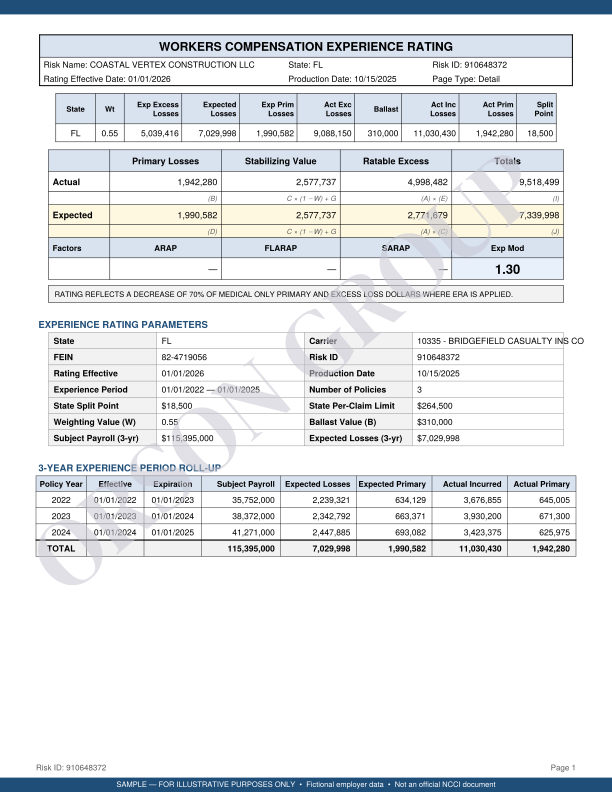
Run the dollar math on a $200,000 workers' comp premium, a realistic number for a mid-sized Southeast trade contractor. A single average-severity gunshot claim at $116,920 (NCCI, April 2026) is more than half that premium landing as one claim, inside the same frequency-and-severity split that decides how hard any claim hits the mod. A written prevention plan doesn't undo that claim once it happens. What it does is give an underwriter something concrete to weigh before the renewal, and a contractor can use an EMR calculator to see what the gap between a mod that absorbed a claim like that cleanly and one that didn't actually costs on the next bid.
What an audit would check
An audit checks whether a contractor's loss runs already carry an assault-coded claim that never got flagged as such on the worksheet, and whether the classification and payroll tied to that claim match the work actually performed. It also looks at whether a carrier's schedule-rating decision reflects any documented safety program at all, violence-related or otherwise, since that is where a written plan would show up first. It stops well short of telling a contractor how to build that plan.
A rising NCCI trend line won't lower anyone's mod on its own. Send us your worksheet and find out whether yours already reflects an exposure carriers are only now starting to ask about by name.