How Is EMR Calculated? The Experience Mod Formula, Worked
Your mod is a fraction: the losses you had over the losses you were expected to have, with three adjustments that decide who gets hurt by what. Here's the arithmetic on one page.
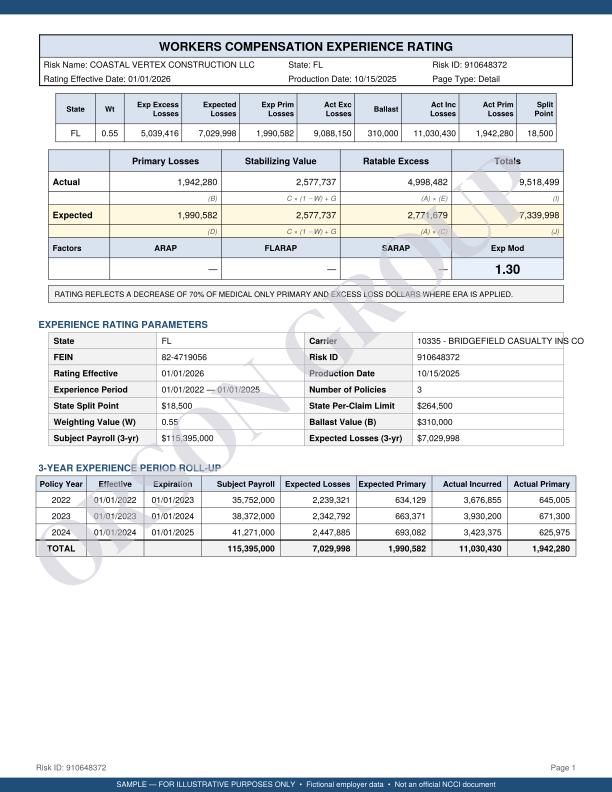
EMR is calculated by dividing your actual workers' comp losses by the losses expected for your payroll and class codes over three policy years. The formula counts small losses in full, discounts the large part of big claims, and adds a stabilizing value to both sides. Losses equal to expected produce 1.00; more produce a debit, fewer a credit.
Most contractors know their mod the way they know their blood pressure: one number, handed over by someone else, with no idea what went into it. The calculation behind it isn't secret, and it isn't complicated. It's one fraction with a few adjustments, and each adjustment explains something that otherwise looks unfair.
The inputs: three years, two sides
An experience modification rate compares two things over the same window. The window is three full policy years, ending a year before the mod takes effect, so the most recent year is left out.
One side is expected losses. For each class code, the rating bureau publishes an expected loss rate per $100 of payroll. Your payroll in each class times that rate is what an average employer doing your work at your size would have lost. This is why classification matters twice: it sets your rate, and it sets the yardstick your claims are measured against.
The other side is actual losses: what your carrier has paid on each claim plus what it has reserved, as reported at the valuation date. Paid plus reserved, not paid alone.
If the formula stopped there, the mod would be actual divided by expected. It doesn't stop there, because that version would bankrupt a small contractor over one bad accident.
Adjustment one: every claim is split in two
Each claim is cut at a state-specific dollar threshold called the split point. The portion below is the primary loss and counts in full. The portion above is the excess loss and counts at a fraction.
The logic is that frequency says more about an employer than severity does. Whether an injury happens is partly in your control. Whether it turns into a six-figure claim is partly luck. So the formula takes the first dollars of every claim seriously and the later dollars with a grain of salt. Expected losses are split the same way, using a published ratio for each class, so the comparison stays like for like.
Adjustment two: how much your own record counts
The excess portion is governed by a weighting value. A small employer's weighting value is low, so most of its excess losses are ignored and replaced with the expected figure. A large employer's is high, so its own large claims count for more. The bigger the payroll, the more the formula trusts your record over the average.
Adjustment three: the ballast
A stabilizing value, called ballast, is added to both the top and the bottom of the fraction. It pulls every mod toward 1.00 and pulls small employers hardest. Without it, a contractor with $20,000 of expected losses and one $40,000 claim would see a mod of 2.00.
The whole formula, with numbers
Put together, the top of the fraction is actual primary losses, plus ballast, plus the weighted share of actual excess losses, plus the unweighted share of expected excess losses. The bottom is total expected losses plus ballast.
Take a contractor with $100,000 of expected losses, of which $40,000 is expected primary and $60,000 expected excess. Say the weighting value is 0.20 and the ballast is $30,000. Over the three years the contractor had $50,000 of actual primary losses and $80,000 of actual excess.
The top is $50,000 plus $30,000 plus 20% of $80,000, which is $16,000, plus 80% of $60,000, which is $48,000. That's $144,000. The bottom is $100,000 plus $30,000, or $130,000. The mod is 1.11.
Now notice what moved it. Actual losses were $130,000 against $100,000 expected, 30% over. The mod is 11% over. The $80,000 of excess losses added only $16,000 to the top. The $10,000 of primary losses above expectation went in dollar for dollar.
Run the same contractor with no claims at all and the top is $30,000 plus $48,000, or $78,000. Over $130,000 that's 0.60. That is the minimum mod, the floor this contractor can't go below no matter how clean the record.
Two things the formula does before it starts
A medical-only claim is reduced by roughly 70% before it enters the calculation in most states, so how a claim is coded changes its weight more than what it cost. And very large claims are capped at a per-claim limit, so a single catastrophe can't run the number without bound.
What an audit would check
The formula is public and the arithmetic is rarely wrong. The inputs are another matter. An audit checks every number that feeds the fraction: payroll by class code behind expected losses, claim values and coding behind actual losses, and whether what the carrier reported matches what the claim files say today. Send us your experience rating worksheet and we'll review it for free, or estimate what a lower mod is worth first.