Concealed Payroll Workers Comp: The $10.39 Rate Tell
A Florida arrest backs into $10.39 per $100 on hidden payroll, a field-labor rate, not clerical drift. Under Fla. Stat. 440.10, a general contractor holds that same exposure when the sub's coverage fails.
Concealed payroll in workers comp is priced at the class rate of the work actually done. Florida DFS says one construction owner allegedly hid $968,278.71 of payroll, paid $9,297.43, and cost the insurer $100,565.57 (Florida DFS, November 10, 2026). That implies roughly $10.39 per $100, field-labor territory, and the same payroll is a contractor's exposure if it lands uninsured.
A $9,297.43 policy is a rounding error on a construction job. The one the Florida Department of Financial Services (DFS) described on November 10 is a reminder of why it isn't.
DFS says investigators arrested Israel Carballo, a construction company owner, on November 5, 2026, on charges of grand theft, organized scheme to defraud and workers' compensation fraud (Florida DFS, November 10, 2026). These are allegations, and the release doesn't name his company. It does give the arithmetic: $968,278.71 of unreported payroll, $9,297.43 paid for the policy year, and $100,565.57 in lost premium (Florida DFS, November 10, 2026). Another $1,074,278.71 was allegedly cashed through money service businesses (Florida DFS, November 10, 2026).
The state's own headline calls it a $100,000 scheme. Read it the other way. The policy cost the owner 8.5% of what it should have, and the missing 91.5% is the story.
The rate hiding in the press release
Divide the lost premium by the hidden payroll and you get $10.39 per $100 (Florida DFS, November 10, 2026; division by this report). DFS didn't publish that number, and it blends a class rate with whatever mod and credits applied. It's still a tell.
Under the workers' comp premium formula, premium is payroll times a class rate per $100, then modified. Florida's joint underwriting association table runs from $0.105 for clerical code 8810 to $5.116 for concrete code 5215 (FWCJUA, January 1, 2026). An implied $10.39 is about double the concrete rate and nearly 100 times the clerical one. Nobody misfiled an office manager here. Whoever was paid in those checks was doing hazardous field work, and the policy priced a sliver of it.
Where the general contractor's exposure sits
The hidden payroll doesn't vanish when the policy is underpriced. It sits in the chain. Fla. Stat. 440.10(1)(b) says that when a contractor sublets work, "the contractor shall be liable for, and shall secure, the payment of compensation to all such employees, except to employees of a subcontractor who has secured such payment" (Florida Legislature, 2026). Subsection (1)(c) adds that a contractor "shall require a subcontractor to provide evidence of workers' compensation insurance" (Florida Legislature, 2026).
The exception turns on the word "secured." Whether a policy written on 8.5% of the real premium counts is a question for counsel and the carrier, and the statute doesn't answer it. A certificate in the file proves a policy exists. It doesn't prove the crew on your roof is on it.
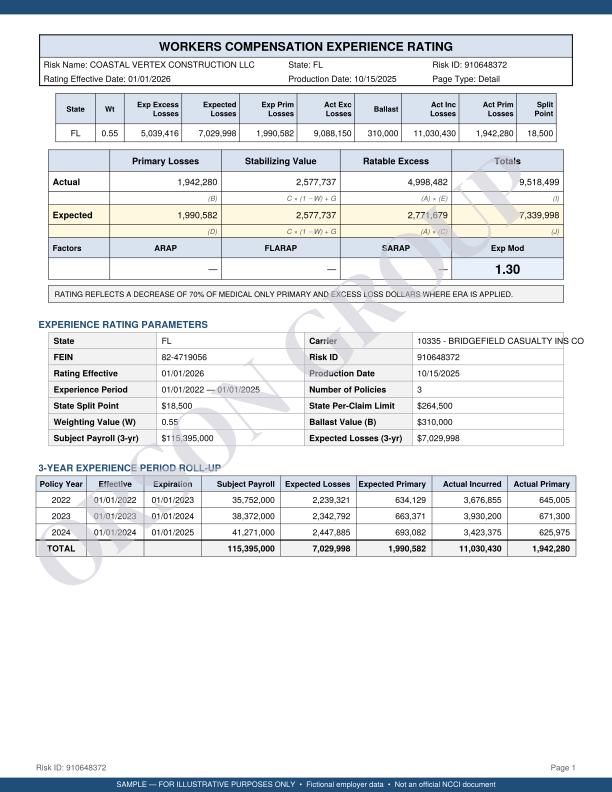
Now the worked number. Put a crew like this one under your paper instead of his. The same $968,278.71 of payroll at the implied $10.39 rate is about $100,600 of premium, before your own mod multiplies it (Florida DFS, November 10, 2026; $968,278.71 x 10.39%). That's 10.8 times the $9,297.43 the policy actually cost. If your own mod runs 1.20, run the difference through the EMR calculator to see how far it stretches.
The bid side was the first half of this story
The earlier Palm Beach premium fraud report covered what hidden payroll does to a bid: it removes cost before the number reaches an estimator. The Carballo case shows the other half. The savings go to the cheaper bidder; the liability goes to whoever hired the crew. Those are two different people.
DFS Chief Financial Officer Blaise Ingoglia said, "We will continue to protect Floridians and their businesses from fraudulent activity" (Florida DFS, November 10, 2026). Enforcement arrives after the policy year, though. Your renewal doesn't wait for the prosecution.
And the mod can't see any of it. An experience rating worksheet only knows payroll and losses that reached a carrier on your own policy. Hidden payroll under someone else's policy leaves no trace there until a claim or an audit drags it across.
What an audit would check
An audit checks whether the subcontractor's reported payroll is plausible for the trade and class it was priced under, and whether the coverage in your file describes the crew actually on the job. It reads your own class code assignments against the work performed, since a misplaced code is the quiet cousin of this problem. It also weighs where an uninsured exposure would land on your worksheet if it surfaced.
A certificate tells you a policy exists; it doesn't tell you what's under it. Send us your worksheet and subcontractor roster and we'll tell you where your exposure sits.