Fake Insurer Certificate Florida: When the COI Is Real
Two Florida prosecutions in one week target the carrier behind the paper, not the paper. A certificate can be genuine and still name an insurer that never existed, and your mod inherits the gap.
A real-looking certificate proves only that someone typed a carrier's name. In Florida's Wave Insurance indictment, prosecutors allege falsified certificates backed $651,000 in premiums for an unlicensed insurer (Insurance Journal, October 29, 2026). Under FS 440.10(1)(b), a contractor must secure compensation for an uninsured subcontractor's employees, so the claim and its mod damage land on the GC.
Most contractors treat a certificate of insurance as a document to check. Two Florida cases from the past week treat it as a document to forge, and the forger's real product wasn't the paper. It was the insurer behind it.
On October 29, 2026, Insurance Journal reported that a federal grand jury indicted Christopher Brossett and Brady Howard over The Wave Insurance, a risk retention group incorporated in 2025, and Hydrogen Deep. Prosecutors allege neither entity was licensed to write property-casualty insurance in Florida, and that the pair took more than $651,000 in premiums over two years and issued falsified certificates (Insurance Journal, October 29, 2026). Both pleaded not guilty on October 16, and trial is set for December 14 in Pensacola (Insurance Journal, October 29, 2026). These are allegations, not convictions.
A day earlier, Florida's CFO announced the arrest of Yaudat Ohan, barred from holding an insurance license since 2002, and Alberto Villaruel, a licensed agent charged as his accomplice. A flooring contractor had handed two certificates to a state compliance officer in April, and the named insurer said the policies were never active (Florida CFO, October 27, 2026). The contractor paid $10,500 in premium over at least four years (Insurance Journal, October 28, 2026).
The state also issued a stop-work order against that flooring company for lacking workers' comp coverage (Insurance Journal, October 28, 2026).
The certificate was never the control
The Wave's own figures show the problem. Florida requires $5 million in reserves and $4 million in operating funds for this kind of insurer, and prosecutors say it held neither (Insurance Journal, October 29, 2026). The $651,000 it allegedly collected is 13.0% of the reserve floor alone ($651,000 divided by $5 million). A certificate from that carrier reads exactly like one from a real carrier. Only the licensing record tells them apart.
Our earlier reporting on certificate fraud in the Escobar case showed forged paper. These cases are the next rung up: paper that may be faithfully copied from a policy that is itself worthless.
Where the loss goes when the sub is uninsured
Florida's statute doesn't care how good the certificate looked. FS 440.10(1)(b) deems the employees of a contractor and its subcontractors on the same contract work to be employed in one business, and the contractor must secure compensation for all of them, except those of a sub that has already secured it (Florida Statutes, 440.10). If the sub's coverage is a fiction, nothing was secured.
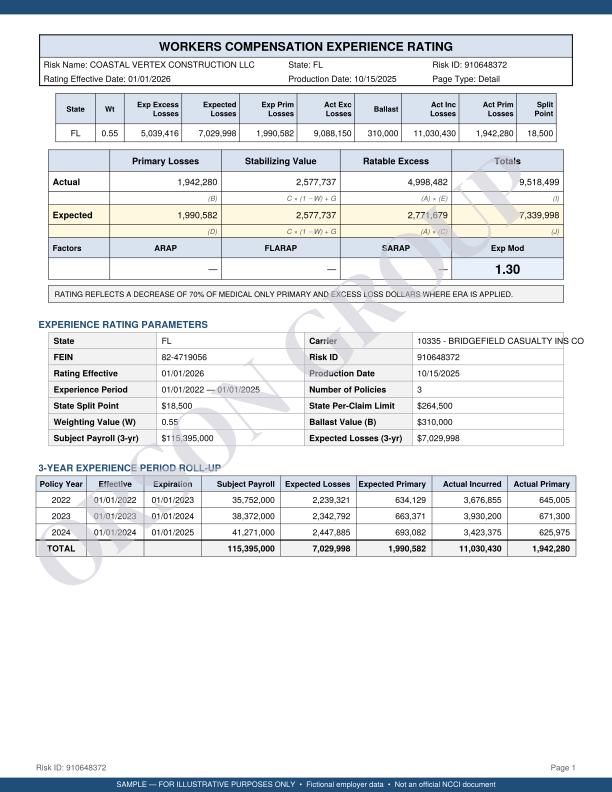
That's the moment the sub's injured worker becomes your statutory employee. Your carrier pays the benefits, and the claim is reported on your policy, where it can sit in your experience modification rate calculation for three rating years. The sub's $10,500 policy turned out to be worth nothing, but the claim it should have absorbed is worth whatever the injury costs.
The penalty math is just as lopsided. Florida assesses an uninsured employer twice the premium it would have paid at approved manual rates, or $1,000, whichever is greater (Florida Statutes, 440.107). Applied to $10,500, the floor is $21,000, and manual-rate premium on a flooring crew will usually run higher. That is the cheap side of the ledger. One injured worker is the expensive side. You can price the gap between a mod your file supports and the one you were handed with the EMR calculator.
Florida's CFO put the public-policy point plainly: "Floridians' insurance policies are meant to protect them, not fund criminals' bank accounts" (Florida CFO, October 27, 2026). The contractor's version is blunter. A fraudulent policy protects nobody, and the person left holding the claim is whoever sat above the sub.
Why a clean-looking file still fails
A general contractor who collected a certificate, filed it and moved on did what most prequalification processes ask. Ohan's four-year run shows how long that can go unchallenged: nothing about a forged certificate changes until an injury or a compliance officer forces the question (Insurance Journal, October 28, 2026). Our piece on what a fake certificate does to a GC's audit covers the premium side of the same blind spot.
What an audit would check
An audit checks whether any claim on your worksheet traces back to a subcontractor whose coverage didn't hold, and whether the loss was reported against your policy when it should have sat elsewhere. It also asks whether the certificates on your jobs ever named an insurer whose license was never tested. For Florida contractors, the answer decides whether a mod is earned or inherited, so send us your worksheet and we'll tell you which one you're carrying.