NC Workers Comp Exclusivity Doesn't Cover a Supervisor's Fists
A North Carolina appeals court confirmed a supervisor who punches a subordinate isn't shielded by comp exclusivity. The sharper point: that claim never touches the mod, because it was never a comp claim.

No. North Carolina workers comp exclusivity doesn't bar a suit against a supervisor who intentionally strikes an employee, even without intent to cause the injury. The Court of Appeals confirmed that October 7, 2026, in Hembree v. Hendrick Automotive Group (COA26-172, October 2026). The claim then sits entirely outside the comp system, past the standard $100,000 each-accident employer's liability limit.
Randy Hembree worked at a Charlotte dealership group for a decade, from 2015 until he could no longer work in January 2025. His supervisor, Eric Wright, allegedly struck him and other subordinates in the head and neck as a form of motivation. Hembree had neck surgery in 2015. The blows allegedly continued anyway, and by 2022 he was reporting vertigo, blurred vision, numbness and fatigue that eventually cost him his job.
Wright moved to dismiss, arguing NC workers comp exclusivity gave the Industrial Commission sole jurisdiction over anything that happens on the clock. On October 7, 2026, the Court of Appeals disagreed, affirming the denial of his motion and letting Hembree's suit proceed (Hembree v. Hendrick Automotive Group, COA26-172, October 2026).
The ruling isn't really about punching. It's about where the experience modification rate stops mattering, and that line is narrower than most safety directors assume.
What the court actually held
North Carolina's exclusivity bar normally means a hurt worker collects through the comp system and nowhere else, no matter how careless the person who hurt them was. The exception traces to a 1985 case where a worker, trying to scare a coworker with a truck engine and a horn, hit him with it instead. The state Supreme Court held that willful, wanton and reckless negligence occupies a twilight zone between ordinary carelessness and an intentional injury, and treated it as intentional for exclusivity purposes (Pleasant v. Johnson, N.C. Supreme Court, 1985).
Wright argued Hembree hadn't alleged the right kind of intent, not that he meant the specific harm that resulted. The court rejected that framing. What matters under the Pleasant exception, the court wrote, was "his intent to make the unwanted contact," not an intent to produce the harm that followed from it (Hembree v. Hendrick Automotive Group, COA26-172, October 2026). A fist thrown on purpose clears the bar even if the cervical injury wasn't the point.
Two shields, two different owners
The corporate entities named in the same complaint aren't automatically exposed just because Wright is. Suing the employer itself for an intentional tort runs through a tougher standard, requiring proof the employer knew serious injury or death was substantially certain to follow from its conduct (Woodson v. Rowland, N.C. Supreme Court, 1991). Three corporate defendants still had motions to dismiss pending while Wright's narrower appeal was decided (Business Insurance, October 2026).
That gap is the real lesson. The exclusivity shield on the entity's own conduct sits behind a high bar. A supervisor's personal conduct sits behind a much lower one, and a GC that assumes its comp carrier handles anything that happens on the clock is reading only half of that split.
The money the mod will never see
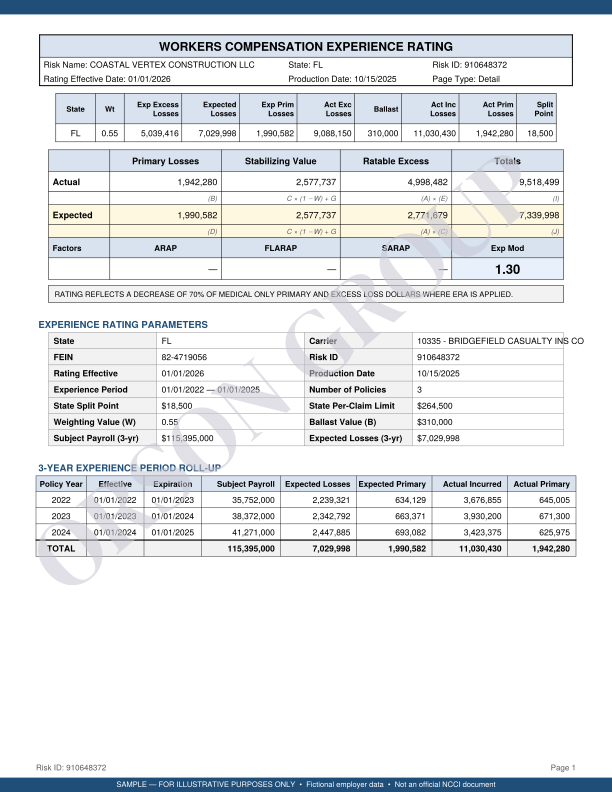
This is where the experience rating system goes quiet. An EMR is built from paid and reserved workers' comp claims an insurer reports to NCCI on a unit statistical report. A civil judgment against a supervisor, decided in superior court under tort law, generates no such report. It never becomes a claim the experience modification rate can see, favorably or otherwise. A single lost-time comp claim normally rides the mod for three rating years. A Pleasant-exception verdict rides nothing. It arrives, in full, somewhere else.
Where it arrives depends on the paperwork. North Carolina's standard workers' comp policy carries a Part Two employer's liability limit of $100,000 each accident, with a $500,000 aggregate for disease claims (NCRB Basic Manual, Rule 5). That layer exists to cover suits the comp bar doesn't catch, like this one. But it was never written to absorb a verdict built on years of documented, repeated, on-purpose contact, and once a judgment clears it, the remainder has nowhere left to go inside the comp tower. It attaches to the GC's general liability or umbrella program, or to Wright personally, neither of which a comp renewal will ever flag.
Hembree isn't gaining traction because the facts are ugly. The same day it issued, the Court of Appeals also revived a staffing worker's tort claim against a concrete contractor in a separate exclusivity dispute (NC Court of Appeals, October 2026). Two exclusivity exceptions clearing one appellate docket in a week, against a backdrop of 77,780 serious nonfatal workplace violence injuries recorded nationally in 2024 (BLS SOII, 2024), says these claims are clearing the dismissal stage more often, not less. A contractor who wants to know what this would have done to their renewal, had it stayed inside the comp system, can model that distance with the EMR calculator. It won't model this one, because this one was never going to show up there.
What an audit would check
An audit checks whether a contractor's employer's liability limit was set to match actual payroll and claims history, or left at the policy's printed minimum because nobody asked. It also checks whether supervisory incidents handled as HR matters, rather than reported as recordable injuries, left a gap between what the comp carrier knows and what happened on site. Neither question is about preventing the next incident. Both are about knowing, before a verdict lands, which policy is supposed to catch it.
The worksheet that drives your renewal only reflects claims your carrier actually received. Send us yours and find out what else might be missing from it.