Florida Workers Comp Rate Cut 2027: A 7.4% Cut Nets 2.6%
Florida's proposed 7.4% comp cut sounds like relief, but at construction's 5.2% wage growth a contractor with the same crew pays only 2.6% less. The cut breaks even at 8.0% payroll growth.
Florida's proposed 7.4% workers comp rate cut for January 1, 2027 (Insurance Journal, August 2026) nets to about a 2.6% lower premium at constant headcount, because construction pay rose 5.2% over the past year (AGC, November 2026). The cut only breaks even if payroll grows 8.0%. Wages claw back roughly two thirds of it.
A rate cut is quoted on the rate. It's billed on payroll. That gap is where Florida's proposed January 1 decrease goes missing, and the number that fills it was published three days ago.
NCCI recommended a 7.4% average decrease in Florida voluntary workers comp rates, effective January 1, 2027, which would be the 10th straight annual cut (Insurance Journal, August 2026). The prior cut was 6.9% (Insurance Journal, August 2026). Ten years of falling rates trains a contractor to expect a smaller bill. This year the arithmetic says otherwise.
The Florida workers comp rate cut, run at constant headcount
Here's the November 6 AGC release. Construction production and nonsupervisory pay rose to $39.70 an hour in October, up 5.2% over the past year, against a 3.3% gain for production workers across the private sector (AGC, November 2026). The all-private average was $32.75 (AGC, November 2026).
Now hold the crew still. Same people, same hours, pay rising at the AGC rate. A contractor paying $100,000 in Florida premium today has payroll growing 5.2% and a rate falling 7.4%. Multiply it out: $100,000 x 1.052 x 0.926 is $97,415. The bill drops $2,585, or 2.6%, not $7,400.
Work it backward and the cut's limit shows. Payroll would have to grow 8.0% for the 7.4% decrease to net to zero. At 5.2%, wages hand back about $4,800 of every $7,400 the filing appears to give. That isn't a hidden fee. It's the formula doing exactly what it's built to do.
Why the wage pressure isn't leaving
"Nonresidential contractors are adding employees and raising hourly pay at rates far exceeding the broader economy," said Ken Simonson, AGC's chief economist (AGC, November 2026). Contractors read that as a hiring story. A premium analyst reads it as a base story, because payroll is the thing the rate gets multiplied against.
The pool that would cool it keeps shrinking. Job seekers with recent construction experience numbered 363,000 in October, the lowest October figure since 2018 (AGC, November 2026). Total construction employment sat at 8,367,000, up 1.5% from a year earlier (AGC, November 2026). When firms compete for a thin bench, pay climbs, and the premium base climbs with it.
This builds on the general point we made in an earlier report on payroll and rate cuts. What the November data adds is a date and a number: for Florida's renewals, the offset is 5.2 points, and it's already in the books.
What the cut doesn't touch
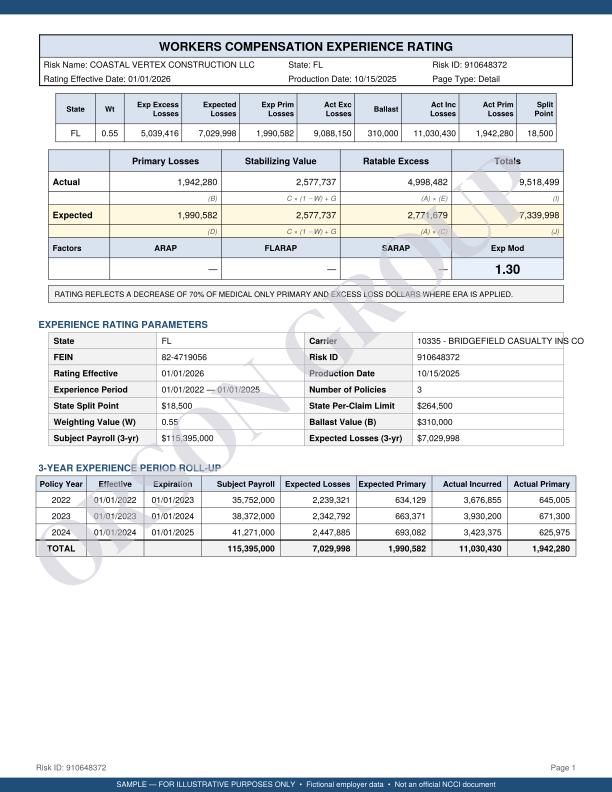
Both moving parts, the filed rate and the crew's pay, are set outside your office. Neither one cares about your claims. The workers' comp premium formula has a third term that does: your experience modification rate, the mod.
On that same $97,415 of post-cut manual premium, a 0.10 difference in the mod is about $9,700 (the $97,415 figure above x 0.10). That's nearly four times the $2,585 the rate cut and wage growth leave you with. The EMR calculator will price your own gap. The filing gave every Florida contractor in your class the same direction of travel; the mod decides how far your own bill actually moves.
Contractors who call us in January usually lead with the rate cut and ask why the invoice didn't look like the press release. The answer is almost always on the payroll line, and then, one line below it, the mod.
What an audit would check
An audit checks whether the mod being multiplied against the new, smaller base is supported by the worksheet underneath it, including the claim values and the payroll by class. It also reads whether the payroll that grew 5.2% on paper grew the same way in the class codes where it was reported. The rate is settled by the state; the worksheet is still open.
If your renewal arrives looking flat, send us the worksheet and we'll tell you whether the flat bill is the market or the mod.