Silicosis Workers Comp Claims: The Mod Hit Arrives Late
Two October verdicts put $100 million on Caesarstone, but the fabricator's own comp policy carries the injured worker. Experience rating was built for frequency, so one silicosis claim can swamp a small shop's mod.
Silicosis workers comp claims hit a stone contractor's mod as one severe claim, not a pattern. California counted 592 engineered-stone silicosis cases and 65 lung transplants through June 2026 (KMPH, August 15, 2026). One verdict reached $67.7 million, $60 million of it non-economic (Business Insurance, October 30, 2026), so comp sees only the economic remainder.
Two juries just priced the product. Nobody has priced the payroll. The silicosis verdicts against Caesarstone, whose U.S. arm is based in Charlotte, North Carolina, will be read as a manufacturer story (Business Insurance, October 30, 2026). For a stone contractor, the quieter story sits on the workers' comp policy, where the same disease arrives as one claim that an experience rating model was never built to expect.
What the verdicts actually say
A Los Angeles jury awarded $67.7 million to a fabricator diagnosed with silicosis at 35, then given a double-lung transplant two years later; $60 million of it was non-economic (Business Insurance, October 30, 2026). Five days earlier, an Orange County jury returned $33 million for a fabricator with 13 years in the trade (Business Insurance, October 30, 2026).
Read the fault splits. In the $33 million case, the fabrication shop, Lucky Stone, drew 70% of the responsibility and Caesarstone's entities 22% (Business Insurance, October 30, 2026). In the Los Angeles case, the shop, Primus Marble, drew 30% and Caesarstone 69% (Business Insurance, October 30, 2026). Whoever the plaintiff sues, a shop employed the worker. Workers' comp is the path that doesn't require a verdict.
Why the mod can't see it coming
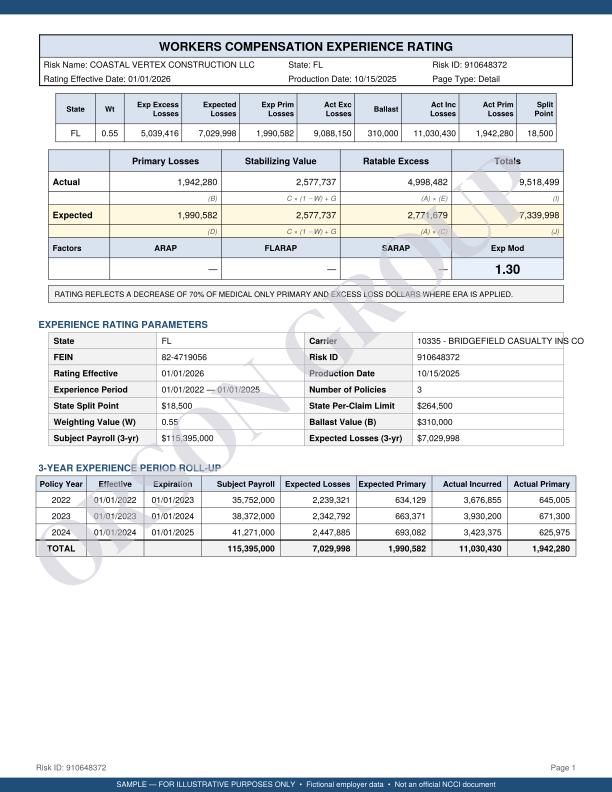
Experience rating compares your actual losses with the expected losses for your classes and payroll. Expected losses come from the claims a class usually produces, and a class full of cuts, strains and falls doesn't price a transplant. California counted 592 engineered-stone silicosis cases, 31 deaths and 65 lung transplants from January 2019 through June 2026, with a median age at diagnosis of 46 (KMPH, August 15, 2026). About 100,000 U.S. stone fabricators are at risk of the disease, according to one study (Business Insurance, October 30, 2026).
Frequency models absorb a hundred small claims gracefully. They struggle with one claim that is the whole year. Saint Louis University law professor Michael Duff put the larger point plainly: "When somebody gets injured or killed, there's no question that somebody is going to pay, the only question is who" (Bloomberg Law, April 2026). On a comp policy, the who is the shop's carrier first, and the shop's mod second.
The worked number
Strip the $60 million non-economic award out of the $67.7 million verdict and $7.7 million is left (Business Insurance, October 30, 2026). That remainder is the part that looks like what comp covers: lifetime medical and lost wages. It's the right order of magnitude for a transplant patient, since average life expectancy after a lung transplant is 6 to 6.5 years (Bloomberg Law, April 2026). That means years of treatment, not a single bill.
The mod doesn't absorb all of it. Experience rating limits how much of any single claim counts, and a large claim lands mostly in the excess layer, which is discounted. But a stone shop's expected losses are small. A slice of a $7.7 million claim can still be many times larger than everything the class would have predicted for that employer. Caesarstone itself expects losses on 35 claims at up to $13 million each (Bloomberg Law, April 2026). Those are tort numbers, but the same lungs generate the comp file.
To see what a mod swing costs on your own payroll, run the EMR calculator. To see how one big claim lingers, read how a severe claim stays on a worksheet for multiple rating years.
The part with a clock on it
Silicosis is a late-arriving claim. One former fabricator worked about a decade before diagnosis and another 17 years (Bloomberg Law, April 2026). By the time the claim shows up, the crew, the shop's dust practices and sometimes the carrier have all changed. The exposure belongs to years the current mod never measured, and the reserve belongs to a worksheet someone is reading now.
Contractors send us worksheets where every tile and masonry claim is small, and one lung claim stands alone like a skyscraper in a ranch neighborhood. The question isn't whether that claim is real. It's whether its valuation, its coding and its timing were handled the way the plan allows.
What an audit would check
An audit checks which policy period the disease claim was assigned to, whether the reserve reflects the worker's current medical picture, and whether the payroll behind the expected losses sits in the right classification. It also checks how much of the claim the plan actually counts against the shop, because that number, not the verdict, is what moves your renewal.
The verdicts will keep growing, but your worksheet is the part you can still contest, so send us the file and we'll tell you which number is doing the damage.