Wage Inflation and Workers Comp Rates: Cuts Shrink Fast
Construction pay rose 5.2% in a year while Missouri contracting loss costs are proposed down 2.0%. Rates are priced per $100 of payroll, so rising wages refill the premium the cut just emptied.
Wage inflation shrinks workers comp rate cuts because rates apply per $100 of payroll. Construction pay rose 5.2% in October 2026 (AGC, November 6, 2026), while Missouri contracting loss costs are proposed down 2.0% (Insurance Journal, November 5, 2026). On the same headcount, that cut becomes a 3.1% premium increase, before your mod enters.
Every filing headline this month promises relief. Read the denominator before you celebrate. A loss cost is a price per $100 of payroll, and your payroll is the one number in the formula that's moving the opposite way.
Construction production and nonsupervisory pay hit $39.70 an hour in October, up 5.2% from a year earlier, against 3.3% growth for comparable private-sector workers at $32.75 (AGC, November 6, 2026). ABC's read of all construction employees was 4.7% against 3.1% across all industries (ABC, November 2026). AGC's chief economist Ken Simonson put it plainly: "Nonresidential contractors are adding employees and raising hourly pay at rates far exceeding the broader economy" (AGC, November 6, 2026).
The wage story isn't only construction. NCCI's July 2026 State of the Line showed countrywide payroll up 4.8% for 2024 to 2025, built from a 4.3% wage-rate increase and only 0.5% employment growth (NCCI State of the Line, July 2026). Nearly all of the payroll growth is people being paid more, not more people being hired.
What a filed cut really buys
Start with the filings. Missouri's proposed 2027 loss costs are flat overall at 0%, with contracting down 2.0% (Insurance Journal, November 5, 2026). Kentucky approved a 0.0% change after a 9.7% decrease for 2026 (Insurance Journal, November 16, 2026). Florida's final order approved a 7.4% average decrease (Florida OIR order, November 16, 2026).
Now run Missouri contracting through a worked example. Take a $500,000 manual premium. A 2.0% cut is $10,000 off. But if the same crew works the same hours and payroll climbs 5.2%, the base becomes $526,000, and the cut lands on that: $515,480. The filing said down. Your invoice says up $15,480, or 3.1%.
The same arithmetic trims Florida's headline. A 7.4% cut against 5.2% payroll growth nets to about 2.6% on that crew, not 7.4%. Kentucky's 0.0% isn't flat at all. With wages at 5.2%, it's a 5.2% increase to the employer who didn't add a single worker.
That's the gap between the filed number and the paid number. A carrier doesn't have to raise a rate to raise your premium. The payroll audit does it for them.
Where the mod comes in
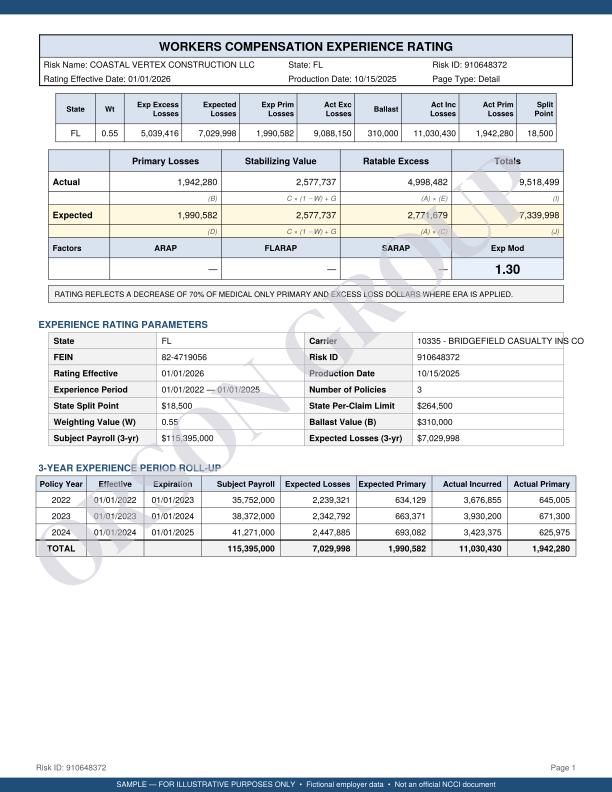
The cut and the mod are two separate dials, but wages touch both. Indemnity checks are tied to wage-based benefit formulas, so the same injury costs more when pay is higher. A claim from 2023 and an identical claim from 2026 aren't the same dollars, and the experience rating worksheet compares claim dollars against expected losses built from payroll and the Expected Loss Rate (ELR). Rating values refile alongside loss costs, so a lower filed cut can come with a different benchmark, not a lighter one.
That's why we keep seeing the same pattern at renewal: a contractor budgets for the headline decrease, then payroll growth and an unchanged claim history leave the Experience Modification Rate (EMR, also called the X-Mod) doing the damage. Each point on a mod multiplies a premium that wage growth just made bigger. Use the workers' comp premium formula to see where payroll enters, and the EMR calculator to price what a few mod points are worth on the larger base.
A broader look at how filings reach the worksheet is in our read of the 2026 rate filings.
What an audit would check
An audit checks whether the payroll growth on your policy is real wage growth or classification drift, whether the claims in your experience period sit in the right class and at the right value, and whether the filed cut ever reached your renewal at all. If wages are the biggest premium driver you can't control, the mod is the one you can still question.
Bring the worksheet and the renewal quote, and we'll show you which number moved your premium.