How to Read an Experience Rating Worksheet, Line by Line
Your mod is one number. The worksheet behind it is every payroll figure and every claim that produced it. Most contractors have never read theirs. Here's what each part says.
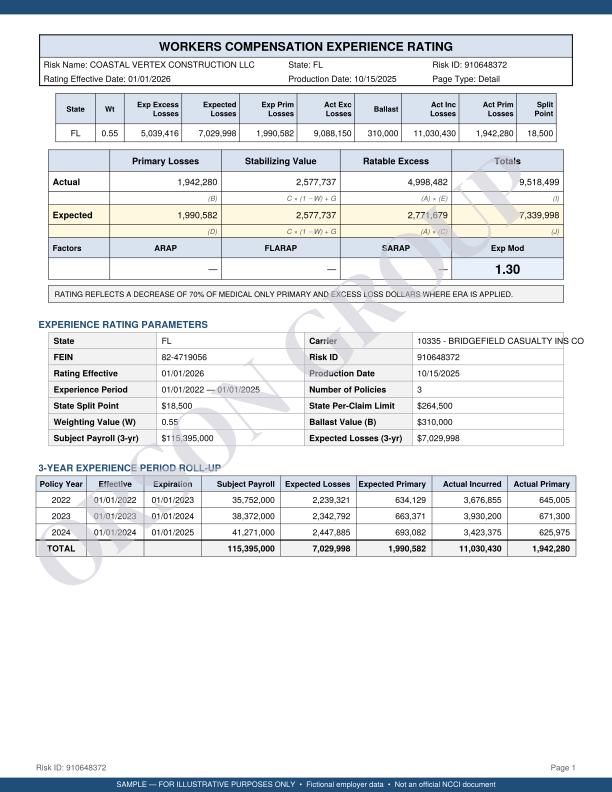
An experience rating worksheet is the document that shows how your EMR was calculated. It lists, for each of three policy years, your payroll by class code, the losses expected from that payroll, and every claim with its incurred value. A summary line combines them into the mod. You can request it from your agent or carrier.
The number on your policy has a document behind it, and you're entitled to see it. The experience rating worksheet is where the rating bureau shows its work: every input that went into your experience mod, by year, by class code and by claim. It reads like a tax form. Once you know the layout it takes ten minutes.
The header: who and when
The top identifies the employer being rated and the period the mod applies to. Two things here matter more than they look. The rating effective date tells you which renewal this mod prices. And the entity named is the one the bureau believes it is rating, which, after an acquisition, a name change or a new related company, is not always the one you think.
The header also tells you which bureau produced it. In most states that's NCCI. A few states run their own bureaus with their own layouts, and California's WCIRB calls the result an X-Mod. The parts below are the NCCI layout, and the independent bureaus carry the same ideas under different column names.
Three blocks, one per policy year
The body is three blocks, one for each policy year in the experience period. The year that just ended isn't there. Each block has two halves, and they're the two sides of the fraction.
The left half is your payroll, one line per class code. Each line carries the payroll reported for that class, an expected loss rate, and the expected losses that result from multiplying them. It also carries a ratio that splits those expected losses into a primary share and an excess share. This half answers one question: what should an employer of your size, doing your work, have lost that year?
The figures here come from your premium audits, not from your estimate at the start of the policy. If payroll sits in the wrong class, or the audited payroll never replaced the estimate, this half is wrong, and it's wrong quietly. Understated expected losses make ordinary claims look like bad experience.
The claims half
The right half lists your claims for that year. Each line is one claim, with a claim number, a code for the type of injury, a marker for whether the claim is open or closed, the actual incurred loss, and the actual primary loss.
Each of those columns does real work. The injury code is what tells the formula whether a claim is medical-only or lost-time, and the two are weighted very differently. The open or closed marker tells you whether the incurred figure is final or still partly an estimate. The incurred figure is paid plus reserved, so on an open claim part of it is the adjuster's forecast. The primary column is the part of the claim below the split point, the part that counts in full.
Small claims usually don't get their own line. They're grouped into a single entry by type, which is why the number of lines on the worksheet rarely matches the number of injuries you remember.
The summary line
At the bottom, the three years are added up and the formula's remaining values appear: the weighting value that says how much of your excess losses count, the ballast that stabilizes the result, and the totals for expected and actual losses, each split into primary and excess. The last box is the mod itself. If you want to see how those pieces combine, the calculation is worked through here.
The summary is also where you can see your floor. Take the claims out of that arithmetic and what's left is your minimum mod, the number you'd have with a clean three years.
What the worksheet can't tell you
Here's the limit. The worksheet shows what the carrier reported on a fixed date, the valuation date, months before the mod took effect. It doesn't show what's true today. A claim that closed for less, a reserve that came down, a recovery from a third party, a payroll correction at audit: none of that is on the page unless the carrier reported it in time.
So the worksheet is internally consistent almost every time. The arithmetic checks. What it can't do is vouch for its own inputs, and it was never compared with your records before it priced your policy.
What an audit would check
An audit checks the worksheet against the documents that should agree with it: current loss runs for the claims half, final audit workpapers for the payroll half, and the claim files behind the codes and reserves. Where they disagree, the mod is wrong by a number that can be calculated. Send us your experience rating worksheet and we'll review it for free.