Alabama Assigned Risk Rates Rise 1.6% as the Voluntary Market Falls
NCCI's Alabama filing for March 2027 points two ways at once: loss costs down 2.2% for the open market, rates up 1.6% for the pool. Last year both fell. The gap just quadrupled.
NCCI's Alabama filing for March 1, 2027 proposes a 2.2% decrease in voluntary market loss costs and a 1.6% increase in assigned risk rates (NCCI, October 2026). A year earlier it proposed cuts to both, 4.5% and 3.6%. The filing is pending before the Alabama Department of Insurance, so neither figure is final yet.
Alabama contractors have spent three years reading the same headline: workers comp costs are going down. The filing for 2027 says it again, and then says something else in the next clause.
NCCI (the National Council on Compensation Insurance) submitted its Alabama filing on October 7. It proposes a 2.2% decrease in loss costs for the voluntary market and a 1.6% increase in assigned risk rates, both effective March 1, 2027 (NCCI, October 2026). Two markets, one state, opposite directions. Which number is yours depends on which market will write you, and Alabama assigned risk rates in 2027 are the half of the filing nobody is quoting.
The cut is running out
Start with the good news, because there's less of it each year. Alabama's loss costs fell 6.1% for 2025 (Insurance Journal, October 2025). For March 2026, NCCI proposed 4.5% (NCCI Alabama 2026 filing summary, October 2025). Now 2.2%. Each cut is roughly half the one before.
NCCI says why. The decrease still comes from a long decline in lost-time claim frequency. But the filing reports an uptick in large losses that began with policy year 2022 and continued through policy year 2024, and says those losses put upward pressure on the indication (NCCI, October 2026). Fewer claims, and bigger ones among those that remain.
That pattern isn't only Alabama's. Across NCCI states, lost-time frequency fell 2% in 2025 while lost-time medical severity grew 4% and indemnity severity grew an estimated 4% (NCCI, October 2026). The workers comp combined ratio moved to 91% from 86% a year earlier (NCCI, October 2026). The line is still profitable. The cushion is thinner.
What the split is worth
Take $100,000 of Alabama premium and hold payroll flat. If the filing is approved as proposed, the voluntary side's loss costs point to about $97,800. The same $100,000 in the assigned risk plan becomes $101,600. That's a $3,800 spread per $100,000 that wasn't there before the filing. You can run your own premium against it.
Run last year's proposal the same way. A 4.5% cut and a 3.6% cut (NCCI Alabama 2026 filing summary, October 2025) took $100,000 to $95,500 and $96,400. A $900 spread. The two markets moved together. This year they've come apart, and the distance between them is about four times what it was.
NCCI attributes the assigned risk increase to higher assigned risk expenses and a larger provision for uncollectible premium (NCCI, October 2026). In plain terms, the pool costs more to run and more of its premium goes unpaid. Those costs are spread across whoever is left in it.
One caution on the voluntary number. A loss cost isn't a rate. Each carrier applies its own multiplier to get from one to the other, so a 2.2% loss cost decrease is a ceiling on what the filing gives you, not a promise. And payroll is moving the other way: NCCI puts payroll growth at 4.8% from 2024 to 2025, with wages up 4.3% (NCCI, October 2026). A 2.2% cut on a payroll base growing faster than that is a higher bill.
Why the mod decides which number you get
Nobody chooses the assigned risk plan. An employer lands there when voluntary carriers decline the account, and a loss history that produces a high experience mod is one of the common reasons they do. So the filing's two numbers aren't really about two kinds of contractor. They're about one contractor on either side of an underwriting decision.
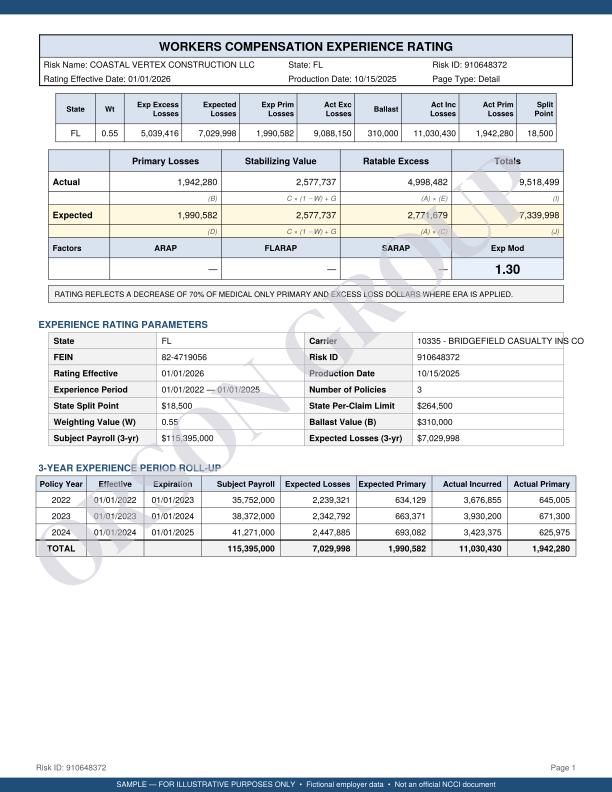
That changes what a few points of mod are worth in Alabama next spring. On the voluntary side, a mod that's overstated costs you its own surcharge. Near the edge, it can also cost you the market, and with it the 3.8-point spread, on top of whatever the pool already charges above a voluntary quote. The filing made bringing an inflated mod down worth more than it was on October 6.
The large-loss trend points the same way. If big claims are what's holding Alabama's indication up, they're also what's sitting on individual worksheets, valued at whatever the carrier has reserved.
What an audit would check
An audit checks whether the mod that carriers are underwriting against is the one your record supports: the reserves on open large claims, how each claim is coded, and the payroll and classifications behind expected losses. If you're renewing in Alabama after March 1, send us your worksheet for a review before the market decides which side of this filing you're on.