PBM Fee Disclosure Rule Skips Workers Comp Pharmacy
DOL's final PBM rule exposes spread pricing and claw-backs for large health plans from July 2027, but it doesn't reach comp pharmacy, where those same charges land on your claims and your mod.
DOL's final PBM fee disclosure rule, announced October 29, 2026, covers large self-insured group health plans for plan years starting on or after July 1, 2027 (DOL EBSA, October 2026). Workers' comp pharmacy is a separate system outside it, so the rule's PBM spread, rebate and claw-back disclosures don't extend to comp, though the cost still reaches the mod.
Your health plan's pharmacy benefit manager is about to be forced to show its work. Your comp program's PBM, in many cases the same company, isn't.
The Labor Department finalized its PBM fee disclosure rule on October 29, 2026, projecting savings of as much as $22 billion in prescription drug costs over 10 years across self-insured employer plans covering about 90 million Americans (DOL EBSA, October 2026). Assistant Secretary Daniel Aronowitz put the point plainly: "The rule gives employers the tools they've been denied for far too long" (DOL EBSA, October 29, 2026). Read the scope line before you celebrate.
What the rule makes a PBM disclose
The final rule applies to covered service providers to large, self-insured group health plans, generally 100 or more participants, where the provider expects $1,000 or more in compensation (DOL EBSA fact sheet, October 2026). It reaches plan years beginning on or after July 1, 2027 (DOL EBSA fact sheet, October 2026).
The disclosure list is the part contractors should read twice. It includes spread compensation, meaning the gap between what the plan pays and what the PBM pays the pharmacy, by drug and pharmacy channel. It includes manufacturer rebates and fees, and "copay claw-backs and other retroactive adjustments" to pharmacy reimbursement (DOL EBSA fact sheet, October 2026). Renewal disclosures arrive 90 days ahead, and any compensation line that runs 5% or more over the initial figure needs an explanation (DOL EBSA fact sheet, October 2026).
Nothing in the fact sheet mentions workers' compensation. That silence matches the statute underneath it: ERISA's Title I excludes plans maintained solely to comply with workers' compensation laws (ERISA section 4(b)(3), as applied in DOL Advisory Opinion 1975-47).
Where the comp program sits
The comp program is a different animal. It's a statutory benefit, not a group health plan, and its pharmacy spend is billed claim by claim under state fee schedules. The PBM may be the same vendor with the same affiliated pharmacies. The contract is not the same contract, and the new disclosure schedule doesn't attach to it.
That matters because comp pharmacy is where channel pricing shows up in the data. Quarterly prescription payments per medical claim rose 24% at the median of 31 states, from $51 in Q1 2022 to $63 in Q1 2025 (WCRI Drug Trends, 6th Ed., 2025). In the dermatological category, delivery pharmacies averaged $653 per prescription against $136 at retail (WCRI, 2025). The earlier report on those numbers traces the mechanics.
A worked example from those two prices: five topical fills through a delivery channel run $3,265 at $653 each. The same five at the $136 retail average run $680. The $2,585 difference sits in the claim's incurred total whether or not anyone can see who kept it (WCRI, 2025).
Why the mod is where this lands
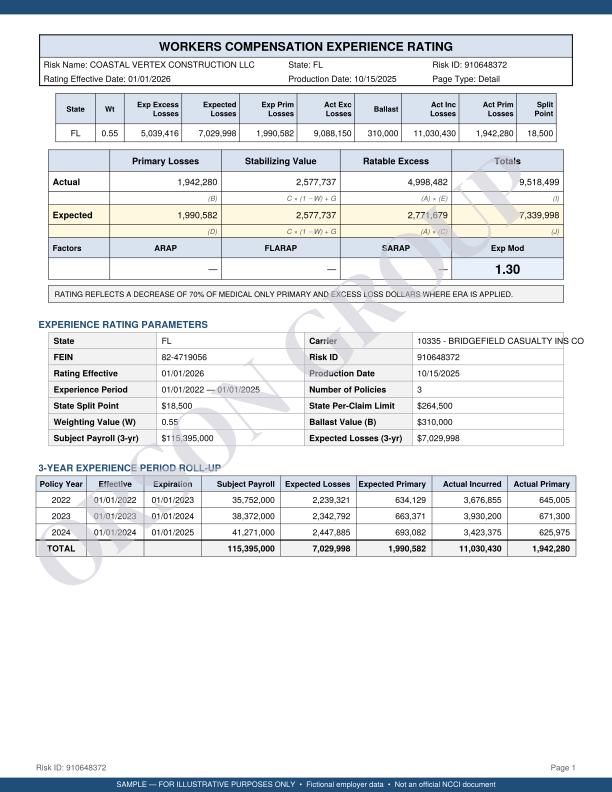
The rule gives health plan fiduciaries an audit right, at least once a year, with the auditor of their choosing (DOL EBSA fact sheet, October 2026). The comp side gets none of that, but it still feeds the experience rating worksheet. The experience mod, also called the X-Mod, is built from incurred losses, and pharmacy dollars are incurred dollars.
So the disparity is odd. A contractor will soon be able to see spread on a $40 maintenance prescription for an employee's blood pressure. The same contractor can't see it on a topical billed to a claim that stays in the mod for three years. On a medical-only versus lost-time split, the inflated charge may be the difference between a claim that barely registers and one that moves the number.
Transparency isn't the same as bargaining power. A disclosure schedule is only worth what a renewal conversation does with it.
What an audit would check
An audit checks whether pharmacy charges in the claims on your worksheet match the injuries behind them, and whether the dollars in the incurred column reflect a channel premium rather than care. It also asks whether the vendor on your comp program is the one now disclosing on your health plan. Price the stakes with the EMR calculator, then send us the worksheet, and we'll tell you how much of it is pharmacy.