Medicaid Loss and Workers Comp: Why Construction Pays More
WCRI's preliminary data ties Medicaid loss to a 10.1% jump in construction lost-time medical payments, driven by hospital billing. Your crew's coverage gap lands in the claim, then in the mod.
Losing Medicaid raised medical payments per lost-time claim 3.1% after 12 months overall and 10.1% in construction (Business Insurance, March 2026). Hospital payments rose 6.7% while non-hospital payments fell 3.3% (Business Insurance, March 2026). The mod absorbs that higher severity, so a crew's health coverage gap can show up in your premium.
Nobody on a jobsite files a Medicaid form with the comp carrier. But when a laborer loses that coverage and gets hurt, the comp claim becomes his only door to care. Medicaid loss and workers comp costs are now linked in the data, and construction took the hardest hit.
The Workers Compensation Research Institute (WCRI) released preliminary findings from a study of lost health care coverage, presented by Sebastian Negrusa, its vice president of research, at the 2026 WCRI Conference. Loss of Medicaid was associated with a 2% to 3% increase in medical payments per workers' comp claim (WCRI, March 2026). The effect was largest for lower-wage workers, men, and workers in construction, manufacturing, and leisure (WCRI, March 2026). A fuller report followed in November, limited to 12 months of claim maturity, so treat every number here as an early look (Risk & Insurance, November 2026).
The construction number is the outlier
Across all industries, medical payments per lost-time claim rose an estimated 3.1% at 12 months of experience (Risk & Insurance, November 2026). Construction rose 10.1%, and manufacturing rose 6.1% (Risk & Insurance, November 2026). Male workers saw 4.7% (Risk & Insurance, November 2026).
The reach matters. About 12% of non-disabled workers ages 21 to 64 reported Medicaid coverage in 2022, and about 20% of restaurant and entertainment workers did (Risk & Insurance, November 2026). Construction wasn't in the published share, but the claim effect says plenty about who was on the rolls.
One more thing the researchers did not find: a measurable change in overall claim frequency (Risk & Insurance, November 2026). Injuries didn't multiply. They just cost more once they happened.
The site of care is the story
Hospital payments rose an estimated 6.7% while non-hospital payments fell 3.3% (Risk & Insurance, November 2026). One reading is a change in where injured workers get care after losing coverage; the report itself suggested providers may be seeking new revenue (Risk & Insurance, November 2026). Prescriptions moved too: the share of claims with prescription payments increased (Risk & Insurance, November 2026).
That fits a simple picture. A worker with no primary care relationship doesn't call a clinic on Monday. He goes to an emergency room Friday night, and the comp claim absorbs a hospital-priced episode instead of a clinic-priced one. Nothing about the injury changed. The invoice did.
How the extra dollars reach the mod
Take a construction lost-time claim carrying $40,000 in medical payments. A 10.1% increase adds $4,040, taking it to $44,040 ($40,000 x 10.1%; Risk & Insurance, November 2026). That's a single claim, and the added dollars are real losses in the frequency versus severity math, where severity is the side contractors usually can't see coming.
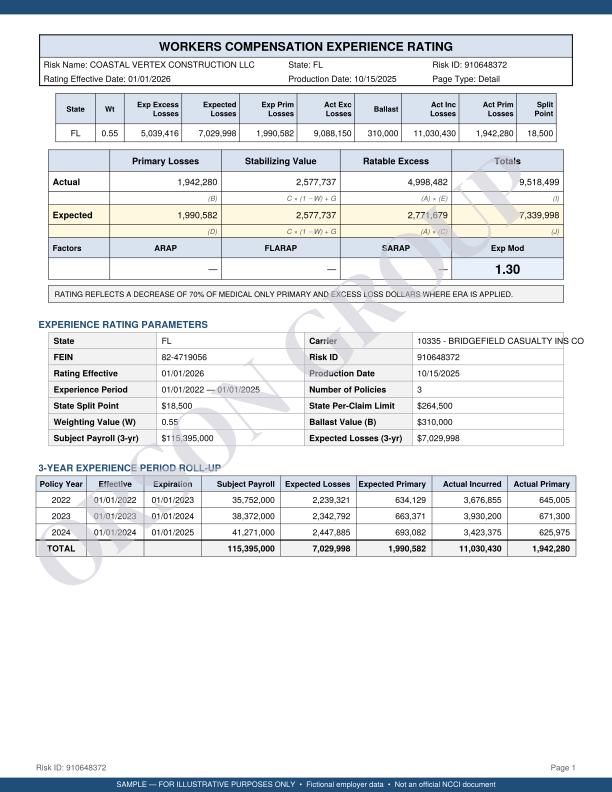
Because those dollars land early in a claim's life, they sit in the primary layer that the formula weighs most heavily. The 2027 split point change decides how much of a bigger claim counts in full. Run the arithmetic through the EMR calculator and a few thousand dollars of inflated medical on one file is the gap between a mod you can live with and one that prices you out of a bid.
WCRI's own caution is worth repeating: even small percentage shifts can add up to large dollar amounts across the system, per Negrusa. A contractor lives that math one claim at a time.
What an audit would check
An audit checks whether the medical lines on your open claims reflect the injury or reflect where the injured worker happened to land for care. It reads hospital-heavy billing on claims that began as minor strains against the reserve the carrier set. And it asks whether the worksheet your mod rests on carries those dollars at full value when the file doesn't support them.
The data is still an early look, but your worksheet already exists, so send it to us and we'll tell you whether coverage-driven hospital billing is sitting in it.